Monday, 11 April 2022

Interview with Noisms about "Hall of the Third Blue Wizard"


Matthew Adams left this comment on Facebook; "Ha, now I can tell mum and dad I am a genius!

But also, the look of concern on your face Patrick when you looked at the yoon suin art. Please forgive me! Though I admit I did laugh a little bit because I was expecting it. And you are not the only one to express concern or even dislike of my MS paint art.

David is mostly right about why I am doing a lot of my art in MS Paint and other old digital formats like PETScii. I enjoy working within the constraints those programs enforce, and there might be some nostalgia there as well. But there is also an element of burnout involved. A few years ago, just before the end of g+ really, the whole process of drawing on paper started to make me almost physically sick. I don't know why. Depression, anxiety, doubt, all played a part, and maybe something wasn't clicking creativity wise. But for quite a while the act of putting pen or pencil to paper was enough to make me vomit. Now I am doing more analogue drawing again, but it's usually within the constraint of designing rubber stamps."

Friday, 8 April 2022

Paint Yourop, Draw Yndja

Other cultures, what even do they look like. A question for academics. Here in the Mughals Painting workshop (about 1500), and the German Print Shop (early 20thC), we are on a deadline people! The Mughal says "Draw Youropeen", Herr Schvitz say "Draw Indian God for export schnell!" What goes in the background? Yourpeen things, Ynjan things I don't know just finish the fucking picture! 


We start with whats honestly a pretty great painting of a foreigner from the Mughals court (I think Akbar? Dunno and I'm not checking).

Youropeen


But whats happening here in the background of this very Youropeen landscape?

Youropeen plant


And where do Youropeens live? Hut or possibly city...

(Honestly not bad for 1500 or so)

How do they worship? Ehhhh hmm temples?


"Here we go worshipping christ again! As we commonly do here in Yourop!"


Meanwhile, (in fact several hundred years later), Germany leads der printing welt! Time to impinge on British Raj mit VORGESETZTER prints of Indian Gods for popular market! Quick, draw Vishnu!


Not that bad? A bit stiff and euro-saintlike but wait, what is India even like anyway?


They have.. der schloss?


Aaaand... seltsame runde Dinge, vielleicht ist es ein Dock, ich weiß es nicht

Never mind, draw Krishna!

Krishna with his Gopis


Perfect! Now eine Stadt in den Hintergrund schieben oder so

what do Ynjan cities look like?


Vvvvenice? Kind of?


and uh.. gebäude.. setzt...

Saturday, 2 April 2022

Whats in the OSR Iceberg Tier Meme?

 (I will probably have to delete this if it actually gets popular so have fun while you can.)


Wednesday, 30 March 2022

Martyrs of the Glass Maze

 (A note on sources - As our eye turns deeper into the Prescience Wars, useful histories become less common. The Pogrom of Albraneth and the following Water Horse Wars left after them waht seems to be a near decade of relative peace and stability. Furthermore, the cultural transformation of the Pathist victories seems, (at least to our limited sources), to be less than total, something more akin to a political or dynastic change. This provided space for true histories to be written and published. We have one of these; 'Our World War' by Wood, and the epic poem "The Chaos of the Waves" by Eastsource-Tan and the later ritual retelling "The Dharma of Care" by Apsanalan, both likely drew from these sources. 

The Amber-Court wars, though they surges back and forth for many years, had no such civilisational colophon, leading directly to the Fall of the Amber Court and the full consumption of the world into the Red Shift, from which we were ultimately lead (Praise be to God), by the Sleeping King. Therefore few coherent histories appear. In addition to this, the closer on approaches the Red Shift and its ancidents, the greater the danger of Vermin Tales and other cognitive and causal dangers increases. We must be careful with our sources! 

Even so, the simple lack of time and stability, and the growing ontological collapse, are but little explanation for the shift in the tone and substance of our sources as the Amber Court Wars wove on. Instead, as I shall argue and you shall see below, the mind-set of the cultures involved was subtly shifting away from the previous conceptions of secular collective truth and towards a growing, though still nascent, conception of revealed divine truth.) 


"Many are the Martyrs and Many the deaths, few honourable, all true. Yet bless their memories, the seers orb robs men of honour but even those who die in shame may show the way and leave the sign by which truth shall be seen, so praise the dishonoured dead and learn their lessons well... 

Many are the Martyrs to the Glass Maze, dying not in honour, but in shame. How can it be? Men will ask in later times, that such were accounted martyrs at all? For those who served gods in lost ages died all in defiance, whether through war or torture, imprisonment or distain, though they fell in subjection and were pressed into the mire, these martyrs, those we would call as such, died all in clear decision, their deaths their own. All were offered mercy for conversion, all refused, so their deaths, like their lives, were the product of their own souls. Such has it been in latter times and such has it been for those we might call 'martyrs to the cause', whether the cause itself be good or no, for us or against. 

Yet, many will claim, how be it that these 'Martyrs to the Glass Maze' should be called so? For many died not by their own clear choice at all, nor died well, not in defiance, nor subjection, but in great confusion and despair, either by their own hand or by the hand of others. These, men will say, were no martyrs deaths. 

This we must explain and speak well, for here is the mark and the telling of the nature of our wars for never before in Time has man faced such a foe, not of any state or sultan, or worker of deeds for in those past times no enemy of any kind could take from the soul of man that final thing - to choose to die. 

Whatever the foe or the battle, even in the deepest dejection and without resource, still men’s lives have been their own. For those for whom no muscular force or working of will may serve, even so, no  matter the catastrophe, mortal hearts may choose to go down into dusty death, defiant to the last, contemptuous of their enemies, perhaps hoping to light by such sacrifice the spark of defiance in others, or to at least leave a mark in histories page, or even simply that they may pass from this world knowing, if only within their own minds, that they were thereby true unto the last to their people, their creed, king or faith. 

It is this very theft which marks the martyrs to the glass maze, the corruption of the Seers eye, that more-than demoniacal power which fumed forth from Frost more than a decade after the closing of the wars of Horse and Water, of the insidious conspiracy of the Amber Court and its terrible victories over a world and a people made weak by victories of their own, the sickening rebirth of the taint of Albraneth, now cancerously grown and armed, like a teratoma of the human soul, with teeth and nails. 

Many were the shames of the Amber Court Wars in their first years, near-total the losses, awful the tales and great the madness. 

For that purpose we here set forth as full an accounting as can be made, (times and sources notwithstanding), of the great and shameful manipulations of the Amber Court and its Twice-Cursed King. Few heroes shall you find amongst them but tales of shame and madness, fear and delusion, oof great lives spent like piss against a wall, their thoughts and efforts trickling to nothing of all human hope and heroism made null and nothing for those trapped within the glass maze of the Seers dreams. 

Here you shall hear in full of the Harrowing of Trulzch, how the great force and strong army of Corbin Trulzch which set forth to strangle the Amber Viper at its first striking, was lead astry, harrowed, lead through storm and wave, subject to suicide and madness and finally induced to besiege the city of Mir, within which were found only plague corpses which infected first the remaining forces of Trulzch, and then upon their sad retreat, the native populations of their lands. 

Here the lay of Trevelyan who was frozen into madness by Amber trickery, facing first this way then that, besieging, re-enforcing, manoeuvring, escaping, all to nothing till, driven past madness he finally attacked through the Salt flats of Zeltbahn and was drowned in the terrible wave of that year. 

Here you will hear of sorrow, madness and a loss of hope, for this is the fruit of the seer, this is the benison of the Amber Court, the gift of the Damned, that they should take not only lives but souls, strip man even of his bones of self, leaving not even ghosts. 

Aye there are few true heroes in these tales, but warnings and dark truths, though there are rays of black hope, as if shining from a darkened sun. 

You may read here the tale of Corbin Mir, how he executed his deluded staff, blinded himself by staring into the sun and committed himself to the attritional horror of the Holger Pass, inflicting upon the Amberites at that time losses greater than they feared, and the legend of Colonel Penrose, the first of the Iron Path to experiment with alterations on his own mind, of his great sacrifice, by pin and vice, saw and needle, of his memory of each day and thusly of his sense of self, a man lead by fury and righteousness alone, who feared no manipulation for he could not comprehend it, and therefore by its chains could be but little bound. 

We who have walked from the Harrowing and learnt is lessons. We are the Riders of Truth. We are the Heroes of Man and of Pure Causality. We are the children of the Iron Path and no matter the cost, no matter the suffering or ages spent, ultimately and eventually, we shall win and wipe the foulness of the Amber Court from the face and memory of the world. Will shall give mankind back its soul, and in pursuit of that, no suffering is too much. 

Read then of the Martyrs of the Glass Maze, and learn there the horror of your Foe." 


Transcript of the Introduction to a copy of "Martyrs of the Glass Maze", Pathist text of the mid-to-Late Amber Court Wars, recovered as antiquary treasure in the Ninth Crusade against Suleman lord of the Haeretici Ferrea. Full contents damaged and partially redacted due to potential CurseThought as prognosticated by Truly-Bound Daemons of the Eleventh Pussiance sealed as such by the Holy Inquisition may all who break this seal fall beneath the Eye of the Black Sun, amen.
Tuesday, 29 March 2022

The Technique of Mughal Miniature Painting

Curiously, just before reading this I had finished a Clark Ashton Smith collection into which the enormous and specific work and attention paid to every aspect of a pure luxury good, as well as the almost magical-alchemical assembly of these wonderous, varied and specific materials - the fur of a young kitten, Lapuz Lazuli ground with rough salt and separated by grain, soft repetitive polishing with crystal or malachite, would seem to slot almost perfectly. 

While transformed-orientalism western idea of Luxurious Otherness has a pedigree which seems to flow all the way from 'Othello' to Jabbas Palace, the particulars of the creation and social milieu seem to cry out for some boutique D&D adventure - the Emperor calls for a painting and his artist, the 'Wonder of the Age', needs *this* specific kind of malachite, grains of gold and Lapis Lazuli and the tail fur of this specific kind of kitten, and you only have 50 days to finish the painting, and the artist has enemies who wish to sabotage him, and the Emperor might be about to be assassinated.. "Vorsprung durch Luxus"..


"The Technique of Mughal Miniature Painting

Miniature painters sat on the ground while working with one leg flexed to support a drawing board. (Plate 19). Their technique was deceptively simple: opaque watercolour on paper or occasionally on cotton cloth. Artists learned the trade secrets of their ateliers as apprentices, often from fathers or uncles, as this craft was frequently a family occupation. As children, they were taught how to make balanced, finger-fitting paintbrushes of bird quills set with fine hairs plucked from kittens or baby squirrels. They also learned how to grind mineral pigments, such as malachite (green) and lapis lazuli (blue), in a mortar; how to sort them grain by grain according to purity and brilliance; and how to prepare the aqueous binding medium of gum arabic or glue. Other pigments were made from earths, insect and animal matters, and metals.


(Plate 19)

To make metallic pigments, gold, silver and copper were pounded into foil between sheets of leather, after which the foil was ground with rough salt in a mortar. The salt was then washed out with water, leaving behind the pure metal powder. For a cool yellow cold, silver was mixed with it; for a warmer hue, copper was added. Because such pigments as copper oxide were corrosive, the paper was protected from them by a special coating. Some artists, such as Basawan (Plates 6, 8, 12, 13) were particularly admired for their manipulation of gold  which they pricked with a stylus to make it glitter - burnished or modelled by tinted washes.

Although artists did not make paper, they were connoisseurs of its qualities. Composed of cloth fibres, it varied greatly in thickness, smoothness and fineness. Akbar' painters of the late sixteenth century preferred highly polished, hard and creamy papers, while Shah Jahan's artists employed thin, extremely luxurious sorts, possibly made from silk fibres.

A complex, very costly series of steps involving many people was required to make a Mughal painting. Pictorial ideas usually began with the patron, who summoned the appropriate artist (or artists) to carry them out. Several of the most renowned Mughal aritsts were specialists, such as Govardhan, who was noted for portraits of saints, musicians, and holy men (Plate 24), or Mansur, famed for birds and animals (Plates 26-27). 

(Plate 26)


After the painter and patron had conferred, sketches, such as Figure V, were prepared. In this instance, the artist drew from life, which lent his sketch disturbing immediacy. Like others of the sort, it was intended not for the patron but for the workshop, as a model from which to paint, and it did not have to be formal and tidy. Mistakes were scumbled over in white pigment and redrawn.

(Figure V)


Later, in the artists studio, the drawing would either be copied or pounced (traced) onto the thicker paper or cardboard of the finished work (Figure V, Plate 23). 


(Plate 23)


Tracing was done with a piece of transparent gazelle skin, placed on top of the drawing, the contours of which were then pricked. It was then placed on fresh paper, and black pigment was forced through the pinholes, leaving soft, dark outlines to be reinforced by brush drawing. Sometimes the original drawing included notations of colours, in words or washes of pigment.

Unfinished paintings reveal the progress from bare paper to thin outlining in black or reddish brown ink and to the many stages of colouring, which were built up layer by layer to enamel-like thickness. Usually, gold highlights were the last step before burnishing. Burnishing was done by laying the miniature upside down on a hard smooth surface and gently but firmly stroking it with polished agate or crystal, a process comparable to varnishing an oil painting, which provided protective hardening and gave an overall unity of texture.

The length of time it took to accomplish all this varied according to the painting and period when it was done. Robert Skelton and Ellen Smart discovered a small marginal inscription on an illustration to the Babur-Nameh stating that Ram Das worked on it for fifty days (see Figure II). Other paintings published here must have taken considerably longer. After the artist had finished his picture and shown it to the patron, who had probably overseen its progress step by step, it was turned over to other specialists to be trimmed, mounted on splendidly illuminated borders, and bound into a book or album, according to imperial wishes. Occasionally, pictures were mounted on walls (Plate 17).

(Plate 17)

The social position of artists varied greatly. Akbar himself learned to paint as a child; and some of the artists were aristocratic courtiers who also served in diplomatic or other governmental capacities. Most court painters, however, were revered but humble craftsmen, whose talents had earned them privileged positions near the throne. A  few, such as Jahangir's favourite artist, Abu'l Hasan, who was honoured with the title "Wonder of the Age," grew up in the royal household.

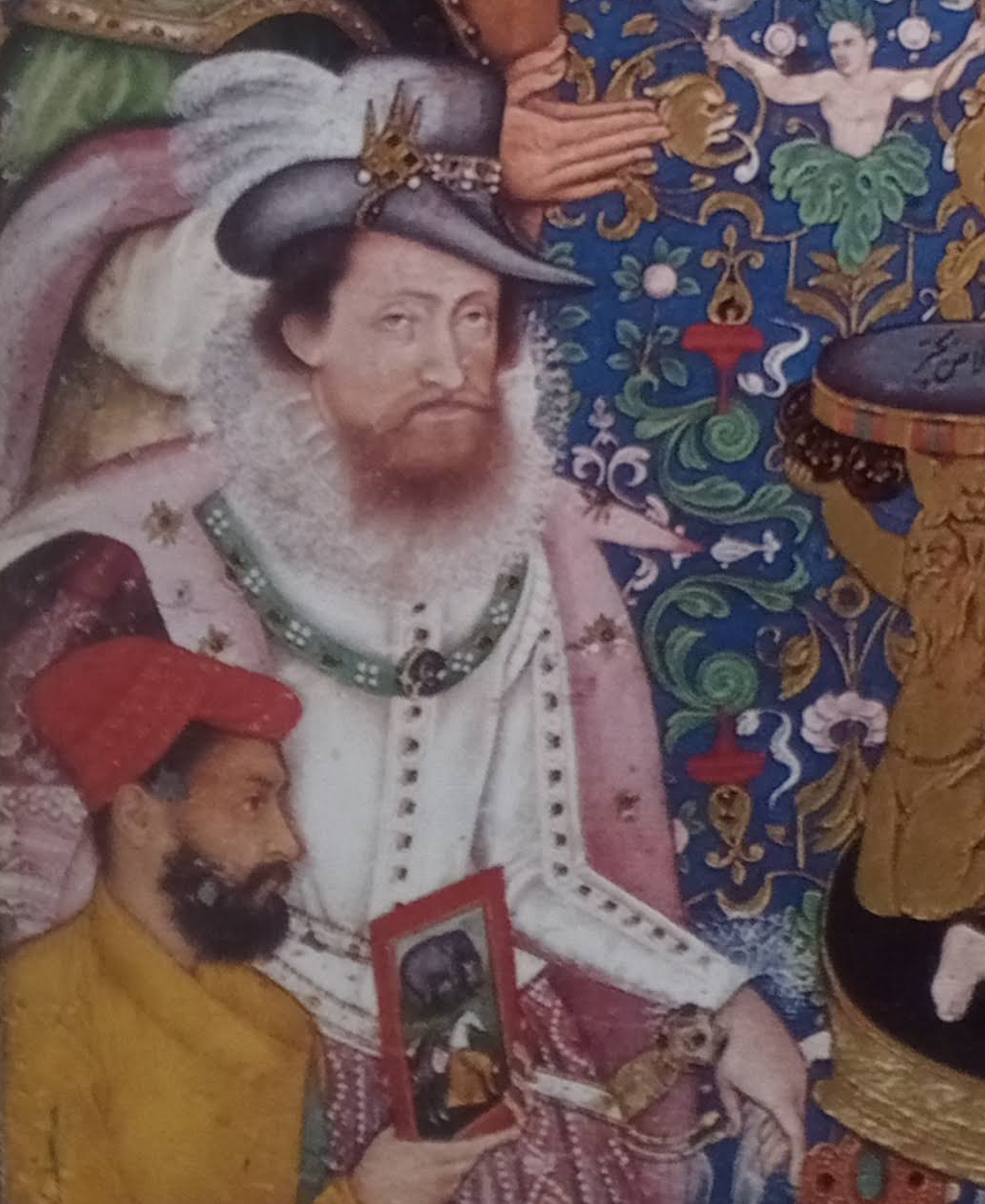
Paradoxically, the lot of artists was often more secure, and probably happier, than that of princes. Arists painted on and on, from one reign to the next, while royalty rose to dizzy pinnacles of wealth and power, too often only to be imprisoned or murdered. Since all but a few Mughal rulers were keenly interested in painting, artists were generously rewarded. Salaries must have been ample, and when a patron was especially pleased, presents were lavish. Bichir painted himself in the foreground of a picture (Plate 22) holding a miniature of an elephant and a horse, gifts no doubt from Jahangir."


(Plate 22)


("Prithee allow me in thine painting sirrah".
Closeup of Bichir getting photobombed by some European dude..)

From "Imperial Mughal Painting" by Stuart Cary Welch

Monday, 21 March 2022

Ok I'm going to re-write this

 In games YOU have been in, or which YOU have run, do YOU remember any particular experiences of;


- Too many options, not enough direction, decision paralysis.

- Sense of a loss of freedom, a muting of interest, feeling like you are just "going through the motions"

- Any "just right" states where the range of presented options and possibilities synergised really well and seemed to both guide and allow play.


In those situations;


- Can you describe the situation as it occurred?

- What games were they? (if it published adventures you don't have to name them if you don't want to.)

- Did you notice anything about the adventure design that made them that way?


Saturday, 19 March 2022

WHAT IS FLOW CONTROL?? (AND WHY SHOULD I CARE?)


(i kind of already know what it is, i'm not completely against it but i'm just sort of generally ambivalent and prefer to minimise it. I think on the whole I prefer an adventure with high possible interconnections and less-managed ones)


DESCRIBE THE SITUATION PATRICK

I've been talking with an internet friend about this adventure concept, a big house or mansion, full of strange artefacts. The artefacts are all potentially dangerous, potentially useful, dangerous to leave alone but also dangerous to interact with, like a fantasy S.C.P. essentially.

Talking about stuff like numbers of rooms and relative labrynthyness of the mansion, we disagreed, revealing likely intuitive differences in assumptions in adventure design.

My intuitive assumption was to - since it’s a house, to have a very open plan with immediate (in theory) access to most of the rooms, or at least, you need to explore to find them and then investigate, but there are relatively few locked doors or hard blocks sopping you from exploring most of the house, the difficulty being in investigating and understanding the collection and dealing with the rituals and mysteries of the house. Largely a very 'open' concept, in which you can go in any direction and where the difficulty increases as you interact with more things, largely as a consequence of you interacting with them.

We haven't got deep into this yet but my friend hasn't responded yet, but if I were to guess I would guess they were imagining a more... 'dungeonly'? experience? With more locked doors, more things and areas hidden away, a more controlled experience in which you were more certain to encounter or deal with this thing and then that thing e.t.c. with more 'difficulty walls'(?)

That’s my guess anyway.


SO WHATS YOUR PROBLEM WITH FLOW CONTROL ANYWAY?

It’s not like I *hate* it, in fact I think it’s necessary. I try to arrange my encounters so there is likely to be some kind of rhythm  between types of things, I try to loop and pierce dungeons somewhat, I try to build up (to a degree) to the really weird shit, (at least after MotBM). And truly, every dungeon is by its very nature as a literalised flowchart, an exercise of a kind in flow control. (Though this need not be the case as much for more naturalistic settings).

But at the same time something in me pushes strongly against it.

most dungeon design is a complex synthesis between 'game-ish' and diegetic elements, treating the adventure purely as a game, or seeing it as in inhabited world, you can make good adventures from either polarity of course and like I wouldn't mind (or don't think I would mind as I don't really play computer games) if I were playing a Nintendo game, being channelled around a long and encountering a series of interconnected boutique situations, but the moment I feel even the hint of those walls close in around me in an adventure I basically shit myself with resentment.

(Which brings up the complex question of is it bad because the walls are there or is it bad because I can sense the walls and actually I have been happy with a wide range of experiences which were actually very controlled but just so well controlled that I either didn’t sense it or didn't care).

Largely I am much happier with a sense of freedom, even if it leads to a less pleasant experience
at least, that’s the story I tell myself about who I am, a 3rd party analysis might get a different response. I am much much much happier re-interpreting a problem rather than "finding" the planned solution to one


SO CAN YOU BRING THIS DOWN TO A QUESTION OR SOMETHING

It's a difficult thing to shape a query to but I would like to PROBE the blog readers for a deeper awareness of the polarity between these modes of thought. I couldn't really shape a strong defence or pro-statement for the more-flow-control side of the argument, too wrapped up in my own responses, 

BUT

I would like to hear from YOU PEOPLE

Specifically play or design experiences, games you yourself have been in and specific times where you yourself have thought thoughts equivalent to;

"There's too much flow control here."

and/or

"There's not enough flow control here."


what were the circumstances when you noticed this? 

Did you think it was a feature or a bug (did the adventure writer fail to attain their own goals or were their goals just different to yours?). 

What differentiates the two situations in your mind? (When would you think "Ah, more flow control would be good here in this situation", or the opposite.