Showing posts with label Pretentious. Show all posts

Tuesday, 9 February 2021

Dungeon Poem Challenge

 Dungeon Poem Challenge

I had this idea of, not a Gygaxian Democracy dungeon, but a kind of blog-ring alter-dungeon challenge thing

Take one of the more interesting (and SMALL) Dyson Logos maps.

This one (I like it because it has a river on it).

Original here.


And anyone who wants to; make a dungeon of this map.

Thats; everyone use this specific map 

I am going to try to do mine and will attempt to post it by Saturday or Sunday, and if anyone else wants to do one and tell me about it I will link it here. And we will see what everyone comes up with.

The general concept is; Artpunk plus functional. So original ideas preferred, as pretentious as you like, but minimal text, shaved right down, and functional as a dungeon for players without any extra context. But as much as possible, honed for beauty, interest and strangeness.

The link to 'poetry' being not the euphony structure or rhythm of the text, (though you can try that if you like), but the condensation of utility, beauty, meaning and originality into a functional and interesting micro-adventure. 

All those things traditionally being opposed or at least difficult to have at the same time.

To do as much as possible with as little text and information as possible


Tuesday, 2 June 2020

Criticism and Popular Media

Made the following comment on a Discord and people seemed to like it so here is Blursed Sontag to give you a cultural think;


"I had great fun playing Bioshock and my response to it and to its criticism was very typical of my response to the bourgeoisie create/criticise cycle which I will now lay out for you AT LENGTH

FIRST - Someone makes a good example of a low-status artform. (action movie, video game (in the past) - this is good and it often has a dab of philosophy in it BUT - the dab of philosophy is not the main reason it is good. The source of its goodness is often something beautiful but only intuited by the player integration and synthesis of space, form, character, some combination of things bourgeoisie critics find it hard to analyse and talk about (to be fair, these things are actually hard to analyse.)

SECOND - these middle class critics watch/play this thing, and they really enjoy themselves, and they find it fulfilling. But they can't sense WHY exactly they find it fulfilling, (because in a coherent work of art it is actually hard to tell what is good about it as good art brings together in harmony many slight things)

SO - they feel 'this is good', but 'its also low status', so they try to do the right thing and say "Hey everyone! This piece of culture is actually good, it has PHILOSOPHY or a POLITICAL POINT, it is about THE CONVERSATION.

Now in fact, the political and/or philosophical element of the work is usually only one slight strand and not the main thing about it, and its usually not like a fucking leap in thought, it usually comes from books someone wrote 30 years ago - because this is a popular art form and why the fuck would you make it a thesis statement?

THEN - some clever wag notices and points out - "Hey, the PHILOSOPHY" in this piece of POPULAR ART is actually kinda DUMB. Maybe your are dumb and it is also dumb"

Then the Critic and fans respond saying "no actually we are not dumb and maybe you thinking we are is because you are actually the dumb one hmmm?"

And the wheel goes on

Anyway, judging interesting but flawed pieces of mass popular art by the fragments of 'high culture' theorising they sometimes contain is usually a broke ass way to either validate or invalidate them.

Case in point - Joker - a not bad dance movie about a man having a meltdown. Does it have a strong political point to make? Does it fuck. But it is still a pretty good film.

There endeth my rant.

Wednesday, 13 November 2019

The Prospero

Here is a vague plan for an adventure which will probably never get made.

---------------------------------------------------------------------------


The slave-ship "Prospero", storm-wrecked, its hull burst open.

The PCs escape.


THE PCS

The PCs have randomly generated gender, tribes/nations and status-levels.

They also have a semi-random range of languages, meaning they can speak their own tribal language, and may be able to speak other local languages,  depending on their closeness and the PCs intelligence, education and status level, as well as a rough lingua-franca of their overall culture-group.

This sounds complicated and will probably be abstracted. Key thing is, the PCs cant all talk to each other easily or directly, their will be semi-random patterns of communication. For instance, a Prince may only be able to speak easily with a criminal of his own tribe and a young woman of a nearby tribe. The young woman may be able to speak a little with all PCs.

The PCs also have particular status-levels, with the chart tilted more towards the 'interesting' or dramatic possibilities, rather than the 'realistic' curve of almost everyone being a poor farmer.

Everyone has a reason for ending up a slave as well, captured in war, a victim of political intrigue and conflict, being simply low-status and expendable, maybe being a low-level criminal, or even being a really horrible criminal who probably deserved imprisonment, if not actual slavery.

Point being, the PCs start with a complex web of societal roles, assumptions and patterns of communication, co-operation and resentment.

Could also leave an option open for (very) old-school STR limits for Female PCs, probably with a statement saying only use this if you are randomising PC gender at start and if all the players are into it.

Does any of this really matter and is it workable?

I suppose I will write on and see. Probably you could run the 'basic' version without it.


THE ISLAND

The PCs have no idea where the Island is. It is far from anywhere.

The island is enchanted, full of magic, strange airs, mild illusions, softness, trickery, and danger. It plays upon the mind. If you want more I'm going to have to re-read The Tempest (and probably all the associated fictions and poems).

Control of the Island is split between three individuals, though only one claims true rulership.


The Lord of the Island is Caliban - a crooked, bestial, but intelligent and strong, sorcerer.
powerful body. He wields a staff made from two pieces of sea-stained broken wood tied together. Once they may have truly been part of the same staff. The power of his magic lies in the staff and in books, which he refers to, but guards closely.

The books themselves, when encountered, are drowned. They have soaked in brine and now bulge. The magic in them seeps. The books grow coral in wild forms from their pages.

Calibans magic is kinda janky and fucked-up, but its the most immediate and practical form on the Island. In D&D terms he has most of the actually-immediately-destructive Wizard spells. And he is always armed with them. And not above blasting a PC to illustrate exactly what he can do.

He is also tough as shit physically and hyper-paranoid and distrusting. And he knows all the secrets of the Isles, its tricks and spirits, and more mundane dangers. Even stripped of his magic he would be a powerful opponent for the PCs.

Caliban desires above all, love and respect as the islands true Lord.

He cannot feel or acknowledge love, having never been loved, and his crushingly low self-esteem makes him flail in imperious rages and degrade others. If he meets a criminal, he will try to enslave them, (though he will probably get along better with them than anyone else), if he meets a Prince, he will try to awe and impress him. He will probably try to marry any possible wife. (Or more realistically, rape them, if you are ready for your game to get that edgy. If not he may just obsess over persuading/forcing them to like him).

But if Caliban could truly feel love, and could recognise respect, he might become quite a different being. While he is physically mildly horrific, he is still.. potent, and he does genuinely love the Island. If his behaviour were to change he might not necessarily be a terrible Husband, though thinks are likely to be.. STORMY.

For now, his main problems are Ariel and Stetebos.


Stetebos is a terrible God whom Caliban worships, and fears.

Calibans mother Sycorax was a worshipper of Stetebos and passed that faith on to her son. Stetbos liveth in the eye of the moon. They are an Outer God. A creature of terrible unreality.

When Caliban took over the Island and "found" "his" books, he, quite faithfully, used the magic in them to find some way to bring Stetebos to our terrestrial orb. This was a mistake.

The nature of the ritual he used means that Stetebos grows more powerful the closer the moon gets to full. While the moon is full, they can physically incarnate on the Isle, but they are pissed (in as much as an Outer God can be pissed) that their physical form is trapped in this brief cycle of time and on this shitty island.

Stetebos rules from their unnerving and dreamlike Lunar Court in something like the manner of a Rennaisance Prince/Queen/Horriblefuckingmonsterthing.

In as much as Stetebos wants anything, its to personally ontologically fuck reality, piece-by-piece, and after doing as much of that as seemed interesting on this island, they have started to have almost humanlike thoughts about stuff like 'ships' and 'logistics'.

Stetebos can promise anything to its servants and could maybe do a lot of it, but wont. It is a child stamping on tadpoles in a pool until it gets bored (or something stings it).

The most powerful weapon against Stetebos is the magic in Calibans books.

But Caliban still essentially worships Stetebos (like mother taught him) and has little other source of meaning in his life. And no fucking way is anyone else getting near those books, not after all the shit he had to go through to get them.


Arial is an Opposing Spirit of the Isle, and (especially in Calibans eyes, a carpetbagging tourist).

Ariel is light, etherial, beautiful and has little combat capacity. Though, outside of doing direct damage to anything, they are potentially insanely powerful. They could run around the world a bunch of times. Move faster than light. Trick, delude and persuade people, and are incredibly slippery; near impossible to trap and harm. (Unless you trap them in a pine).

Arial and Caliban have something of a Joker/Batman thing going on here, or more like a Road-Runner/Wile E. Coyote thing, with Caliban obsessed with trapping and controlling Ariel and Ariel thinking Caliban is a massive tool and endlessly fucking with him (in relatively minor ways).

Ariel is totally and utterly obsessed with never being under anyones control ever again and will accept no authority or command. They can only be charmed with fine manners, sad stories, music, beauty, dance or play. They rarely do harm but can inflict great mischief, and can find out most things.

Ariel is well aware of how insanely dangerous Stetbos and their Lunar Court are, but firstly Ariel is not exactly super-woke to the value of consensus reality, this one being only one of many to them, and secondly Stetebos is one of the few creatures that could easily harm or control Ariel, and Ariel won't go near Stetebos.


Other NPC's

The Phoenician

- This is a skeleton flowering with shells and coral who hangs around being maudlin and poetic. Caliban tries to drag them in to guarding the books, due to the sea theme and Skeletons being sleepless. The Phoenician lives in a slow whirlpool in the Island.

Other NPCs'/Spirits?

Comments are open to anything from either the bits of the Tempest I have forgotten or all the associated poems and (good) fiction relating to it that I doubtless haven't read.


Wednesday, 24 October 2018

I Could Not Get This Snail Knight Story Right


And I am currently swamped in other things and will not be able to get back to it for a while. So now its 'content'. It's long so you may want to PDF or copy/paste it.

The Tale of Sir Babbling of Bromborough

We turn now to the tale of Sir Babbling of Broms-Burgh, called by some "The Nonsense Knight", so layering his names by three for he was never dubbed so by the King, nor did his mother call him "Babbling" in the crib (even when he babbled for sure), but named him Silence, for she despised clamour and hated noise above all things. Her heart was tuned too neatly to the world and buzzed like a wire in wind. Elf-Blood bubbled in her veins, she fizzed when spoken to and boiled at every shout. Only in the silence was she free, away from the banging of man. Only in the still calm could she smile and laugh her soundless laugh. Silence was her joy, so hence the name.


Perhaps she should have spoken to him more. Perhaps it was the old elf-blood (from Silences Great Grandfather Raven-Bone Brok, the Elfin Knight). Or perhaps it was neuropathology.

Sir Silence had a flaw upon his tongue. That flaw was like a notch in gold, for in courtesy, in courage and in kindness he bore the bell (meaning he would lead the herd of knights, if knights were goats).

He was also both clever and calm, though neither are really chivalric virtues and are distantly regarded by most knights, like an abandoned spanner, and his calmness breathed only in the presence of just acts. When witnessing injustice he was death.

He was as beautiful as summer and warm as wet wax, though his storm-coloured snail Thorgool claimed plutonic temperament, reserved and dark. Yet when mounted on Thorgool the glistering sharpness of his arms, the butter-bright summer of his looks, the fiery courage of his heart and the glacier-melting kindness in his smile made him seem like a bright sun rising from a storm. He was like an ice-age ending. There was one fine day in the middle of the Knight.


Wednesday, 7 February 2018

Rhymes Older than Gods

This is all from the Oxford DIctionary of Nursery Rhymes;

[Line breaks added by my and Umlauts and other things I can't easily repoduce removed in transcription as adding them back in was a bitch.]

Image by Darrell Raw
https://500px.com/photo/49365130/reaching-by-darrell-raw

LADYBIRD


"Ladybird, ladybird,
Fly away home,
Your house is on fire
And your children all gone;

All except one
An that's little Ann
And she has crept under
The warming pan."

Child's warning to the ladybird. Traditionally the insect is set on a finger before being addressed. This is what the present writers used to do, and what a woodcut of the reign of George II depicts. When the warning has been recited (and the ladybird blown upon once), it nearly always happens that the seemingly earthbound little beetle produces wings and flies away.

The names by which it is popularly known in this and other countries show that it has always had sacred associations: 'Lady-bird' (from Our Lady's bird), 'Marygold', 'Gods Little Cow', 'Bishop that burneth'; the German 'Marienkafer' and 'Himmelskuchlichen'; the Swedis 'Marias Nyckelpiga', the Russian 'Bozhia korovka', the French 'Bete a bon Dieu', the Spanish 'Vaquilla de Dios', and the Hindu 'Indragopa.'

The rhyme is undoubtedly a relic of something once posessed of an awful significance. It is closely matched by incantaations known in France, Germany, Switzerland, Denmark, and Sweden, sometimes even to the detail of the name Ann:

Goldchaber, flug uf, uf dine hoche Tanne,
Zue diner Muetter Anne.
Si git dir Chas und Brod,
's isch besser as der bitter Tod.

Another German version is:

Himmelskuchlichen, fleig aus!
Dein Haus brennt,
Deine Kinder weinen alle miteinander.

And in France, where the words are also addressed to the cockchafer:

Vole au firmament bleu,
Ton nid est en feu,
Les Turcs avec leur epee
Vont te tuer ta couvee.
Hanneton, vole, vole,
Hanneton, vole.

Varieties of the Coccinella are found in most parts of the world, and are almost everywhere regarded as friendly. To kill one is unlucky. This would seem to rule out the hypothesis that a witch or evil spirit is represented and that the rhyme is a form of exorcism. (A much-practised method of ridding oneself of witches was to tell them that their dwelling was on fire.)

A theory in Germany is that the rhyme originated as a charm to speed the sun across the dangers of sunset, the house on fire symbolizing the red evening sky. In the Rosicrucians the beetle is compared with the Egyptian Scarab and the rhyme thought to be a remnant of beliefs associated with Isis. It has also been pronounced to be a relic of Freya worship. In England country children also employ the insect for divination."


SNAIL


"Snail, snail,
Come out of your hole,
Or else I'll beat you
As black as a coal.

Snai, snail,
Put out your horns,
I'll give you bread
And barley corns.

This chant is comparable to 'Ladybird, ladybird, fly away home' (q.v.) in its inexplicableness and probable antiquity. The rhyme was said, or sung, or sometimes the snail was held at arms length and swung round. Douce says (c. 1805), 'It was probably the custom, on repeating those lines, to hold the snail to a candle, in order to make it quit the shell. In Normandy it was the practice at Christmas for boys to run round fruit-trees, with lighted torches, singing these lines:

Taupes et mulots,
Sortez de vos clos,
Sinon vous bruerai et la barbe et les os.'

This conjuration of field-mice and moles was still eployed in France in the present century, the summons sometimes being lengthier:

Taupe et mulot,
Sor de mon clos,
Ou je casse les os;
Barbassione! Si tu viens dans mon clos,
Je te brule le barbe jusqu'aux os.

On the first Sunday in Lent (la Fete des Brandons ou des Bures) the peasant walked through the fields and orchards with lighted torches of twisted straw, accompanying their threats with discordant tin horns and cat-calls, in order to be rid of the pests. A similar motive may have provoked the threat to the snail.

Chambers (1842) remarks 'In England, the snail scoops out hollows, little rotund chambers, in limestone, for its residence. This habit of the animal is so important in its effects, as to have attracted the attention of geologists, one of the most distinguished of whom (Dr. Buckland) alluded to it at the meeting of the British Association at Plymouth in 1841. The ... rhyme is a boy's invocation to the snail to come out of such holes.' Chambers adds that in Scotland good weather is prognosticated by the creature appearing to obey the injunction,

Snailie, snaile, shoot out your horn,
And tell us if it will be a bonny day the morn.

Whatever is the significance of the snail to engender such invocations, it must lie deep in the history of the world. The diversity of languages in which the rhyme is found is almost unparalleled. JOH quotes equivalents from Denmark and Germany; a writer in _Notes & Queries_ (1851) from Naples and Silesia. Countess Evelyn Martinengo-Cesaresco (1886) adds verses from France, Tuscany, Russia, Roumania, and China. The call is also known in Spain.

The English rhyme is found in print from 1744 onwards, and may have been referred to by Shakespeare. In The Merry Wives of Windsor (IV.ii) Mistress Page tells how Mr. Ford, considering himself a cuckold, 'buffets himself on the forehead crying, "Peer out, peer out", meaning, appear horns. A version of the rhyme still known is,

Peer out, peer out, peer out of your hole,
Or else I'll beat you as black as a coal."


There is more information in the notes for both entries but there is a lot of it and its dense.

Points of curiosity.


  • Both Living Things. Not pure objects or integrated natural events like rain or whatever.
  • Both Haptic Rituals. Both are small enough to hold in, or on the hand. And on the hand of a child. And they are common and slow enough that a child can get hold of them easily.
  • Both Transform. The Ladybird looks like a slow, plodding, earth-bound, but colourful thing, then turns into this flying dot with blurs for wings and disappears out of vision into the air. The snail is hard and smooth, regular, fluidly geometrical, like a perfect stone. But inside is this cthonic *thing* strange, alien, mysterious and slimy.
  • Air and Earth. One from deep in the earth, but appears on the ground. Could be a stone but isn't. It's ritual involves threats and bribery to get what you want. The other beautiful, appears on earth but transforms into air, its ritual is sad but noble. This is a "good" avatar of something.

Wednesday, 24 January 2018

What if it was all a dream?

Suppose the following;

The cosmos is the dream of a particular, single meta-being. This being is unconscious now, we don't know how long it’s been asleep and we don't know when it will wake up but we know, absolutely, that it *will* wake up.

All this is known without question, it's provable in some simple and obvious way.

How would this affect human culture?

In Lovecraft this is a nightmare scenario, but in real life probably people would just adapt to it. It’s a rather rough religion but its noticeably more hopeful than pure materialism (unless you are Sam Harris and the illusion of transcendence is the REAL monster).

If you knew that you were a fragment of another beings sleeping imagination, would it change, in any material sense, anything you do or anything about the way you act?


DEATH


There would, I think, be three kinds of death.

The first would be the mild death, this would be like a character being cancelled from a TV series or serial comic, only to come back in another form or in another continuity.

Because everything is the giants dream, no-one and nothing is ever truly completely lost, they could, in theory, just be brought back into reality and all our thoughts and memories would accept this as normal like people in dreams don't react to any strangeness in the dream.

So one attitude to death is that the person isn't really dead or fully gone, because nothing ever is, and you, or someone exactly like you, may interact with them in some future continuity or reality. They are 'dead for now', or 'dead in this continuity'.

The second death would be the 'fully forgotten' death. In this case, the giant has completely lost interest in that person and is no longer going to re-create or renew them. They are like an unpopular character, or a character on an old 1950's TV series where the original tapes have been lost, and no-one recorded them, but a few people sort-of remember them. In this case the dream goes on but they are utterly void.

An interesting thing is that people in the dream wouldn't know if any particular death they witnessed was a type one or a type two death. So a prayer would be for the life of a particular loved one to be so interesting or relevant to the giants dream that they are certain to be brought back at some point, in some reality, in some way. And the aim of a life might be to be worth remembering (for a Giant meta-being, whatever that means).

And then the final death would be 'The Giant Wakes Up', a kind of apocalypse for this reality in which everything goes.


WAKING UP


When the Giant wakes up will its dreams then become thoughts or will they be wiped out and forgotten like most of our dreams?

Would it be so bad to be a forgotten dream? It could be like being transformed into a being of mighty extra-reality purpose. Dreams are a bit idle and purposeless but perhaps, when we wake up and the substance of dreams transforms and becomes thoughts, they become filled with energy and direction? In this version of the apocalypse, everyone and everything gets broken down and re-energised, but now full of illumination, drive, direction and unquestioning purpose, everything would become what it was meant to be and maybe that would feel pretty good? If so it’s good for the giant to wake up.

Or, maybe we are transformed like a caterpillar, mulched up into goo & genetically re-combined and the new thing made of our substance isn't really us in any meaningful way so we pretty much die like idle forgotten thoughts. In this case the great waking-up is pretty bad (though still divinely mandated so just shut up and deal with it "materialists").


WHAT KIND OF DREAM IS IT?


In this reality the status and nature of dreams is a vital subject. Do dreams affect us once we wake? If we remember them do we learn anything? Do they affect us even if we don't remember them?

Some think the dream is a prophetic one, and an important prophecy as well, so that everything we do has, not only serious purpose in the outer world but also a kind of transcendent purpose, even in that reality, that we are engaged in seeing into the future of a reality beyond our own.

Others think it’s important for us to generate some vital new idea, like a generative dream that a scientist or artist might have, and argue that this must be the reason as why else have a dream of such complexity? The Giant must be dreaming of something consequential, dangerous and important. If we can somehow embody or represent that idea, we can maybe make a thought that will save another world.

Some people think we should work to make sure the Dreamer has a pleasant dream as this makes them less likely to wake up, thereby extending out existence, and if they do wake up they will have pleasant memories and will be in a better mood when they go about their 'day' whatever that is, so our lives will have some positive effect on 'the real'. Some want the giant to have a pleasant dream because, why wouldn’t you? If you can’t do anything else you may as well make things more bearable for your meta-creator.

(A minority points out that we have no idea how long the 'sleep' has gone on since all our thoughts, memories and records could have been created a moment ago and we wouldn't realise, and could be re-created on a moment-by moment basis and we wouldn't know that either, so any conception of the 'length' of the dream is meaningless.)

Others think fuck no, make it a Nightmare. It’s hard to wake up from a nightmare, you always remember a really nasty one. If we are going to have an effect on the real, it may as well be a strong one, plus fuck the real if they made us like this, but also (calm voice) could a 'bad' effect also be a 'good' effect, like a moral lesson? like a Scrooge situation where whatever it is wakes up and realises they should be less of a dick.


The Mundanes say all of these suppositions are stupid and that this is a commonplace dream of a hyper-being, they use statistics to confirm this.

And of course it’s always possible that someone, somewhere, is the point of view of the Dreamer. Some say that’s stupid as why would an omni-intelligence incarnate as a micro being in a dream of such scale. The dreamer must be aware of all things that are happening everywhere as the dream is built around them. Others say, no, it could happen, you could dream you were an ant in a hive and dream the whole hive at the same time. Also who the fuck are we to say what may or may not be possible for a hyperbeing capable of imagining the whole cosmos simultaneously (presuming they are actually doing that and not just imagining a small section of it and 'painting the backgrounds'.)


WHATS OUT THERE?


Thinkers try to understand the nature of the outer-world by examining the nature of this one
just as our dreams mimic and transform the 'real world' is this reality a surreal version of another? By examining the dream, could you work to understand the Real?

Our dreams have weird physical laws and strange, unpredictable events, so if our 'reality' is proportionately more 'dreamlike' than the Real, but looks the same, does that mean the Real is a place of ultimate Iron-hard mundanity from our point of view, and all this "physics" shit is actually pretty whacky compared to the real entropically-locked Cosmos?

And if the Real is really more real in exactly that way, then does that mean that Cosmos is dying faster than our own? And if it is like ours, and dying, then is this the death-dream of a Final HyperBeing? and the reason we haven't woken up is that the giant is having a heart attack or orbiting a black hole or something and that there will be no waking up except into ULTIMATE DESTRUCTION?

Wednesday, 2 August 2017

There's Probably No Pre-History?

I think the term 'Pre-History' should be changed to 'Pre-Record History' or maybe 'Inaccessible History'.

Why?


PART ONE - WHAT IS 'THE RECORD'?

Ok, so what can we agree is history? Let's go through it one-by-one.

Writing - if someone wrote something down and we can get it, especially they themselves were deliberately trying to record their own past, then everyone can agree that yes, this is definitely history.

This is kind of a shit definition since even people who would strongly defend it can probably think of things that are definitely history but that don't involve writing. But it’s also the clearest and most inarguable one that has the most consensus. Like, most people would agree that things other than a painting can be art, but everyone agrees that paintings are art.

Hugh Trevor-Roper, who was a bit of a dick, asked the question "Does Africa have a history?*", which is a typically dickish way of putting it since most people will immediately say "Yes of course Africa has a history, even the non-literate bits that didn't write anything down."

So there is something to examine here in the way we think about the validity of the record. If the subject we are talking about is near-modern people who were non-literate, or mainly non-literate, and who we interacted with in a creepy and colonialist way, pretty much everyone will be willing to say that group has a history, even if it’s unclear to us. We are assuming and accepting the existence of a history which is present but which we cannot directly perceive.

Whereas if we are talking about actual deep-history non-literate stone-age cultures, well we didn't colonise those people and we have no perceivable relationship with them so we are happier dumping them into 'pre-history', which is a slightly different mental category.

(And just to be clear, I don’t think it’s bad to have a ‘hard’ definition that might be unfair or limited in some way. The world needs hard definitions, without them things become a bit of a blur and people don’t even know what they are arguing over any more.)


Oral Stories - still the baseline of intra-person communication for most people on earth. Much more low-fidelity than writing but capable of doing some crazy stuff (Polynesian oceanic navigation, aboriginal Australian stories that seem to record deep-historical geological events). You can run a pretty damn complex society on oral transmission alone. Insanely and utterly near-impossible to ever get an accurate date out of them.


Big Stone Things - If someone spent a lot of time building something FUCKING MASSIVE like a pyramid or a coliseum, then even if it doesn’t have any writing on it, or if it does but we can't really understand what it says. Or if we have sweet fuck all about the exact and specific reasons that it exists (i.e. Stonehenge or anything Neolithic), we still never claim that it is anything except history. Because look at it; its huge and made of stone.


Pictures and Art - Ok but to what extent. So a European oil painting or a Mughal Miniature is history. Are those French cave-paintings history? Probably? How about a piece of bone with cross-hatch scratches and ochre marks? Mmaybe?

That brings us to;


Small Made Things that Probably Aren't Art - An Assyrian clay tablet with a bit of Gilgamesh on it must be history because that’s a thing, and writing, and the writing is itself about past events, making it double-history. History Plus. What about a Greek Cup with some gods and centaurs on it? Ok that's in. What about an unmarked clay cup but the tag on it says it was excavated from so-and-so level on such-a-date in the ruins of Mojinder-Daro? What about an unmarked clay cup? What about part of an unmarked clay cup? What about a single shard of worked clay, but you know where it came from?


Bodies - So a bunch of Iron Age bodies in a bog, with particular weapon wounds and forensically-identifiable damage so we can see that they have been in a battle and estimate the kinds of combat and weapons used; that's almost certainly history. I mean the wounds are a record of a precise series of events. Like words. So they must be history.

That guy that got frozen in ice with his hair and tattoos and whatever. That should be history probably? We can read the wear on his teeth, see the fractures in his bones that healed and puzzle over his tattoos.

Here's a question for you - at what point, from what origins, in what context and of what subject do a bunch of bones move from being a record of history to something other than that? When they are from an indeterminate person? When from a non-human hominid? A near-human hominid that could probably speak a bit?


Genetic History - So this is a very weird one. I suppose we can break it into two parts.

Analysing the Genetics of Old Bodies - This is almost certainly history. We can slot it in as an expansion of or improvement of forensic and cultural Archaeology. If we can look at tooth wear patterns and shards of iron in a wound then adding genetic knowledge to that seems reasonable.

Reading Our Genetic Book - The archaeology of our own bodies. So the ways in which this is like history is that its literally a code - information. An abstract piece of knowledge you can print out on a sheet and which says *only what it says*. Once recorded and understood, the information is the information.

The way in which it is unlike written history is that in using it to build an image of the past, we are creating this imaginary supposition, a winding webwork of descent and change which we try to overlay on, and adapt to, what we know from other sources. The way we interpret this is unlike other forms of historical analysis.


Part 2 -"PREHISTORY WAS JUST A BIG WASH OF PEOPLE BEING HUNTER-GATHERERS."

NO IT WAS NOT AND COULD NOT HAVE BEEN.

First- 

Look at the enormous cognitive, cultural and behavioural differences between people living at a stone-age level of technology in our formally-recorded history. By the standards of 'Pre-History', all these people are simply 'Hunter-Gatherers'.

Hugh Trevor-Roper said another interesting thing, which I've mainly forgotten; "It is not in how they get but how they spend that men show their nature*". Hunter-Gatherers might have done relatively similar things to get their living surplus but they spent that surplus in becoming radically culturally and maybe even cognitively different to each other.

I'm just going to assert at this point that the world had a greater diversity of culture and cognitive styles before the advent of civilisation, with a lower total population, than it did after, and that the growth of civilisation, which has raised the population level, has also reduced diversity of thought and experience.

And I'm not doing evidence because this has taken too long already, because I'm not smart or well-read enough to do it and because it would take years to really do it properly.

So, having blindly accepted that, we now know that 'pre-history' had a great diversity of particular and specific cultures, more than we have now. The societies and groups of that time had specific structures of authority and specific cultural desires. They wanted different things and saw the world in different ways. They had cause to co-operate and cause to compete, and did so in specific ways.


Second - 

There are no non-specific actions in the human past. 'Humanity' never left Africa, particular groups of humans did, and of those groups one particular group must have been the first, and that particular group must have had an authority structure; a way of making decisions. And that means there is a particular range of times and places you could go and see, directly, the decision structures that lead to humans leaving Africa.

You could tell a story about it about a particular group of people, and it would be a true story. We will never know what it was, but the information did exist at one point.

The same is true for every human migration in 'pre-history', humanity didn't cross the land-bridge to the Americas, specific people did, and moved to Australia, and, crucially, arrived in New Zeeland.

And its here that 'pre-history' which I think might not really exist, meets 'history', because no-one reading this is going to tell the Maori that they don't have a history, yet if we go purely by the technological and material record, the colonisation of New Zeeland by the Maori was 'pre-history' even though it happened in near-modern times.

The same with every technological development. 'Humanity' never discovered fire. Specific people did, and then many probably re-discovered it in many places, but these too were particular people. Same with flint knapping or building a particular kind of canoe. Nothing happens to Humanity, humans do things.

And our current global configuration, the way societies work and are laid out, is utterly dependant on these particular actions and decisions made by these particular people.


Part 3 - IS HISTORY THE RECORD? 

(or is History What Happened, regardless of whether we know it or not?)

If History is the record then, logically, we know all history at any particular time. Because we know what we know. We know everything in the record; that’s what history is. Therefore we know all history.

No-one accepts this as reasonable or true.

History cannot be defined simply as what has been recorded.

It might be more interesting and accurate to define it as a process. As the act of remembering, of contextualising and questioning and of searching for memory.

And, if we go back to the beginning, if Africa has a history (but we don't know what a lot of it was), then Pre-History also has a history.

The mistake we have made in thinking about the world is like having a photograph of something really important, and the photo being really blurry and out of focus, and then confidently stating that the events depicted in the photo are 'The Blurred Times'.

"Ah yes, the Blurred Age, things were terribly out of focus then you know. All a big wash of shapeless forms."

Except we know that for the people in those circumstances, things were not blurred. They were particular, individual, highly distinct and mutually consequential. It is accepting our own lack of knowledge about the time as a reasonable label about that time.

That is an insane thing to do.

If I have one central element to my argument its that we should stop accepting the idea of a 'Blurred Age' and instead think about the existence of a specific, unique and consequential series of events which we will never be able to fully access.

The difference between these two modes of thought might seem minor but it changes our moral and intellectual relationship to our own past and our own selves from something comfortable, superior, thoughtless and wrong to one inquiring, curious, humble, ignorant and right.

So there is no 'Pre-History', only 'Inaccessible History'.


Sunday, 11 October 2015

Consensus Robs the Strange

There is a reason that strange people or every political stripe, even quite far left, tend towards a strong sense of individuality and somewhat combative politics.

If your thoughts and opinions, more than that, if the nature of yout mind and soul is close to the mean. If when you walk into a room you are more than likely to meet someone like you, then to exist in a consensus-based political system is to be empowered.

Since your thoughts and emotions are already very close to the average of your group, then as a political or social consensus is formed around you, you lose very little of your selfhood, you are not forced to compress, explain, argue for, disavow, hide or surrender many of your views or moral intuitions. Instead you are invisibly empowered by a vast and growing chorus of voices that all seem to echo your own self. Your certainty and confidence grows and your inner self grows more and more like that of the group.

If, however, your selfhood exists outside the mean, if you are unlike other people, then a consensual system is hell. It is like being confronted with a huge and growing alien mass. The connections between you and the rest of society, probably already tenuous, run through intermediate people. Those who are a little like you and a little like the general mass. They exist in a kind of penumbra around a cultures central nodes of being, like lightning conductors, they link the very odd people living at extremes to the cultural core.

As consensus grows, those people start to disappear. A small number will be ejected and spray out into the social oort cloud, but most will be sucked in, make themselves more and more like the general mass and find (somewhat uncomfortable) places in the societal core. As they disappear those of us left spinning in the outer cloud loose our connection to the whole, becoming more alone.

So a consensual system designed to bring people together can, on some people, have exactly the opposite effect, isolating and freezing them in social space. A system made, with the best of intentions, to be warm, welcoming and reassuring, is to those outside it, cold, self-annihilating and frightening.

A highly individualist and combative system, though apparently more aggressive, and possibly containing more emotional or cultural strife in total, can, by comparison, be more pleasant and freeing.

The difficulties and pressures of navigating social difference are already 'built-in' to the outsider perspective since they would have to to that anyway. Since everyone is expected to argue with and explain themselves to everyone else all the time, and crucially, since difference is *assumed*, then the pre-existing difference of the outsider shows up less strongly and offends less when it is encountered.

This is a problem if you judge the moral worth of a society by the level of conflict within it. The horror of physical violence is one of the few things that everybody in a diverse system can agree on as a core value. Because it's something we all agree on, it becomes a moral centerpiece for arguments over right and wrong and a key currency in the trade offs we make between freedom and control. In almost all circumstances 'might-lead-to-violence' = 'bad'.

This becomes very complex when the moral prohibition over violent conflict seeps over into a prohibition over conflict in general. Often for pretty good reasons.

It leads to a strange paradox in which often quite-vulnerable people who have meaningful reason to fear cruelty, violence and alienation, and who generally really do not want to see anyone get hurt at all, can reasonably find themselves defending a rougher, less compassionate, more individualist social matrix, because though it is harsh, its rule ends at the borders of their flesh and will probably allow them to be the strange being they are inside without interference.

Saturday, 18 April 2015

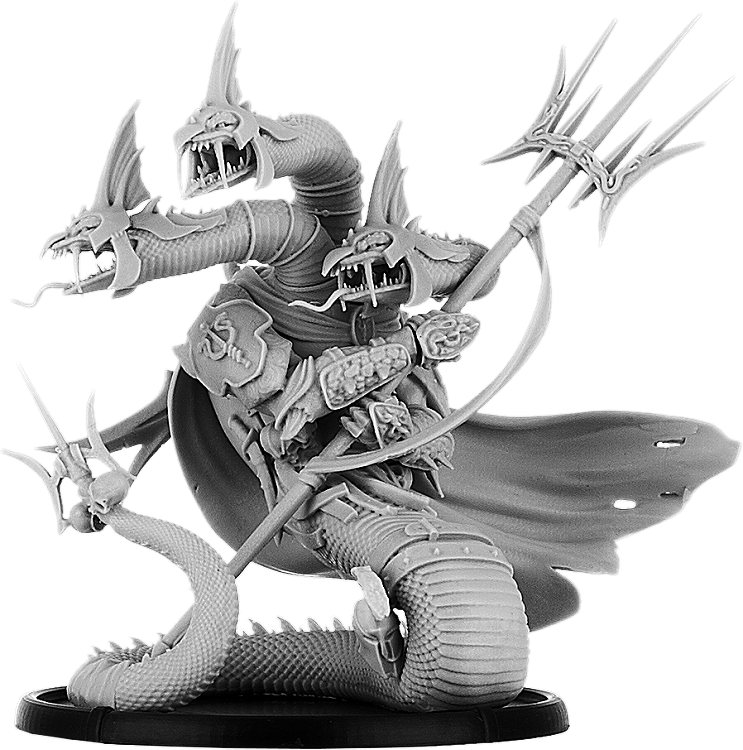
Thoth, Anax of ÝDron

What the fuck is an Anax?*

Nevermind. This is me talking about this mini and why I like it;


It's by Mierce Miniatures and you can find it here.

Big image here.

As you can see from its page, the concept is by Robert Lane and Tim Fisher.

Artist Beth Hughes.

Sculptor Oliver Nkweti

Painter Sebastian Picque. (But I don't think we can see a painted version yet.


GENERAL SHAPE

Gonna call this the wave hydra because the whole thing is like a tsunami of movement.

The snakebody is a classic compressed 'S' shape. This brings in feelings of power and dynamism.

The wave of the cloak is arranged so that the line of the staff strikes directly across it, the fluid shape leading your eye one way then a strong interrupting line.

The straight line of the trident actually has a leather band or strap with a bow of fabric. The straps break up the line of the staff and highlight its length and the hanging bow of fabric is yet another curve opposed to the staff.

There's like a ray of spikes haloing the model from left to right from the tail-trident to the helmets of the three heads to the held trident of the weapon.

The rule of three gets repeated three times across these spikes. Three spikes on the trident, three heads and another trident, (this one actually has five, or even seven spikes but three are larger and more dominant.)

So the mini goes:

- 'S' curve snakebody
- 'Wave' curve cloak
- '/' strikethrough staff
- ')' bracketed strap
- '^^^ ^^^ ^^^' halo of spikes rising and falling from left to right

You sense this all at once. Cuve-wave-strike-loop-and-spikes-haloing-everything.

None of these alone are super-original effects for a war-mini, but their collection and arrangement here is powerful and bold, I think, and they unify and react with each other very well.


DETAILS AND 'STUFF'

Counting from the tail of the mini to its head, here are all the individual 'things' or artifacts I could see.

  • Tail-trident spike.
  • SKULLS.
  • Possible lower-tail-covering.
  • Leather belts.
  • HELMET.
  • Armour of some kind with leather pleats.
  • Wave-shaped dagger in sheath.
  • The trident itself has serpents embossed or etched on it at its head.
  • Shoulder caduceus/trident symbol.
  • Artificial lizard scaled embossed on the forearm guards.
  • Symbols or figures on the hand guards, possible snake-around-staff again.
  • Its there again in the cloak clasp, you can just see it under the heads
  • The cloak itself,
  • Necklaces or neck-bands, thongs or torcs with visible fastenings. Three or four on each neck. 
  • The helmets, with neck segments to allow the presumably sinuous movements of the snakelike form.

The helmets spikes are a little like crests and a little like waves, or sails. The waves return us to the sublimated sea-theme in the figure, never explicitly stated in its form. 

The crests remind us of the lizard-like nature of the creature, but are also versions of the crests we might find on Greek or roman helmets, and are also like the kind of ritually-reproduced bodyform that humans put on armour, except this is for lizards. 

People put enhanced versions of their human musculature on breastplates, or enhanced humanoid faces of the front of helmets. By doing this they take symbols of strength, vividness and selfhood and reproduce them on the outside, isolating and projecting the energy. A real-life lizard person might have head crests that present in times of threat and the crests of the helmets could be enhanced versions of that in the same way the muscly-torso breastplate might be for a human being. The super-scales on the forearm guard might do the same kind of thing.

The line of the alien flesh is continually being broken up by lines and straps. Could these be 'kinetic greebles', marks across a moving flexing surface made to draw the eye to the nature of its movement so that is can be more explicitly registered?

(I would have maybe put a scroll on.)


SKULLS

Ah skulls. The old 40k classic.

Uses of skulls in minis:

- Demonstrates both martial potency of character and also savagery, savages keep skull trophies, civilised people just kill and leave the bodies.

- Illustrates scale of model even with no other model nearby. We know how big our skull is, when we see one on a mini perhaps we imagine it as ours and thereby contrast the size of the mini without own size in a subconscious way.

- Skull is a beautiful object in itself.

- Symbol of death or deadness perhaps increases liveliness or livingness of mini in a point/counterpoint way. Like, this piece of plastic simulating a living thing with frozen movement, seems more alive when there are tiny symbols of death included in it. Death being the shadow to life. A shadow cradles mass so the stillness of the skull highlights movement and expressiveness. 

- Brings symbols of enemy factions into mini in another point / counterpoint manner to highlight cultural 'selfness' of model. This is more true of helmets really, which are a kind of skull-shell, with more boldly expressed cultural information than a skull. Skulls symbolise humanity in general, the empty helmet expresses a particular culture. So a little piece of the 'enemy' culture on this model makes you feel its 'home' culture more fully.


AS A CHARACTER

The Whole model is a snake around a staff, a Caduceus, and versions of this symbol are repeated again and again on its armour. The Caduceus was the symbol of Hermes, Hermes may derive from, and has often been re-combined with, Thoth. The name of the character is Thoth. So there you go.

This is a monster, but also a person. Animalistic and human-culture aspects are arranged in a dissonant but interesting pattern. 

This is presented the opposite way to a standard futurist sci-fi/fantasy mini. In those the face and shape presents human-level information, story and character information, and the strange weaponry suggests inhuman or more physical information. Like, the space marine Sergent's face is a human face but his weapons are much more inhuman.

But with this guy, his (her?) face is deeply inhuman. The personality-based information is in the objects attached and the story they infer. And the most person-like part is the way she is holding the trident, the cluster of shapes around the hands and staff making another yin-yang sign right under the heads. That looks like something a person does.

The heads themselves are disturbing and monstrous with no capacity for human emotional information. So there is dissonance. The story information , the information that says 'this is a person in a  particular set of circumstances' is not where we would expect it to be so you 'read' the sculpture in an unexpected way, yet one that ultimately resolves as it should, with you knowing all the kinds of things you feel you should know.


WHY I LIKE THIS KIND OF THING

I think maybe I take pleasure in the extremely wide range of information drawn from, of so many different kinds. Shape. Detail. Character. Use. All meshing together in ways it never could in a naturalistic sculpture, because the range of information wold be limited, or in a more abstract sculpture, because the social and human-level stuff like the 'story' and the Greek helmets and the use wouldn't be the same. I like my art to bring its world with it into mine, sometimes at least.

The machismo perhaps. I'm generally an easier sell for a mini that's about to fuck something up and looks like it could kill me. Maybe I want to own things that could kill me in miniature form?


WHAT I'D LIKE TO KNOW MORE ABOUT

Details of the design process, right from the first idea all the way to creation. There are five people mentioned above and they all interacted to produce this.
 
All the stuff you will be familiar with from my previous posts about how design and an imagined race and faction and world combine. Stuff about how it matches or meshes with the rules. How the design brief was given. Did anything change during the creation process. How was it manufactured and how do the tolerances and requirements of the mass production process impact the aesthetic effect. All the usual stuff.


(* I looked it up.)


Thursday, 18 September 2014

Monday, 11 August 2014

Beauty and Imagination

Long ramble that goes nowhere, prompted in part by recent events, partly by this. It felt like I was going to get close to a point, but the dammn thing slipped away somewhere and I'm tired of searching for it. Read at your own risk


Saturday, 19 July 2014

The Egyptian Queen

On the fourteenth day, as they broke the door to the chamber, there came
a soft gonging from somewhere deep; the ground beneath their feet

rippled, enough to coat their boots with dust. And, touch by touch,
   the light...
Canoptic jars, grave dolls, small flasks that once held honey. The
   catafalque

cracked under their hands; and, when they shifted the lid, a cloud of bees
came out, although...came forth...was what she wrote, the only woman

to see this: unmarried, a known hysteric, soon sent home to 'rest
and repair' , her journal somehow lost. The gateway stela gave clues:

I FED TO THE WOLVES SMALL CATTLE...[lacuna]...CLEANSE ME...
[lacuna]...TEARS OF RA...the locals knocked up a basic counter-
   weight gantry,

then worked through the night by Tilley-lamp to crate
the smaller stuff, before chiseling the image of Anubis off the frieze.

The flasks were etched with a hieroglyph depicting a bee,
which does mean 'bee'...came forth the queen, dark-eyed and tremulous.

- David Harsent

Wednesday, 23 April 2014

Ride the Iceberg


There’s a theory that passengers on the Titanic could have ridden the iceberg and lived.

The iceberg the titanic hit was large and, apparently, flat. The ship didn’t have enough lifeboats to take everyone. Anyone going into the water would freeze to death in minutes. They do have enough boats to ferry people over to the berg. Steps could be cut up and people moved to the top. Anyone there would still freeze or starve to death, but that would take days, not minutes, and rescue ships are already on the way, they arrive the next day.

It’s a slightly crazy plan maybe, but, if you were the captain of the Titanic, and you knew for a fact that a huge number of your passengers were absolutely going to drown and freeze, and that you would too, and if someone described it to you, would you have given it a try?

The reason people don’t think about riding the iceberg is because they are fucking terrified. When you are scared you don’t think of the thing that has killed you as the thing that can save you.


I bring it up is because it is a good example of one of the things I love most in RPG’s. The re-contextualising of information when under pressure. Seeing everything in the environment almost ‘as-one’, as if you were both outside and within. Being aware of every object and process, not just as it applies to you, but as what it is in itself, its qualities apart from your interaction with it.

There is a deep pleasure for me in thinking about things in this way.

When you are aware of all the things on their own, separated from their immediate contexts, you can then allow them to drift and settle into new configurations. Threats become tools, or toys. The poison that you drink becomes a weapon in your hands.

The castle is surrounded by an acidic moat, the Frost Giant Queen is being attacked by demons like a swarm of flies. What if she got in the moat? That’s not what the moat is there for but it is something the moat can do.

You need to break into the Caliphs castle. The Druid can change into animals. The Caliph likes presents. What if the Druid changed into a beautiful bird, got into a golden cage, and was given to the Caliph?

You have stolen the goblins war-pig. The rest of the goblins are holed up past a barrier in a narrow stairwell below. What if you pointed the war pig down the stairs and set fire to its arse?

The succubus wants to eat your soul, there is nothing you have that can harm her, you cannot break out of her grasp. Why not make out with the succubus? You might charm her and, at least, die slower.


There is absolutely no other form of entertainment I can think of that does this. Improv theatre might, but you can’t ‘win’ improve. Probably trying to win is a good way to fuck Improv up.


There are RPG’s that get a long way from this idea. This is because people are stupid and if you give them something good wrapped in a necessary shell they will work hard to throw away the good part and obsess about the shell. Then they will make something that is all-shell and be very proud of it.


The presence of Iceberg-Riding is one of the reasons that I think about RPG’s and computer games as being almost non-overlapping schema. Like science and religion. They are both games but computer games are good to the extent that they stop you questioning them. They work perfectly so long as you are happy with all of the things you can’t do.

Want to play Half-Life and fuck off to another part of town to talk to someone new? Can’t do it. Why not? Because it’s a game. It’s stupid, after all, to want to do things in a computer game that you can’t do in a computer game. Only children playing for the first time fail to understand that. They keep pushing against the borders of the system, trying to re-contextualise the information.

Older players already know that your job as a player is to not think about the things that you can’t do, just concentrate as much as you can on what you can do, on what the game presents to you, and the more you do that the better you will be at the game.

Nothing really wrong with that. All games have rules. They are all bounded. That’s what makes them games, even RPG’s. But how many computer games make it necessary that you to re-contextualise information inside the game in ways the designers know they could never have predicted themselves? That if you do not push against the orders of what the game has given you then you will probably fail the game?

Minecraft?

“Think beyond me, or die” says the dungeon.

Monday, 17 March 2014

Would you Buy This

If I took a buch of stuff from this blog (which you alredy got for free), cleaned it up, re-arranged it and put it into a book, would you buy it?

The index would look like this;

Table of Contents
The Point of No Return 5

1 – Thinking about Games 7

Ill Deeds 7
Complex Theory, meet Mundane Reality 9
Monsters of Incompetence and Atomic Bread 13
Monsters and Military Incompetence 14
Atomic Bread 16
Ghost Protocols 18
Acting Dumb 21
Contrarian Knobend Dungeons and Dragons 23
Art in Games 27
godz without limitz 34
BUT WHY KENKU? 37

2 – A River of Shadows 39

Before Dawn 39
A Commentary on Appendix P 40
Empire of the Summer Moon by C.S.Gwynne. 40
Blind Descent by James M.Tabor 41
Unquenchable Fire by Rachel Pollack 41
Personal Memoirs of U.S.Grant. 42
The Air Loom Gang – Mike Jay 42
In The Mail 43
“I should have lived before Kennedy died” 46
Millers Crossing – The Cohen Brothers 46
Afghanistan, a Cultural and Political History by Thomas Barfield 48
A Paradise Built in Hell – Rebecca Solnit. 49
The Insurgent Archipelago by John Mackinley 50

3 - Game Objects 52

A city without a name 52
The Demon Behind Glass 56
Bunny World 57
I fucking love writing badly 59
The Prince of Carcasses 64
Pluvial 66
Five.. Four... Three.. Two... ONE! 72
There are so many signs of trouble 75
My Means of Destroying You All 78
Frost Squid 81
d7 Doppelgängers 82
The Hours in Balach 84
A Knight of Mars 86
ORCNEAS 86
FROST-FETTER 87
STORM-WIFE 88
WEEP-YET-I-DIE 89
Oath of Mars 90
Oath of Repentance 90
Marriage Song 91
Curse of Mars 92
My Island is the centre of the world. 93
A City On The Edge Of Deception 98
But. 101
The Sorrows of The Thane of Coates 105

4 – Culture 111

The Joey School 111
Old Snow 115
this post is less good 119
Animal Crackers 124

5 - Teens 128

Opening Comment 128
The Dog Was Called Priestly 128
Teens 129
'They called me the Riddlemaster' 133
The Riddles I Made 135
Emotions 137
Telepathic Snails 138
Fake Being Gay to Kill Thieves 139
"You know it's always more fun when we split up." 141
The Rules Don't Cover Imploding Friendships 142
Trigger Warning for Stupidity 144
Teens don't know what Evil means 146
Like A Beckett Play 147
"You can't feminize me, I'll demote you." 148

6 – Sculpture 151

Completely enclosed in the hollow of his hand 151
Jesus Likes Your Backpack 157
“But is it aaaaaarrrrrtt?” 161
"Still, that is not the point.” 162
Ten Ideas For The Backs Of Toy Soldiers 168
Ten Masks of the Creatures from Before Time 171
In case you didn't notice how fucking clever I was being 173
Exo-Suits of the Hot Girls 175
    Six Science Fiction Fortifications 181
Plan For The Film Of An Alien Siege 185

Tuesday, 18 February 2014

Because no-one demanded it, more Ruskin


Make if BIGGER

“For there is a crust about the impressible part of men’s minds, which must be pierced through before they can be touched to the quick ; and though we may prick at it and scratch at it in a thousand separate places, we might as well have let it alone if we do not come through somewhere with a thrust : and if we can give such a thrust anywhere, there is no need of another ; it need not be even so “wide as a church door,” so that it be enough.

And mere weight will do this ;  it is a clumsy way of doing it, but an effectual one, too ; and the apathy which cannot be pierced by a small steeple, nor shone through by a small window, can be broken through in a moment by the mere weight of a great wall.”

Fuck ribbons, frankly

“”is there anything like ribands in nature? It might be thought that grass and seaweed afforded apologetic types. They do not. There is a wide difference between their structure and that of the riband. They have a skeleton, an anatomy, a central rib, or fibre, or framework of some kind or another, which has a beginning and an end, a root and head, and whose make and strength affect every direction of their motion and every line of their form.

The loosest weed that drifts and waves under the heaving of the sea, or hangs heavily on the brown and slippery shore, has a marked strength, structure, elasticity, gradation of substance ; its extremities are more finely fibred than its centre, its centre than its root : every fork of its ramification is measured and proportioned ; every wave of its languid lines is lovely. It has its allotted size, and place, and function ; it is a specific creature.

What is there like this in a riband? It has no structure : it is a succession of cut threads all alike ; it has no skeleton, no make, no form, no size, no will of its own. You cut it and crush it into what you will. It has no strength, no languor. It cannot fall into a single graceful form. It cannot wave, in the true sense, but only turn and be wrinkled. It is a vile thing ; it spoils all that is near its wretched film of an existence. Never use it. Let the flowers come loose if they cannot keep together without being tied ; leave the sentence unwritten if you cannot write it on a tablet or book, or plain roll of paper.”


Also, railways.

“Another of the strange and evil tendencies of the present day is to the decoration of the railroad station. Now if there be any place in the world in which people are deprived of that portion of temper and discretion which are necessary to the contemplation of beauty, it is there. It is the very temple of discomfort, and the only charity that the builder can extend to us is to show us, plainly as may be, how soonest to escape from it.

The whole system of railroad travelling is addressed to people, who, being in a hurry, are therefore, for the time being, miserable. No one would travel in that manner who could help it – who had time to go leisurely over hills and between hedges, instead of through tunnels and between banks : at least those who would have no sense of beauty so acute as that we need consult it at the station.

The railroad is in all its relations a matter of earnest business, to be got through as soon as possible. It transmutes a man from a traveller into a living parcel. For the time he has parted with the nobler characteristics of his humanity for the sake of a planetary power of locomotion. Do not ask him to admire anything. You might as well ask the wind. Carry him safely, dismiss him soon : he will thank you for nothing else. All attempts to please him in any other way are mere mockery, and insults to the things by which you endeavour to do so.

….

Railroad architecture has, or would have, a dignity of its own if it were only let to its work. You would not put rings on the fingers of a smith at his anvil.”