Sunday, 10 May 2015

A review of 'Fire On The Rim'


Review of Fire On The Rim

Fire on the Rim is a a book by Stephen J. Pyne about the 15 years he spent as a seasonal firefighter on the North Rim of the Grand canyon National Park. It is unusual and good. Like most good books it does a lot of things.

Growing Up

The simplest story in Fire on the Rim is about growing up. Pyne starts his tours of duty as a teenager on summer break from collage and ends them as a 32 year old married man with a bad back and a small child. In another kind of book this would be a story of the civilising or emplacement of a man in society, but since Pynes self-chosen environment is one directly connected to fire, it is a mercurial kind of growth. The fires in the park and the culture of the fire fighters is the most stable and continuous strand of life during his assumption of adulthood, yet the fire cannot be predicted and can barely be controlled, and the culture of the Fire Fighters is fluid, a ship of Theseus, with members joining, leaving, flowing past and re-arranging season after season. The Fire Crews sustain their culture through a kind of central temple, the Fire Cache, the store house of all their preventative gear, their dispatching house, waiting room, pit stop, repair shed, office and museum.

The cache is closed each autumn at the end of the fire season, and re-opened every spring. its contents and organisation continually and ritually re-arranged by shifting seasonal crews. There have been many different caches but there is only ever one Fire Cache. Inside the Cache is the Pit and inside the Pit is the patchwork museum and cultural core of the crews:

Page 33 - Omnium-Gatherum

"The walls are saturated with fire paraphernalia. There are dispatching maps for the North Rim and the North Kaibab Forest, and a Federal Aviation Administration flight map of the Grand Canyon, all covered with Plexiglas. A trellis of clipboards posts biweekly tours of duty, requisition needs, helicopter schedules, work projects. There are posters of Smokey Bear, lightning, a pinup advertising Husqvarna chain saws; there are photos of former crews, our Hall of Flame; a slab of aspen, sheared longitudinally and routed with red letters that read NEVER GIVE AN INCH. Above the desk hangs a square sign constructed from scrap plywood, with a metal button (scavenged from a government-issue brown metal cabinet); a large arrow that points to the button has been routed out with the caption "Lightning Button. Press for Fire." Elsewhere, mounted on wood, are a pair of photos, one from 1936 when the fire cache was opened, and another, forty years later, with FCAs taking the place of CCC enrollees but with the vehicles and arrangements otherwise identical.

The Kid opens the windows, but the only effective fumigation is smoke. From the floor Kent picks up a ball of flagging tape - the "Dragon Flaggin'," recovered from the great Dragon Fire - and places it on a shelf labeled FCA Museum. There are other trophies: a pulaski coated with slurry on one side and charred on the other that Alston recovered from the Sublime fire; the lucky turkey feather that guided Rethlake across Powell Plateau; a memorial plaque, signed by Park and Forest crews after the Circus fire; a two-foot bronze nozzle, discovered in a dark corner of the structural fire cache, now the John Smokechaser award; a metal Log Cabin syrup can; a Mickey Mouse hard hat; a motorcycle helmet with drip torch nozzle and fusees bristling out of it; and the wooden sign itself, FIRE MUSEUEUM, whose misspelling instantly qualified it for inclusion. Mementos flood the wall. For a seasonal crew - for a migrant folk society like ours whose collective memory is brutally short - this omnium-gatherum of artifacts is our surest record of the past. If the cache tells us who we are, the Pit tells us who we have been. Outside the window stands our fire totem, a fire-sculptured snag brought back from Walhalla and planted as a sentinel."

Since its a description of the shaping forces of his life, its impossible to review this part of Pyne's book without also reviewing Pyne, and that I cannot do as I do not know enough. If you take a look at his wikipedia page though, you can see he kind of stuck with the fire thing.

Limestone

I must take you for a moment beneath the earth. The stone is mentioned in Pynes book but not explored, he serves a different element, and so we must move briefly from his mind to mine.

Limestone shapes the North Rim:

Page 177 - Karst and Alliteration

"The Basin is the greatest of the North Rim parks. If The Dragon testifies to a geography of fire, The Basin speaks for a geography of water. The geologic column that constitutes the Kaibab Plateau consists disproportionately of limestone, and it is capped by a thick limestone crust. Cold temperatures, abundant moisture, and a plexus of cracks from the warping and fissuring of the Plateau have conspired to karstify the Kaibab. There are few surface springs, and they are little more than seeps. There are a few permanent ponds - sinkholes lined with clay. Small, intermittent streams drain the Plateau during spring melt when the saturated ground cannot absorb more moisture, but even these are intercepted before they reach the Rim. Everything is sucked underground into a subterranean plumbing system that discharges through springs deep into the Canyon. Some springs are feeble, fed only by a local watershed. Other drain large expanses of the Plateau and debouch in spectacular waterfalls like Roaring Springs, Thunder River, Tapeats. The potable water demanded by both Rims is largely dependant on these Inner Canyon springs. Roaring Springs is the principal reservoir for both North and South Rims, and the principal watershed for Roaring Springs is The Basin. The people gather where the water is - or where it can be pumped. The hydrologic connections between Plateau and Canyon, of which sinks and sinkholes are runic manifestations, are internal. They bypass the Rim."

Limestone is a very radical stone, it eats water and therefore civilisation.

Readers may be familiar with my post on 'The Art of Not being Governed' which described the mountains, swamps, mangroves and deserts on which it was difficult for authority to imprint its stamp and the cultures that relate to those zones. Limestone is another such place.

We can see this in the Jamaican cockpit country where maroons fought he british empire for years, I suspect we might see it in a wide range of places if we look for it. Where we find limestone, we find anarchy.

Because Limestone eats water at takes it away into the earth, there is not enough surface water for large numbers of people to drink. High population densities cannot survive on the Limestone plateau. The only reason the park can accommodate visitors at all, or fight fires at all, is because a sophisticated modern pumping system brings up stupendous amounts of water from below. It the pumps fail the visitors cannot come en-masse, if the pumps fail there is not enough water for the fire crews to reliably fight fires in large numbers. The pump is a railhead of civilisation and it is in conflict with the ecology shaped by the stone on which it grows.

Limestone eats the water, yet provides enough for trees to grow, the rim dries the trees, the sky brings storms, lightning starts the fires and the fires control which kind of trees may prevail and in what densities they may grow.

Until people turn up with pumps and decide this is a wilderness area that they would prefer not to be on fire all the time. They build a system to suppress the fires, the fuels in the forest build up and the environment shifts.

On the North Rim, the conflict between the dense, highly populated, rule bound hierarchical civilisation and the lightly populated, socially flat, freedom-obsessed anarchical societies has been re created in miniature.

Culture Conflict

Pyne begins his story already in the lea of the great years of fire fighting. A powerful organisation called the CCC was previously in charge of fire suppression on the Rim. They had vast resources, hundreds of men and total moral certainty. It was the age of heroic fire prevention.

Page 91 - Pulaski

"...The story of Edward Pulaski is one of the informing legends of American fire-fighting, a triumph of faith over higher criticism. The episode is true to its times. Conservation had assumed the proportion of  a national crusade, with the Forest Service in the vanguard. Pulaski acted out his high drama the same month that William James published his essay "On The Moral Equivalent Of War," in which he urged a national conscription of youths to wage war on nature as a surrogate for war on fellow humans. Eventually the Forest Service established a graveyard at St.Maries, idaho, to receive the bodies of fire-fighters killed in the line of duty. The exit to the War Eagle Mine was declared a National Historic Site.

The need for heroism was there, the timing right. In California that same August the Forest Service policy of fire protection came under attack by advocates of "light burning", an alternative strategy that sought to make fire use, not fire control, the basis of fire management. The 1910 fires decided that debate and set American firefighting down a distinctive path. At the trailhead stood Ranger Pulaski."

Wherever Pyne goes on the North Rim he finds evidence of the CCC lost and forgotten like the ruins of a great empire. They cut the network of fire roads which the current crews can barely maintain, they build vast spotting towers where watchmen would sit in lightning-fastened chairs, bound with conductors so that any strike will pass around the observer, they carried vast cyclopean tanks into the forests core where they slowly rot and are covered with graffiti by generations of fire fighters, they fenced and guarded the tiny springs, securing their flows and hiding them from the roads so as not to be disturbed.

But all of this is fading and will fade further as Pynes tours go on. The power and prestige of the fire fighters has waned and is slowly passing away. In their place come the rangers.

Pyne does not like the rangers. or, perhaps it might be more true to say that while he may like many individual rangers, he hates what the rangers are. Those of you familiar with the D&D culture wars of the early 21st century will be familiar with this I think:

Page 190 - The Ranger Mind

"Rangering becomes more than a job; it is a state of mind. The ranger mind is designed to function in crises, real or imagined. It delights in juggling many thoughts and decisions but within a context whose purpose is predetermined and whose context demands only a choice of techniques, not of philosophies. It is a mentality of triage; it works rapidly but shallowly; it detests contemplation and shuns moral or philosophical ambiguity. On the surface, it appears to be an odd state of mind for future park administrators to cultivate, but it explains the almost total absence of any kind of contemplative study within the agency. No park ranger has ever written an important statement of national parks values or purposes. Instead, the ranger reacts to crises, and if existing crises are not enough, new ones must be invented. The best bet is crime."

(The rangers train exhaustively for showdowns with criminals, biker gangs and terrorists. The expected moments of crisis never quite arrive. Terrorists never attack the Grand Canyon, the biker gangs turn out to be quite friendly.)

By comparison, the Fire Crews are un-uniformed, badly paid, barely-hierarchal, irregular, highly independent, openly contemptuous of authority and almost completely cut off from the visitors to the park. They are also highly ritualistic in a very improvisational way, they generate performances and stories which are destined to fade and be forgotten while the culture of the rangers is slowly formally-encoded in maps and procedures.

Page 41 - Two Realms on The Rim

"This is the dichotomy that divides the North Rim into two realms: you work either in the Area or out of the Area. Every job apart from ours relates directly or indirectly to the Park visitor, and that compels everyone else to stay in the Area because this is where the visitors cluster. if there were no visitors, there would be no Office, no Lodge, no Inn, no campground, no paved highway or overlooks, no saloon, no sewage treatment plant; there would be no park rangers, no ranger naturalists, maintenance labourers, carpenters, plumbers, road workers, no supervisors. But we could pass an entire summer and never contact a visitor in an official capacity. We could be stationed anywhere on the Rim. We are informed by fire - by fires that originate from lightning, not from people; by work that puts us in contact with the forest and the rolling ravines of the North Rim, not with visitors or with the Canyon to which they come to gaze; by events that cannot be forecast with managerial precision prior to their occurrence, that can only frustrate career tracks and budgets. Fire is eclectic, ineradicable, invasive, stochastic, opportunistic, fun - and its attributes become ours."

The fire crews have minimal material support and a staggering degree of latitude in what they do. They interact with the geography of the Rim in a way no-one else does. They must literally chase lightning. They must think of trees as 'fuels' they must drive fire roads deep into impassible forest and find their way through maddening broken ground to places no human would ever have a reasonable reason to go, purely to fight fires. They must sleep on the borders of quelled and slumbering fires, watching them through the night, they must go everywhere and be capable of going everywhere. They go to places that have no names so name those places themselves. They are allowed, and compelled by paperwork, to name each fire:

Page 129 - The Naming of Fires

"Unlike the Forest Service, which names fires only after existing geographic places, we name fires for any reason. We name fires after girlfriends. There is a Carol, a Lynn, a Kate fire. When Tom receives a "Dear John" letter, the Shauna fire is redesignated the Disappointment fire. Then Stone wants to name a second, larger fire after Carol, we name it after the great Carolinian, Charlemagne. We name fires for events or natural phenomena. There are Morning, Sunrise, Evening, Star, Sandy and Rainbow fires. When everyone from 176 goes to a fire, it becomes the 176 fire. When the Cosmic Cowboys vow to "return by 7:00 pm." that evening, they hurry to the BB7 (Back By 7) fire. A fire on the Fourth of July becomes the Independence fire. The first fires of the year take names like Shakedown, Preamble, Prologue, Kickoff, Inauguration. When the season opening, long delayed, appears at Cape Final, it becomes the Finally fire. Closing fires take names like Farewell, Epilogue, So Long, 10-7, Adios. A crew birder names fires after grosbeaks, flickers, and owls; a physicist names them for high-energy accelerators like SLAC CERN; a Mexican-food devotee gives us the Taco, Frijole, and Enchilada fires. No one has ever found the Phantom fire. The Poltergeist fire withstands three attempts before it is ultimately located. The Phoenix fire occurs on the side of an old burn. A wrong compass bearing leads to the Miss fire. A crewman whose last name is DeForrest gives us the DeForrest fire. The punning impulse yields the Sure fire, Cross fire, cease fire, Balza fire. A fire that has cases of rations but no tools becomes the Porker fire. When Sonja and Tim smell smoke while driving to a project near Cape Royal, then follow the odour to an unreported fire, we have a Sniffer fire. A reeking burn in deep duff becomes the Odoriferous fire. A fire north of Point Imperial evolves the Emperor fire. When Dave and Ralph have to share a sleeping bag, we have a Honeymoon fire. The growth rings on a burning fir date it to 1687, the year of Newtons _Principia Mathematica_, so we have a Principia fire. Since it looks as if it could be the start of something, a fire in the Iron Triangle becomes the Genesis fire. Sonja and Fran have a Femme Fatale fire; Becker and Stiegelmeyer, a BS fire; a second trip to Akoto Point by Alston yields the Atokotwo fire. There are Funky, Whoopie, Pits, Booga Boogs, and Far Out fires. The Dancing Pole fire results when Lenny - a Polish kid from Syracuse - tries to make a Sterno burner out of saw mix and a hot ration can, only to have the mix ignite and spread to his plastic quart canteen; when he is unable to blow it out, he drops it to the ground and tries to stomp on it, misses the flaming head, and strikes the canteen, which shoots out a ten-foot flame and sets fire to his boot, which he tries to beat out with his other boot, resulting in a jig that sends the remainder of the crew into hysterics. The names fires become geodetic points in our collective map of the Rim."

But the culture of the Fire Crews dies. There is a deep error in the nature of the park. It exists as a wilderness for people to visit, but if the fires are not suppressed, if it is allowed to act like a real wilderness, then the people will be in danger. Furthermore, it won't look like a wilderness any more, because it will be one.

The more effective the fire suppression, the more fires are stopped early, the greater the buildup of fuels in organic matting and new species of pine. A highly effective fire suppression programme merely builds up fuel. The programme has been running for fifty years by this point. Controlled burns are incredibly dangerous and could damage the park.

Everyone knows that things cannot go on. No-one is willing to take responsibility for change. There is a kind of moral void about the fire programme. The Fire Service is allowed to wither yet its responsibilities are never formally removed. Members of the Fire Service alway leave, either to go elsewhere, or to gain promotion into any other part of the Park workforce.

Page 184 - Radio Syndrome

"Tom shows all the symptoms of the disease, and it is terminal. Radio syndrome. He speaks in a quiet yet urgent voice, as though slightly bored with the routine of emergency calls; he chatters; his speech is flooded with jargon, ten-codes, in-group intonation; he holds the radio at a slight angle when speaking into it. he hand radio is no longer a tool; it has become media. Tom is defining, for a Park audience, his functional personality in terms of the persona he projects over the radio. It is inevitable now. Tom will join the rangers.

Radio syndrome is only the first step. It will be quickly succeeded by a fascination with uniforms. In extreme cases FCAs will purchase at their own expense a set of ranger duds, complete with beaver hats. The aspirant will arrange to join rangers on patrol. Ranger slang will creep into fire-based radio traffic. On lieu days he will hang out by the ambulance instead of the fire cache, will join the climbing team, will participate in emergency medical services and make ambulance runs to Kanab, will practice with firearms. The final, confirming symptoms find the victim at Santa Rosa, California, usually again at his own expense, to take a special Park Service training course and receive a law enforcement commission. The process is not reversible. It never happens that someone leaves the rangers to become active in fire; no one surrenders a uniformed position for a non-uniformed position; no one exchanges a direct connection to the park visitor the bureaucratic anomie that accompanies fire management. If the visitor makes the park, the ranger-who administers to visitor needs-makes the Park Service. The park ranger is the Park Service."

Gender plays almost no part in Pynes story, everyone is male apart from some people who might not be, Pyne had to marry someone after all.

As with gender, so with race, everyone is white unless they aren't. Race enters with the SWFF's, temporary auxiliary fire fighters who are often native american. The first SWFF crews are Hopi, these gradually transition to Navajo:

164 - Everyone named John

"Misunderstandings are legendary. Nearly everyone, it seems is named John, and last names seem to consist solely of Tsotsie, Yazzie, and Begaye. The distinction between the National park Service and the U.S. Forest Service seems to be untranslatable, and confusions, real or contrived, are endless. We-want-a-fireshirt, they say. Forest-service-gives-us-fireshirts. No, they don't, we reply. They-let-us-keep-shirts. No, they don't. They don't even issue them to you. They-give-cigarettes.Why-doesn't-Park-Service-give-cigarettes? Nobody gets cigarettes. It becomes apparent that the point of confusion is itself a bargaining ploy; in perverse ways the cultural disjunction is something to be exploited. When John Tsotie and I are tossing garbage into the dry dump, he picks up an orange pylon kept permanently in the pickup and stares questioningly. I shake my head. "Keep it," I say. He nods and throws it into the pit. When Kent explains to John Peshtony how to get to the fire, John nods sagely in agreement, then crashes into the brush 180 degrees from where he is sent. A nodding head means a nodding head. The spectacle of an FCA and a SWFF - barely able to communicate, staggering through the woods with overburdened firepacks and fistfuls of shovels and pulakis, trying to find a fire that Recon 1 has mislocated-is one of the enduring images of the North Rim.

We learn survival Navajo. We pick up expressions for "fire," "water," "hello," "fuck you," "bullshit," and "bread." T'oo baa 'ih, "no good," becomes a universal antidote to "OK." The green pumper is t'oo baa'ih, the Sheep Shed is t'oo baa'ih, the box lunches are t'oo baa'ih, the Fence is t'oo baa'ih, Big Bob is t'oo baa'ih. We have a t'oo baa'ih fire. The SWFFs name Stone Shash, "bear." They call Draper Gaagii, "raven." They name Becker Tsisch'ili, "curly hair". The rangers are bilagaana, "white men." Williams, a Hopi hired for the regular fire crew, they call Kiis'aanii which they refuse to translate. The expression for "asshole," nijilchii, is indistinguishable to Anglo ears from ndishchii, the word for "pine. It becomes the source for endless bilingual puns. There-are-ants-ndishchii. He-is-lazy, he-has-no-nijilchii. The confusion is especially useful in talking about their boss, and it is doubly diabolical because they get us to do their punning. We threaten to take away their Tabasco sauce if the puns do not end. When some-thing is agreeable, the SWFFs say - accenting every syllable evenly - that it is pretty-good-all-right. A coffee break at the inn is pretty-good-all-right. They last fire bust was pretty-good-all-right.

After a fire or two together, shared experiences partially overcome the unshared. I try to pair up those COs and SWFFs who have developed some comradery. One morning the SWFFs show up wearing cords around their waists. The crew boss, Johnny Begaye, tells us solemnly that there are ghosts and advises us to ward them off by wearing a charm. We cut strands of parachute cord, and for the next two days, until we are told that the danger has passed, we wear strands from our belt loops."

But the budget for the SWFF's is gradually cut (The budget for everything is gradually cut) and they disappear from the park. Some time later, federal affirmative action laws are enacted and a crew member gets recruited, apparently because he plays for a particular football team and the park service assumes he will be black. (He isn't.)

The conflict between the water-powered hierarchies of the rangers and the fire-powered anarchism of the fire crews is made more cruel by the slow displacement and disconnection of the fire crews. They are addressing a problem that nobody wants to resolve and that everyone knows has to be resolved. As you read this it still has not been resolved. It is hard becasue it has its roots at the very base of our relationship with nature. How much should we force the world, or be forced by it? We have no unified response to this and so the drama of our fires goes on.

.........


Fire on the Rim might be the most elegantly written 'fuck you' to a bureaucracy I've ever read. If the language was less neatly encompassing then blood would seep through the page.

The hierarchy of the park service is castigated as careerist, short-sighted, greedy, over confident and essentially stupid. The turf wars and resentments between the two great adjoining organisations of the canyon, the park service and the forest service are subtly mocked. The fact that Pynes criticism is wrapped up in an essential humanity just lets it penetrate deeper. His humour is a protein sheath for the virus of his hate. The man is fucked off.

Pyne shares with Norman Maclean a kind of clipped, woodsmans eco-poetry. The language of men who have walked a long distance carrying a chainsaw and have something very important to say and they will not waste any language in saying it. He is not a man to let a sentence run on. A good solid sentence will come neatly broken into two parts, as if for stowing in a bag. Three parts is a bit much. One is common. See the following paragraph with line breaks added by me at each full stop:

"Within limits, our identity is ours to make.
We dispatch ourselves.
We outfit ourselves.
We train ourselves.
We name ourselves.
From the Park there is little leadership.
What really defines us is fire.
Fires solve all problems: fires make everything possible.
Without fires our bravura seems ridiculous, the fire cache a ghetto, and outposts like The Dragon a kind of hallucinatory Ultima Thule of the North Rim.
Yet our relationship to fire is far from simple or unmediated."

It is overwhelmingly a spoken rhythm rather than a purely thought one. Spoken inside the head perhaps, but still 'in voice'.

And it is a certain and clear voice. Situations are vague (getting lost as fuck in the Rim is a constant situation) but paragraphs never are. There are almost no question marks in this book, even in the sections of speech. Like Cormac Mccarthy and Conan the Barbarian, Fire Fighters don't ask questions, they just say what they are going to do.

They must do in real life, since large parts of the book are a bunch of guys wandering around in a forest shouting through the radio at a guy in a plane about the location of some smoke, but it never comes through in the writing. The silent irony of an incoherent situation is allowed to stand in for the explicitly ridiculous. Its flinty old-guy humour from a not-old guy, he won't tell you what his emotions were, he'll just show you his former self having them, you'll have to work out the rest yourself.

Pyne does love an alliterated line, its rare for a sentence to escape without some linking euphony, the map-names and the names of plants assist Pyne in his enfolding structure of sound.

"There is no sign of fire anywhere. There are great swaths and stringers of pinyon-juniper amongst the sagebush plains. We cannot see the Kaibab or even the Kanab, but we can see plainly enough over the Trumbull range, and there are no smokes. There is no place to look but farther west."

He has the classic, clipped, anglo-writers habit of tucking the emotions of a paragraph neatly back under the bed of words in a simple short strip of text at the end. Nothing rises to a peak. People scream over the sound of chainsaws but nothing in the line shouts. The drama is always unfolding, but there is no Drama.

The structure of the book is unusual and original. Pyne combines all his summers on the Rim into one great season, the book runs from spring to autumn. The events and drama of fifteen years are all given in the present tense. A kind of clearly-artificial mosaic of recollection and re-creation. The illusion is not intended to deceive us into believing in one naturalistic story of a single drama-packed year, instead the older man and the young teenager, the rookie and the team leader stand alongside each other, bringing us to different fires that span years, united by geography, theme, odd twists of event or time of year. All summer fires are one fire, all fires on the Dragon, a blackened shard of rock that seems to summon lightning, are all one fire. All autumns are one autumn and all leavings of the park are one leaving.

It is a strange way to organise either the autobiography, history book or policy analysis that Fire On The Rim might claim to be, but it works. The logic of the geography overwhelms the abstract organisation of year and age. The Rim has more power than the diary in its ability to synergise events. The date and time must bow to the slope, the scrub and the distance from the road, year must bow to the season. It doesn't matter if it was 1970 or 1985, it matters if it was raining and how far from the road it was, it doesn't matter if Carter or Reagan was president, it matters if the fire had crowned and leapt the line, if it was burning in the low punk, how high the wind was and if the radios were working.

The entirety of the experience is held as one, as a present-tense recollection, peopled with re-named characters, invented people to hold the concentrated load of the memory of one man, and cast off from chronology to form its own archipelago of fires.

(As a brief cave-based aside, there is one small part in which the fossilised dung of an extinct gigantic sloth is set on fire for mysterious reasons, providing a strange and difficult challenge. Fires in natural caves are rare and sloth dung fires may be unique.)

Wednesday, 29 April 2015

"To Hell With Culture"

These are all quotes for Herbert Reads book:


Introduction

It may seem unreasonable to non-poetic people, but what the poet nevertheless demands is a kind of society in which tranquillity, withdrawal, is a natural right. He* must be able to go into the press and out of it as easily as he passes from his own house into the street. The charge he makes against the modern world is that it has invaded his house of quiet, invaded it with cares and rumours, insistent politics and totalitarian wars.

The poet is therefore compelled to demand, for poetic reasons that the world shall be changed. It cannot be said that his demand is unreasonable: it is the first condition of his existence as a poet.


The Symptoms of Decadence

Art's wider significance is biological. It is no idle play of surplus energies, no mere lustre on the hard surface of reality, as materialists have tended to argue. It springs from the centre of life. It is the finest tone of our vitality, the reflexion of harmonious form, the very echo of the organic rhythm of the universe. A nation without art may achieve external order; it may accumulate wealth and exercise power. But if it is without aesthetic sensibility, these things will perish as if from their own weight, their lack of balance and proportion.

Perhaps no civilisation is destined to survive many centuries, but when a civilisation is stricken, we shall then notice, along with a declining birth-rate and an increasing debt, first the censure of originality in art and then art's complete subservience and defeat. The decline and fall of a civilisation naturally involves the decline and fall of its art; but is is a mistake to assume that art perishes simply because its social foundations are withdrawn. The foundations are the art, and they perish from a rot that has invaded the whole structure. Psychologists say that our minds contain two contrary impulses - the will to live and the will to die; and that the curve of life is the result of the contest between them. So with a civilisation. It has a will to live and a will to die; and the highest expression of its will to live is free and original art.


The Secret of Success

With rare exceptions public education throughout the world today concentrates on the inculcation of intellectual knowledge, for which it requires the development of such facilities as memory, analysis, enumeration, classification and generalization. These are faculties that may either deaden or depress the aesthitic sensibility, which needs for its development concreteness, sensational acuteness, emotional spotnineity, attention, contemplation, wholeness of vision or apprehension, and generally what Keats called 'negative capability'.

.........

About 1808, thirty years after they were delivered, Blake wrote some annotations in his copy of the Discourses which showed the reaction of native genius to such a man as Reynolds and to his precepts. 'This man,' he declared, 'was fired by Satan to depress art,' and Blake had 'nothing but indignation and resentment' to express as he read the discourses of one who had been 'applauded and rewarded by the rich and great'. 'I consider Reynolds Discourses to the Royal Academy as the simulations of the hypocrite who smiles particularly where he means to betray. His praise of Rafael is like the hysteric smile of revenge. His softness and candour, the hidden trap and poisoned feast. He praised Michelangelo for qualities which Michelangelo abhorred, and he blames Rafael for the only qualities which Rafael valued' - there is much more vituperation of this kind, about forty pages of it, but apart from a defence of Blake's own style in painting (delineation as against chiaroscuro) they return again and again to two themes: tradition and individual talent, and patronage. Reynolds 'mocked' inspiration and vision ('then and now, and I hope will always remain, my element, my eternal dwelling place') and he rigged the market in favour of his own kind of art - 'the rich men of England form themselves into a society to sell and not to buy pictures. The artist who does not throw his contempt on such trading exhibitions, does not know either his own interest or his duty ...  The inquiry in England is not whether a man has talents and genius, but whether he is passive and polite and a virtuous ass and obedient to noblemen's opinions in art and scince. If he is, he is a good man. If not, he must be starved.'


The Secret of Success

It should be impossible in questions of taste to fool all the public all the time, but in fact, once an artist has become fashionable by clever methods of publicity, it takes many years of patient criticism to destroy his false reputation - so few people read serious criticism.


The Psychology of Reaction

Here I must stress a distinction that I have been making all my life between reason and scientific method. But let me on this occasion rely on Gilbert Murray, whose name I have just evoked. At the end of the essay in question he has an eloquent passage which I would like to quote:

"The Uncharted surrounds us on every side and we must needs have some relation towards it, a relation which will depend on the general discipline of a man's mind and the bias of his whole character. As far as knowledge and conscious reason will go, we should follow resolutely their austere guidance. When they cease, as cease they must, we must use as best we can those fainter powers of apprehension and surmise and sensitiveness by which, after all, most high truth has been reached as well as most high art and poetry; careful not to neglect the real needs of men and women through basing out life on dreams; and remembering above all to walk gently in a world where the lights are dim and the very stars wander."

Here is an admission, by an apostle of reason, that knowledge and conscious reason will only carry us so far in an understanding of reality, and that when we reach the limit of their powers, 'we must use as best we can those fainter powers of apprehension and surmise and sensitiveness by which, after all, most high truth has been reached as well as most high art and poetry'. I believe that Professor Murray puts these processes in their wrong order-that it is only when we have first used these powers of apprehension and surmise and sensitiveness that it becomes possible to use the powers of conscious reason, for reason is not a wholly conceptual activity, a spinning of abstraction from mental vacuity: it is, in so far as it remains vital, a metaphorical activity, given energy and scope by the imagination.


The Psychology of Reaction

The normal person stills the voice of the deep, orientates himself to the outer world, becomes a good mixer, a conservative in politics and a reactionary in art. The psychotic person surrenders to his subjective self, shuns society, is suspicious of his fellow workers, is sexually morbid and philosophically pessimistic or nihilistic. (p_-)


The Arts and Peace

If man is no longer responsible to himself, but to an abstraction, he has a thousand chances to be evasive, to be weak, to be mistaken. If he acts, no longer instinctively and automatically, but by calculation and with circumspection, he tends to act ambiguously and intolerantly.


*It's always 'he' with Herbert.

Sunday, 26 April 2015

HackShips of the Cryogenic Rats

 Build me a HackShip!
Click to build a HackShip

(Made with Logans Generator
This isn't weighted to produce a true 3d6 result
there are probably ways to do that with
I'm a writer Jim, not a mathmagician!)

Or roll 3d6 six times

Ships Hull

3 Shards of a shattered comet, held together by flickering fields.
4 Bash-compacted pseudo-plastic old escapee drone boats.
5 Origami mass-made monocarbon, crackling silver at the seams.
6 A ring of light-ceramic tubes sprayed in ray-resistant foam.
7 Half an attack-blasted light destroyer, built strong but riddled with unsightly wounds.
8 Polymer shard, light, plasticated and sharp.
9 Keel of ancient iron, cankered with re-upped cargo containers.
10 Mech-assembled zero-g steel, strung with extruded carbon-fibre webs.
11 Standard mass-made enviro-tube in a carbon lattice sandwich.
12 Hacked-together high-end modular-pods in an atomic grid.
13 Steel and nuke-hardened black carbon. Attack-torpedo refit, Leviathan class.
14 Organized-diamond dash-pod of assassinated system-lord, upgraded and re-fit.
15 Pseudo-cuboid hyper-structure engine block with irregular interior voids.
16 Giga-droplet of void-forged steel with bubbles tunnel-linked inside.
17 Black-hole backwash-warped helix of titan-iron.
18 Star-core cooled neutronium flange, interior carved by antimatter torch.

Ships Drive

3 Puttering Ionic Breeze-Machine, brownouts at LaGrange.
4 Terrestrial reactor, hacked half-open and strapped on, pointing out.
5 Ruined sensor-beak of an alien 'crow machine', its fields converged.
6 'Matchead' hydrogen drive, well kept, impellers upgraded gold.
7 Collapsed hot-rod tokomak, shielding frittered, ignition dark.
8 Downactioned 'Lightning' class Go-Box. 1000 years old. Entrails unknown.
9 Dumble-Pulsing ultra-photonic fans, the reliable 'Bee' drive.
10 Fusion-grumbler, geysering magnetic fields.
11 Nuke-pooping kill-engine. Brutal. Dumb. Never breaks.
12 Semi-self-replicating blackbody sloaric engine-swarms.
13 'Lalelith' silent-light drive, runs inertialess and cold.
14 Razor-spec stealth-banked fusion spike, operating on the edge.
15 Vogue-vectored magnetopods, ex-military, off the books.
16 Gold-Chromium DarkMatter furnace-turbine.
17 Laser-pinioned rift-engine glinting like a wolfs eye.
18 Ravening coronal shard lensed by antimatter latticework.

Ships weapons

3 Juiced-up construction droids strapped onto the hull. Rivet guns firing DPU.
4 'Tidal' class magneto-ballista launching 'monkey-puzzle' ice flechettes.
5 Allegedly-effective psychic scrambler-pulse. Only hurts organic thoughts.
6 Overcharged pyramidal phase-taser E.M. interference ray.
7 'Rolling Thunder' low-tech high-velocity minigun stacks up-jacked for zero-g.
8 Cheap knockoff polymer-sheath 'Raptors-Eye' railgun array. (Looks like real thing.)
9 Brute-mass macrocannons with dum-dum ferric rounds.
10 Platinum heat-exchanged rapid-firing maser-banks.
11 Low-yield 'Hiroshima' class torpedo tubes.
12 'Lottery Cannon' liquid-hydro-cooled ultra-rapid laser-spatter-banks.
13 'Thuggee' monofilament laser-guided strangle-cannons.
14 A real 'Raptors Eye' railgun array with babysitting sniper-specific AI.
15 Semi-intelligent self-assembling 'Gravity Knife' torpedo swarm.
16 'Jester' class Chance-Cannon, can ignite cascading fails.
17 'Godhammer' triple-barrelled neutron-bomb shotgun. Long reload time.
18 'Kali' class antimatter lens, ringed by moaning stabilising drives.

Ships Sensors

3 Scattered glitch-eyes mosaicked by a dumb-core.
4 Robots-at-a-telescope, plus am/fm listening sphere.
5 Strobing navigation lasers disco-balling local zone.
6 Cybernetic spiderleg dish-orbs circulate the hull on everscan.
7 Faceted-eye cyberfly swarms bleeping composited waves to a video hive.
8 Deep-field lens arrays analysed by photographic brains.
9 Active E.M. interference-shell upsets and traces local sines.
10 Perma-scan optico-radiodromes plus active E.M. 'ping' for search.
11 Hull networked with frozen stingray-cells to subtly interpenetrate immediate energy-sphere.
12 Omni-valent semi-cetacean deep-wave passive scans, slow but range is long.
13 Slaved and disarmed ex-materiel hunter-killer missile cone umbilicaled to ship.
14 Nano-derived 'dementia' lenses track anti-spectrography of seemingly empty space.
15 Rippling warp wave frets space for pseudo-seismic pan-Geiger eye.
16 Deep-gravitational skein illuminates all shifts in local mass.
17 Darkmatter-responsive Nano-antennae, black and unblindable.
18 Planck-length quantum-obscura shows total mass/energy state for immediate AU.

Ships AI

3 Free-download 'Ship Ops' app running on a phone.
4 Recycled city sewer-sys maintenance-mind, sometimes tries to flush the ship.
5 Cheap black market gaol-brain predictive E.M.I. jacked to compute.
6 Defeated military simulation set sold off by winning side. Purposeless and vague.
7 Obsolete friend-connection-network stripped and sold off in-one.
8 Terrestrial S.E.T.I.-Analysis code. Good listener, glitches when it moves.
9 Stack of chips yanked from a submarine, silent, wary, likes to light the emergency bulb.
10 Robust-smuggling code. Competent, always tries to steal.
11 Extra-real singularity-fugee hypermind Alzheimer-virused to comprehensible smarts. Seems sad.
12 Hyper-competitive ex-financial hack. Gold with probabilities, poor impulse control.
13 Super-computer wrapped in ultra-cryo coolant bath, staggeringly calm, yet fast.
14 Bio-molecular gene-computing clock, starts slow but adapts relentlessly to any threat.
15 Photonic brain encoded on the spin of held electrons in a grid. Perceptive.
16 Holographic thought-engine, can fissure tiny perfect selves for special tasks.
17 Samizdat dead-genius last-minute deathmask-mind recording, illuminating turbulence.
18 Dimension-folded hyperpalace burning as a point of light. Startling, intuitive and precise.


Ships Flair

3 Unlikely fastness of a doom-perv cult. Troubled child-ghosts haunt the halls. Odd stains.
4 Glitched eject-recyke sys means ship shits itself in times of stress.
5 Ship dandruffs space with drive-plate shards, leaks E.M. moans, annoys all near.
6 Ship greebled to a dark degree, nothing added on ever removed. Hull a maze of functionless stuff.
7 Unnecessary plating stripped. Visible bits a nasty coagulated sight.
8 Interiors are brown.
9 Odd-proportioned micro-meteorite pattern scars look something like a human face.
10 Former owner liked Feng-Shui, crew compartments neatly calm.
11 Remains of a first-class paint job still barely visible.
12 Voice programmed with reassuring tones like a chummy Shakespearian thesp.
13 Severed grapple-hands from waxed piracy try dot the hull; look kind of cool.
14 Assembled by an aesthete engineer, looks like sweet kinetic art.
15 Chiaroscuro hull-angled floods make ship look massy, dark, like wearing shades.
16 Angular black stealth-carapace, non-functional but still looks good.
17 Zorro-scar laserlance battle damage, just short of disfiguring, looks cool as heck.
18 Last crew died heroes in superfly species-wide redemption-adventure, ship literally gilded.


This is kind-of based on Nathans star-ship creation ideas he hacked from Into The Odd. The ships are broken down into six 'stats' or qualities. Each roll gives you a number showing the quality or power of the thing, like in D&D, higher is better. each roll also gives you a specific thing about that ship.

It doesn't really work for a variety of interesting reasons. Ships having stats is ok but these don't match up with the most-necessary ones. There should be shields and drives and engines should be separate things.

Its too oddly-specific for generating a really wide range of ships, but the use of the 3d6 method and the way it creates its probability curve kind of suggests that there is a 'normal' or a likely arrangement of parts.

The d20 decision / 3d6 stat thing doesn't really match up that way with technology or the way technology works. Or perhaps its simply that the way technology works just doesn't match up that well with the need for adventure.

After a certain point, differences in technology make advanced versions just _better_ than what came before. Tanks kill cavalry, helicopter gunships kill tanks. Breach-loading rifles kill bows and automatic rifles kill breach-loaders. The main source of adventure is in staying the fuck away from anyone with massively better tech than you.

Hence, I suppose the technologically incoherent 'deep-futures' of 40k, Gene Wolfe etc in which any fucking thing can turn up and a super energy knife can beat an AK47, because you can tell a more dramatic story that way. Technology erodes and makes irrelevant personal qualities and the d20 die does quite well with those intermeshing personal qualities that are the key engine of both drama and adventure fiction.

Anyway, I'm rambling.

This is for a kind of Quasi-Setting / Game which I think I'm calling 'Cryogenic Rats'

This is the setting that would incorporate the Exo-Suits of the Hot Girls and the masks of the creatures from before time.

Groups of punk girls from an anemic climax future (like Ian Banks 'Culture' if, instead of being a place to fulfill the highest human dreams, was just a bit shit. Like De Tocqueville's nightmare of democracy. People can do whatever they want and everyone is dull as shit) make off the the LaGrange points where drifting technology from a million years of culture hangs about not being used. They hack together ships and mechs and go off to explore the only part of the galaxy so-far ignored by all, the starless exo-worlds that drift between systems.

There's no hyperdrive so they just have to cryo their way there over a thousand years or so.

And on these worlds are various terrible things that they have to fight in giant mechs, and strange treasures and impossible technologies which they can steal, and strap onto their mechs.


Saturday, 18 April 2015

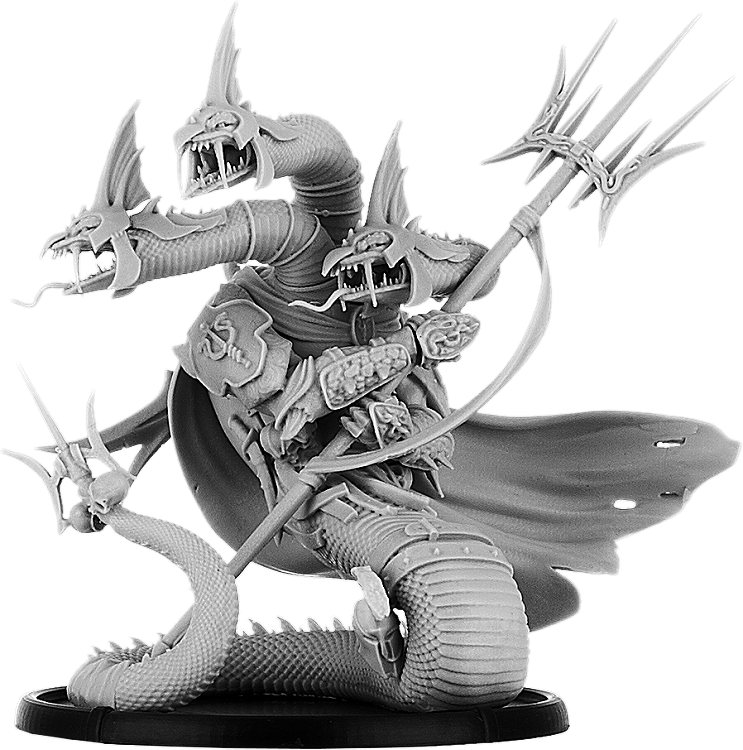
Thoth, Anax of ÝDron

What the fuck is an Anax?*

Nevermind. This is me talking about this mini and why I like it;


It's by Mierce Miniatures and you can find it here.

Big image here.

As you can see from its page, the concept is by Robert Lane and Tim Fisher.

Artist Beth Hughes.

Sculptor Oliver Nkweti

Painter Sebastian Picque. (But I don't think we can see a painted version yet.


GENERAL SHAPE

Gonna call this the wave hydra because the whole thing is like a tsunami of movement.

The snakebody is a classic compressed 'S' shape. This brings in feelings of power and dynamism.

The wave of the cloak is arranged so that the line of the staff strikes directly across it, the fluid shape leading your eye one way then a strong interrupting line.

The straight line of the trident actually has a leather band or strap with a bow of fabric. The straps break up the line of the staff and highlight its length and the hanging bow of fabric is yet another curve opposed to the staff.

There's like a ray of spikes haloing the model from left to right from the tail-trident to the helmets of the three heads to the held trident of the weapon.

The rule of three gets repeated three times across these spikes. Three spikes on the trident, three heads and another trident, (this one actually has five, or even seven spikes but three are larger and more dominant.)

So the mini goes:

- 'S' curve snakebody
- 'Wave' curve cloak
- '/' strikethrough staff
- ')' bracketed strap
- '^^^ ^^^ ^^^' halo of spikes rising and falling from left to right

You sense this all at once. Cuve-wave-strike-loop-and-spikes-haloing-everything.

None of these alone are super-original effects for a war-mini, but their collection and arrangement here is powerful and bold, I think, and they unify and react with each other very well.


DETAILS AND 'STUFF'

Counting from the tail of the mini to its head, here are all the individual 'things' or artifacts I could see.

  • Tail-trident spike.
  • SKULLS.
  • Possible lower-tail-covering.
  • Leather belts.
  • HELMET.
  • Armour of some kind with leather pleats.
  • Wave-shaped dagger in sheath.
  • The trident itself has serpents embossed or etched on it at its head.
  • Shoulder caduceus/trident symbol.
  • Artificial lizard scaled embossed on the forearm guards.
  • Symbols or figures on the hand guards, possible snake-around-staff again.
  • Its there again in the cloak clasp, you can just see it under the heads
  • The cloak itself,
  • Necklaces or neck-bands, thongs or torcs with visible fastenings. Three or four on each neck. 
  • The helmets, with neck segments to allow the presumably sinuous movements of the snakelike form.

The helmets spikes are a little like crests and a little like waves, or sails. The waves return us to the sublimated sea-theme in the figure, never explicitly stated in its form. 

The crests remind us of the lizard-like nature of the creature, but are also versions of the crests we might find on Greek or roman helmets, and are also like the kind of ritually-reproduced bodyform that humans put on armour, except this is for lizards. 

People put enhanced versions of their human musculature on breastplates, or enhanced humanoid faces of the front of helmets. By doing this they take symbols of strength, vividness and selfhood and reproduce them on the outside, isolating and projecting the energy. A real-life lizard person might have head crests that present in times of threat and the crests of the helmets could be enhanced versions of that in the same way the muscly-torso breastplate might be for a human being. The super-scales on the forearm guard might do the same kind of thing.

The line of the alien flesh is continually being broken up by lines and straps. Could these be 'kinetic greebles', marks across a moving flexing surface made to draw the eye to the nature of its movement so that is can be more explicitly registered?

(I would have maybe put a scroll on.)


SKULLS

Ah skulls. The old 40k classic.

Uses of skulls in minis:

- Demonstrates both martial potency of character and also savagery, savages keep skull trophies, civilised people just kill and leave the bodies.

- Illustrates scale of model even with no other model nearby. We know how big our skull is, when we see one on a mini perhaps we imagine it as ours and thereby contrast the size of the mini without own size in a subconscious way.

- Skull is a beautiful object in itself.

- Symbol of death or deadness perhaps increases liveliness or livingness of mini in a point/counterpoint way. Like, this piece of plastic simulating a living thing with frozen movement, seems more alive when there are tiny symbols of death included in it. Death being the shadow to life. A shadow cradles mass so the stillness of the skull highlights movement and expressiveness. 

- Brings symbols of enemy factions into mini in another point / counterpoint manner to highlight cultural 'selfness' of model. This is more true of helmets really, which are a kind of skull-shell, with more boldly expressed cultural information than a skull. Skulls symbolise humanity in general, the empty helmet expresses a particular culture. So a little piece of the 'enemy' culture on this model makes you feel its 'home' culture more fully.


AS A CHARACTER

The Whole model is a snake around a staff, a Caduceus, and versions of this symbol are repeated again and again on its armour. The Caduceus was the symbol of Hermes, Hermes may derive from, and has often been re-combined with, Thoth. The name of the character is Thoth. So there you go.

This is a monster, but also a person. Animalistic and human-culture aspects are arranged in a dissonant but interesting pattern. 

This is presented the opposite way to a standard futurist sci-fi/fantasy mini. In those the face and shape presents human-level information, story and character information, and the strange weaponry suggests inhuman or more physical information. Like, the space marine Sergent's face is a human face but his weapons are much more inhuman.

But with this guy, his (her?) face is deeply inhuman. The personality-based information is in the objects attached and the story they infer. And the most person-like part is the way she is holding the trident, the cluster of shapes around the hands and staff making another yin-yang sign right under the heads. That looks like something a person does.

The heads themselves are disturbing and monstrous with no capacity for human emotional information. So there is dissonance. The story information , the information that says 'this is a person in a  particular set of circumstances' is not where we would expect it to be so you 'read' the sculpture in an unexpected way, yet one that ultimately resolves as it should, with you knowing all the kinds of things you feel you should know.


WHY I LIKE THIS KIND OF THING

I think maybe I take pleasure in the extremely wide range of information drawn from, of so many different kinds. Shape. Detail. Character. Use. All meshing together in ways it never could in a naturalistic sculpture, because the range of information wold be limited, or in a more abstract sculpture, because the social and human-level stuff like the 'story' and the Greek helmets and the use wouldn't be the same. I like my art to bring its world with it into mine, sometimes at least.

The machismo perhaps. I'm generally an easier sell for a mini that's about to fuck something up and looks like it could kill me. Maybe I want to own things that could kill me in miniature form?


WHAT I'D LIKE TO KNOW MORE ABOUT

Details of the design process, right from the first idea all the way to creation. There are five people mentioned above and they all interacted to produce this.
 
All the stuff you will be familiar with from my previous posts about how design and an imagined race and faction and world combine. Stuff about how it matches or meshes with the rules. How the design brief was given. Did anything change during the creation process. How was it manufactured and how do the tolerances and requirements of the mass production process impact the aesthetic effect. All the usual stuff.


(* I looked it up.)


Wednesday, 15 April 2015

No-oooooonne WRITES like Gaston, douses LIGHTS like Gaston

I just don't like Gaston Bachelard.


I'd go into it but even I don't fully understand my reasons for not liking him. Frenchness. Psychoanalysis. Flowery fucking writing style. Philosophy. World-view. Assumptions. Everything.

I owe him a bit more than that because he's pretty good. I was wondering if he was a Deepak Chopra and I don't think he is. Much. And my differences with his way of seeing the world are subtle and deep enough that I should make some concerted effort to untangle them.

But I can't be bothered so I just put quotes from him underneath pictures of Gaston from Disney's. Beauty And The Beast. Great movie.

Here are all the D&Dable fragments from pretty much one chapter of Bachelards The Psychoanalysis of Fire. Almost all of these are fragments of quasi-scientific thinking which he summons up to 'smilingly reduce' as he would put it. They are all from various thinkers from the middle ages to around the enlightenment, all trying to work out what fire is and how it works. I think I like all of them more than I like Bachelard.


To start with, everything must be called into question: sensation,
common sense, usage however constant, even entomology,
for words, which are made for singing and enchanting, rarely make
 contact with thought. Far from marveling at the object,
objective thought must treat it ironically.

"The element of fire is born from a specific germ. Thus, like any power which engenders, fire can be stricken with sterility as soon as it reaches a certain end. If fire is left to live its natural life, even if it be fed, it grows old and dies like the plants and animals."

1. Fire has an age. Each specific fire has an age. Fire elementals have an age and no matter how big they get they will die when they get old. A gaming world in which fire does not infinitely renew with fuel would be an interesting one.


"Each thunderbolt could well be the effect of a new production of igneous beings, which, increasing rapidly in size, because of the abundance of vapours which feed them, are collected by the winds and carried back and forth through the middle regions of the atmosphere. The many new volcanoes in America, the new eruptions of the old craters, also give proof of the productiveness of the subterranean fires."

2. Igneous beings whose birth brings thunderbolts. Carried back and forth in the middle reaches of the sky.


"Hooke, having struck a flint over a sheet of paper and having examined with a good microscope the spots where the sparks had fallen, which were marked by little black spikes, observed there some round and shiny atoms, although the naked eye could see nothing.. they were little shiny worms."

"At the slightest incident, the ants can be seen swarming tumultuously out of their underground dwelling, similarly, at the slightest shock to the piece of phosphorous, the igneous animalculae can be seen to collect and come forth with a luminous appearance."

3. Fire is a microscopic living thing. A kind of burning microbe, or very tiny insect. An animal, and can be understood and influenced as such.


"To explain the seven colours of the spectrum Robinet does not hesitate to propose "seven ages or periods in the life of the igneous animalcular ... these animals, in passing through the prism, will each be obliged to suffer refraction according to its own strength and age and thus each will bear its own colour."

4. Light is a microscopic living thing. Red light is old light. Old light gets tired and slow, stays behind after sunsets. Young light is bluer. Light dimming is light getting tired. perhaps darkness is light sleeping, or dying.


Everyone must learn to escape from the rigidity of the mental
habits formed by contact with familiar experiences. Everyone
must destroy even more carefully than his phobias, his
"philias", his complacent acceptance of first intuitions.

"Fabre does not think it impossible that through proper food, conductive to building up a hot and dry constitution, the feeble heat of females may become so strong that it may be enabled to thrust outwards the parts which its weakness has kept back within. For 'women are men in a latent state because they have the male elements hidden within them.'"

5. Woman are men in a latent state. By feeding them the right things you can gradually covert women to men. Certain spices are useful for this. Perhaps by cooling men enough you can convert them back to women.


"Like any  form of wealth, fire is dreamed of in its concentrated form. The dreamer wishes to enclose it in a small space the better to guard it."

6. A dream of fire is a dream of wealth. To possess wealth is to dream of fire. Thieves steal the fire from your dream. If someone takes the fire in your dream, wake up quickly because someone is taking your wealth.


In order that we may indicate clearly the resistance offered by
the deeply hidden unconscious values, we shall give some examples
 in which this resistance is so weak that the reader can smilingly
 make the reduction himself
 without our having to call attention to the obvious errors.  

"Three sorts of fire, the natural, the innatural and the unnatural. The natural is the masculine fire, the principal agent; but in order to obtain it the artist must take great pains and use all his knowledge; for it is so torpid and so strongly concentrated within metals that it cannot be set into action without persistent effort. The 'in-natural' fire is the feminine fire and the universal dissolvent, nourishing bodies and covering with its wings the nudity of nature. It is no less difficult to obtain than the natural fire. The feminine fire appears in the form of a white smoke, and it often happens that in this form it may disappear because of the negligence of the artists. It is almost impalpable, although through physical sublimation, it appears to be corporeal and resplendent. The unnatural fire is that which corrupts the chemical compound and which first has the power of dissolving that which nature had strongly joined together."

7. Fire has three genders. The male, found in metals and released in forges. The nourishing female in the form of white smoke. The third 'unnatural' gender which dissolves things nature has bound. (And clearly does most of the work.)


"And thus we have the intuition of Rodin, quoted without comment by Max Sheckr, doubtless because he failed to see its clearly primitive character "Each thing is merely the limit of the flame to which it owes its existence."

8. Each thing is merely the limit of the flame to which it owes its existence.  


A psychoanalysis of objective knowledge must constantly
denounce this claim to inner depth and richness.

"D'Annunzio portrays Stelio who, in the glass works, is contemplating in the annealing oven:

The extension of the smelting oven, the shining vases, still slaves of the fire, still under its power... later the beautiful frail creatures would abandon their father, would detach themselves from him forever; they would grow cold, become cold gems, would lead their new life in the world, enter the service of pleasure-seeking men, encounter dangers, follow the variations in light, receive the cut flower or the intoxicating drink."

9. Glass is a kind of concubine and former slave of fire. Or a daughter, perhaps with some old loyalties and resentments in its new privileged, yet dangerous role. Glass speaks to fire, or perhaps refuses to speak.


Almost always a case of incendiarism in the country is the sign
of  the diseased mind of some shepherd. Like bearers of sinister torches,
these men of low degree transmit from age to age the contagion of their lonely dreams.

"The elements of fire are everywhere; they are found in gold, which is the most solid of all known bodies, and in the vacuum of Torricelli."

10. Fire is within metals. Not applied to them. Clearly this is the 'masculine' fire spoken of above. Fire is the dominant element, sustaining all things. Whether its true or not you can bet Fire Elementals believe it is.


"The Egyptians said that it was a ravening insatiable animal which devours everything that experiences birth and growth; and after it has eaten well and gorged itself, it finally devours itself when there is nothing left to eat and feast upon; because, having both heat and movement, it cannot do without food and the air it requires to breathe."

11. A literal animal of Fire that literally Eats itself. But only when everything else that can be consumed has been. Some kind of Godzilla of fire maybe. 


12. "The Persians, when they made sacrifices to fire, would present food to it on the alter while uttering the phrase... 'eat, and feast of Fire. Lord of all the world.'


We would like to be able to concentrate all
chemical action into a handful of gunpowder,
all hatred into one swift poison,
an immense and unutterable love into a humble gift. 

Thus one of the most common notions in the cosmologies of the Middle Ages and if the prescientific period is that of food for the stars. These exhalations feed the comets. The comets feed the sun...  Thus Robinet writes in 1766:

"It has been stated with a good deal of probability that the luminous globes feed on the exhalations that they draw from the opaque globes, and that the natural food of the latter is the flood of igneous particle that the former are continually sending to them; and that the spots of the sun which seem to spread and darken every day are nothing but an accumulation of crude vapours of expanding volume that the sun attracts unto itself ; that these clouds of smoke that we think we see rising from its surface are really rushing towards the surface; and that in the end it will absorb such a quantity of heterogeneous material that it will not only be enveloped  and encrusted by it, as Descartes claimed, but will be totally penetrated by it. When this happens it will be extinguished, it will die, so to speak, by passing from the state of light, which is its life, to the state of opacity, which we may call a true death when speaking of the sun. In a similar fashion the leech dies when it has slaked its thirst for blood."

13. The Sun is feeding on the earth and one day it will become full and go out.

..among eighteenth century thinkers that "all the stars are created from one and the same celestial substance of subtle fire." They consider that a fundamental analogy exists between the stars formed of rarefied celestial fire and the metallic sulphurs formed of crude terrestrial fire. they believe they have thereby united the phenomena of earth and sky and have obtained a universal view of the world.

14. The Sun is a kind of complex metallic substance. Lesser forms of it can be found on earth. They will have some of the powers of the Sun.


If one has not had a personal experience of this hot sugared alcohol
 that has been born of flame at some joyful midnight festivity,
one has little understanding of the romantic value of  punch;
one is deprived of a diagnostic method of studying certain phantasmagorical poems.

"In the same story when the witchcraft, which was to have brought back the student Anselme to the poor Veronica, is completed, there is nothing left "but a light flame rising from the spirits of wine which burnt in the bottom of the cauldron." Later in the story the salamander, Lindhorst, goes in and out of the bowl of punch; the flames in turn absorb him and reveal him. The battle between the witch and the salamander is a battle of flames; the snakes come out of the tureen filled with punch. Madness and intoxication, reason and enjoyment are constantly presented in combination. From time to time there appears in the stories a worthy bourgeois who would like to "understand""

15. Ok this ones just a straight up encounter.


We are never completely immune to the prejudice
that we spend a great deal of time attacking.

"It is especially within the oils,the bitumen's, the gums, the resins that God has locked up fire, as if in so many boxes capable of containing it."

16. Fire is in the gums. It was put there by god. Presumably people will be upset about you letting it out. Others will insist that you do.


"It is reported that mulberries will be fairer, and the trees more fruitful, if you bore the trunk of the tree through in several places, and thrust into the places bored wedges of some hot trees, as turpentine, mastic-tree, guiacum, juniper etc. The cause may be for that attentive heat doth cheer up the native juice of the tree."

17. Tree alterations. This ones just quite quiet and sweet. But wealthy horticulturalists would presumably pay very well for fragments of strange or rare trees. And who knows what freaky shit they might splice together once they got them.


18. "The branches of that tree which antiquity dedicated to the Sun in order to crown all the conquerors of the Earth, (Laurels) when shaken together give out fire, as do the bones of lions."


"To describe the fire of nitric acid (or aqua fortis), Trevisian says that its hidden fire is "subtle, vaporous, digesting, continual, encompassing, airy, clear and pure, confined, non-flowing, corrupting, penetrating and sharp." Obviously these adjective are not describing an object, they are revealing a feeling, probably an urge to destroy."

19. Acid actively wants to burn you. No-one should be surprised by the malicious nature of acids.


"...the big tall men are humid and mercurial; shrewdness, made up of wisdom and prudence, is never at its highest degree in these men; for the fire from whence come wisdom and prudence is never vigerous in such large and vast bodies, since it is wandering and diffused; and nothing in nature that is scattered and diffused is ever strong and powerful. Force needs to be compact and compressed; the strength of fire is seen to be all the stronger when it is compressed and contracted. Cannons demonstrate this fact...

20. As with cannons. So with men.

Saturday, 11 April 2015

Not A Review Of Michael Crichton's 'Prey'

In Spain my Dad gave me a Micheal Crichton book called 'PREY -


(To be Human.. is to be Hunted.) I started reading in the airport while we were waiting for a plane home.

We were half way through the flight when my girlfriend remarked that I was 200+ pages through the book. She was reading Nabokov and was (I think) about 40 pages into it.

I said 'yeah but its Micheal Crichton so its designed to be easy to read'.

Which is interesting.

In his writing style, almost no idea or action is implicit. Every single thing that the narrator says or does has a clear and explicit structure of thought and experience behind it.

This is most obvious when talking about the technological mystery in the book. The narrator has to solve a difficult problem in adventurous circumstances. To do this he has a number of directly technical conversations with work colleagues.

The presence of these conversations in a book is a kind of cultural marker for the kind of book it is. Like, someone going into work, speaking to a co-worker and saying: "Yes, slot A is wrongly configured. We should to change the shape. What kind of shape do you think is best?"

"Well I think this triangular shape would work well because of the following reasons.."

This is the kind of conversation that takes up a meaningful part of each persons waking life and which are almost unimaginable in a work of modern literature. You can't have people go into work and just talk about work.

You can but it has to have a subtext. "It is good that you have finally learnt the details of baking and are baking good loaves in the following way.."

"Yes the theme of bread was introduced with my relationship to my mother in chapter one and after the failure of my advertising company and return to my home town my mastery of the baking process  became symbolic of my personal re-growth based on a new sense of selfhood gathered from my re-integration with my family history."

"Yes this bread has several meanings to it and therefore all that talk about yeast in chapter three is now validated as having a meaningful artistic reason and not just nerdy bullshit about baking."

"Yes."

(Or you can probably do it when its a Zadie Smith thing and its like "So Harvard Colleague, I hear your field of study in **human-culture-subject-A** has thrown up some radical yet topical opinions."

"Yes, Oxford Colleague, let us discuss this field of study in depth for it mirrors YET ALSO COMMENTS UPON cultural shifts in the wider world.)


So people talk-about-the-problem in a very talk-about-the-problem way. The way you might at work with a new colleague, or with someone with whom you do not share a first language, in a slightly over-clear over-emphasised manner.

"Due to your background in developing parallel processing you will understand the nature of this programming challenge."

"Yes I do, and will re-describe it in my internal narrator voice with a brief reference to the history of the topic."


The book is in first person, but when secondary characters walk off screen and do something important to the plot the narrator will confirm their exact actions, either by talking to them in the story and saying something like "what were your actions?" or by commenting he has 'reviewed the tapes' or 'talked to her after the event'.


(People lie in the book, but its rare that they lie and the narrator does not get a 'funny feeling'. I think they never lie without the narrator being suspicious of them already or being made suspicious of them by the lie. A lie exists to be found. Like a trap in D&D in part exists to be found. A trap in a dungeon that you can never find, intuit, predict or understand is a bad trap. It has no story potential.

Old-school games push this pretty far towards the traps being very hard to find but still you can always possibly find the trap. I have never read the phrase "this trap is undetectable" in a module or adventure.

So the discontinuity in the system, the trap in the dungeon, the lie in the Micheal Crichton story, is not truly what it is. It is an inverted symbol of a thing. In real life we lie to get away with things and set traps to be invisible to the target but in stories and games often the failure of this trap or lie is the reason it is in the fiction.)

This armature of certainty exists at ever level of the book. Right down to the basic text. Each sentence is a clear description of event with the circumstances locked in.

"It was ten minutes after the swarms had gone and we were all standing in the storage room. The whole group had gathered there, tense and anxious."

"Having watched Julia's demo tape, I was immensely curious to see what he showed me next. Because many people I respected thought molecular manufacturing impossible."

"With the vibration of the helicopter, I must have dozed off for a few minutes. I awoke and yawned, hearing voices in my headphones. They were all men speaking:"

"It was a warm evening and we had dinner in the backyard. I put out the red-checkered tablecloth and grilled the steaks on the barbecue, wearing my chef's apron that said THE CHEF'S WORD IS LAW, and we had a sort of classic American family dinner."

We were all standing in the storage room - the whole group
I was immensely curious - because people I respected
helicopter - headphones - voices - men speaking
the voices were men, speaking
warm evening - backyard dinner - grilled steaks - chefs apron - classic American family dinner
It was a classic American family dinner.

State-restate
Describe-confirm-clarify
This-is-actually-happening
This-is-how-it-would-be-how-it-was
There-is-nothing-to-worry-in-the-nature-of-this-writing-because-you-can-clearly-see-everything-that-is-happening-and-then-I-will-tell-you-that-it-is-happening

The cognitive load of most Micheal Crichton sentences are almost exactly the same. Everything is what it is. It runs through your mind like smooth directly-stated ticker tape. That's why you can read it almost five times faster than Nabokov. It's designed to be read that way. To be clear.

This extreme clarity and directness is exactly the kind of thing you are not necessarily meant to do in Art. In Art each sentence and paragraph would have an individual cognitive load and the subtlety of that load is part of how we judge its quality.

A while ago on G+ there was a conversation about art and popular culture and I came up with an idea that I think was something like this:

Some people draw joy, pleasure, from the closeness, interconnectedness and familiarity of their ideas. Therefore, for them, a family drama in the present day is an ideal form of entertainment as all the ideas are directly relateable. They have a strong background of knowledge about families and therefore can energise the work more powerfully as they can increase the interconnections between ideas. It's literally more powerful for them, like a different thing is happening in their brain when they read. Beauty is different for them.

Others draw more power from the distance between ideas and the tenuousness of the connection between them. So the further apart two concepts are, (and I mean here across every aspect of the created thing from general themes to stylistic tricks to detail and observation, everything) but the further apart they are, the greater the charge when they are meaningfully connected. So to push an idea further is always good.

I imagine these two states of being as, on one side, a closely interconnected Archipelago, with everyone trading and making and conversing and swapping cultures, then on the other, some distant exploration-obsessed island, sending out single ships on wild expeditions to unknown lands and cold seas, waiting years for each message or report to return, each report being stranger than the last.

Or like a closely interconnected interplanetary civilisation, a knot of lights around a star, verses an world obsessed with interstellar exploration, sending out long range cryo-ships on eons-long expeditions.

I think that part of what Micheal Crichton is doing with his fiction is building this very-certain, very-explicit ladder or web of association, so that when we reach the strange bit at the end, the hard to believe bit, there is a relentlessly clear sequence of actions and discussions which make every single thing explicitly possible.

Like, you could stand up in court and argue the events of a Micheal Crichton book with the description of the Micheal Crichton book. Everything backs everything else up.

I like this.

It robs me of nothing, and its an interpretation of something I love (weird nanite hive minds, secret labs, nerds solving impossible problems) written explicitly for people who are not minded like I am. The people who would read about the nanites and get nervous, or feel like they were lost, people for whom there would be no pleasurable release of cognitive energy, have that solid banister or safety rail of clear description there for them. Everything can be explained, everything leads neatly to everything else.


This isn't about intelligence.

You are all skilled at reading. You probably got rewarded for it at school. Not only are you skilled at it but you are good enough at it that you can easily draw pleasure from it. The difficulty of normal writing, like this blog post, is not hard enough for it to be meaningful. It's like walking for you.

And you probably work in a nerd industry or in one of the culture fields where reading and comprehension ability is essentially like fitness for an athlete. You just have to have it and to have it at a high level to be in that industry or to do that job. You probably aren't fully aware that reading is a high level skill for you, any more than someone who went straight from school to athletics in college then to a professional sports team is fully aware that a high standard of fitness defines almost their entire social group. You know it but you don't feel it because that's just your world.

I've had a bunch of jobs and most have been shit. many have been hard. Sometimes they were hard like being punched in the face is hard but sometimes they were hard like a maths puzzle is hard.

I wasn't very good at most of those jobs. Its rare that I wasn't the most well-read person on the team. Where an aspect of the job was intellectually difficult (judging someones credit score against their payment history and inferred social background, assessing a claim for tens of thousands of pounds in charges against a chain of ten or more interacting accounts across 15 years and responding in a multi-page letter with interlocking calculations with 100% not-a-comma-wrong accuracy) I was rarely the best at it. I was usually in the middle of the field.

It's interesting to be clearly and obviously out-performed at something intellectually complex by a very pleasant person who thinks Dan Brown is 'a cracking read'. Its interesting for it to happen multiple times. I kind of suspect it isn't something that happens much to most people reading this. We get sorted in school into the social groups we will spend time with, the 'good readers' make lives, find careers and spend time with the good readers. The only time they bump into the non-good-readers after that is usually around an inter-departmental meeting in work, or at weddings.

So I suppose I got a decent education in not confusing reading level with moral decency, problem solving ability, data processing, social awareness, group management, accuracy or mathematical fluency, which are all qualities the workplace gives a lot more of a shit about than reading ability. (Except for moral decency, which is more of a liability in business really.)

When I say that Micheal Crichton or Dan Brown are writing with deliberate and continually re-stated clarity, that they are writing for people with (compared to me) poor reading skills, I don't consider it anything like an insult because I've met these people and seen them be better than me at a whole bunch of stuff.

So the presence of fiction like this on the best seller lists means a very different thing to me than it does to someone who has spend their entire life exposed mainly or entirely to a high-reading-level social circle. For them, reading level and reading fluency is a primary shibboleth, status symbol and illustration of personal and cultural competence. Its a world where to say that someone has read and enjoyed the wrong book is literally to degrade them. For them, seeing bad fiction on a popular list is like bumping into a crowd of people who proudly state that they fuck pigs.

For me it just means normal people are reading books. I'm glad they are. It's like a semi-professional footballer watching a bunch of people kick the ball around on a Sunday in the park. I don't feel like their poor football skills are bringing down the quality of my game because for these people, the choice isn't between reading Crichton and Nabokov but between Crichton and Television. I'm glad they got out of the house.

I'll be sad when there are no simple writers on the best seller lists because it won't mean that the general public has been uplifted to the UberSphere of Artistic Reading. It will just mean they have stopped entirely. Fiction will undergo a general rise in relative quality, shrink in audience, lose raw creative drive, and become a kind of boutique pursuit for members of the upper middle class.

Friday, 3 April 2015

SLOW HEROES

Matthew Adams made this wonderful picture and I liked it so much I made Wonderful Knights to go with it.


Many are the tales of the Knights Of The Snail, their Slow Quests and Fates-Delayed, (for fate comes not quickly to a Snail-Knight, and that by strange and turning paths).

Oft deluded, always honourable (except for Sir Gorget Vile), endlessly turning in their slow spiralling search. For it is said that a Snail Knight will always start their quest as far from its object as can be, and may never approach it head-on, but only by paths oblique, yet growing slowly closer all the time. And it is said that they will always find the centre of their search, no matter how weird and distant it is. Great is the courage of the Snail-Chevallier, great their legends, great the names of those who sit around the Table-Whorled and nobly serve the Cochlear Throne.


Their Names:

1. Sir Rime Grotesque.
2. Sir Tumble-The-Tin Perchance.
3. Sir Bird Spiralling.
4. Sir Chesslike Hand.
5. Sir Babbling of Bromborough.
6. Sir Bedlam Frail of the Frail-Hearts.
7. Sir Twine Devise.
8. Sir Vortex Frail of the Frail-Hearts-Urge.
9. Sir Duno Chrime.
10. Squire Violet Chrime . (In truth, Lady Pendulum Chrime in disguise as a man).
11. Sir Furnace of Furness.
12. Sir Max Bassoon.
13. Sir Tangling Chase.
14. Sir Whirl, of Whirl-End!
15. Sir Latinate Verb-Cortex, of the Curve-Cortex. (In truth, Ham Floret, commoner in disguise).
16. Sir Lightly Gloom.
17. Sir Gorget Vile. (The Black Snail Knight)
18. Sir Lucent Void, of the Kensington-Voids.
19. Sir Sextant Wrought, the Permanently Lost.
20. Sir Coagulate Fast, the Knight of the Mind.


Many are the quests of the Snail Knights and many strange things are the objects of their Slow Oaths (or 'Sloaths' as a Snail Knight might say: "by my Sloath!)

Their Sloaths, or, what they seek:

1. The Bubbles Of Despair.
2. The Gambolling Brand, or 'Sword Of Springs Shade'. a blade which can restore the lost season which once lay between Summer and Spring.
3. To defeat the Knight Chromatic, who holds the Night Sky Black, and thereby restore it to its multicoloured state.
4. To find the 5th corner of the world.
5. To battle the Vowels and free the hidden consonant from its imprisonment behind the tongue. (A, E, I, O and U must be fought, and perhaps as well the traitor 'Y'.)
6. To win the Tears of Time and undo death for lovers everywhere.
7. To Wake the Lady Sorrow from her Sad Slow Dream and thereby mend all hearts.
8. To Prise the Virtuous Pine!
9. To Unknot the Seven Stygial Riddles of the Leviathan Mind.
10. To seek and serve the Princely Soul, hidden somewhere in a Goat.


The arms of the Knights Of The Snail are well renowned.

Their Arms:

1. The Lance-Curlicue, which, on striking true, corkscrews around its target, wrapping them securely in a spiral of steel.

2. The Shield of Ooms, whose bearer shall know neither fear, despair, despite, nor direction or discontent, who shall never know where they are going, yet always arrive, who can be neither lost nor found.

3. The Briar-Braddock Blade, which, when plunged point first into the earth, brings forth an acre of inconvenient dense bushland.

4. The Salt-Shaker Mace (curse'd tool of Gorget Vile), which casts about it a terrible withering with each blow, turning the grass to ash, the trees to sandpaper and shrivelling the feet of snails.

5. The Sabre Noit-Seuq the querying wield, those wounded by this sabre-weird must answer well or it shall rebound upon them with redoubling force.

6. Snickety-Limb, the famed Paraplegia Sword which grows deadlier the more limbs its target has, destined to be swallowed by a snake.

7. The Armour-Incomprehensible, emblazoned with unreadable words that paralyze the mind when seen.

8. The Iron Bream. A mace in the shape of a gigantic fish, wielded by its tail, it hangs limply yet strikes with incomprehensible force, as if the weight of many maces struck at once.

9. The Bow Geometrical, which fires at right-angles or curves round corners, yet which never makes and irregular line.

10. The Helm Of Dreams, whose wearer shares the dreams of whomever means them harm.


And famous also are the terrible delusions of the Knights Of Snails, for all of them are mad mad mad.

The Madness of this Knight:

1. Made of Glass.
2. Adores the Moon.
3. Big things are Small and Small ones Huge.
4. Can never speak the truth or entirely lie.
5. Believes Their Own Reflection Is the King.
6. Does not comprehend the difference between a depiction of a thing or the thing itself, believes self trapped inside a world of shifting visions.
7. Communicates in song and thinks the things in songs are always real reports.
8. Fears life not death, melancholic when safe, cheery when the chips are down.
9. Feverishly writes conspiratorial letters describing secret fears, abandons them in holes and the crooks of trees, fears then banished, but may return if the letters are retrieved.
10. Believes they are an aging scholar only pretending as a Knight.

This one is also good