Showing posts with label clearly not even about RPG's. Show all posts

Wednesday, 17 May 2023

The Gravity of Cows

Over many a volume of forgotten Lore, through many an hour of Netflix and Disney dreck and many a meltdown over whatever Games Workshop is doing this week, I have pondered the interlacement of the Paracosm, the Corporation, and Autism.

Lets say instead, - 'autistic traits' or 'light autistic spectrum traits'. Strongly Autistic individuals have a very hard time and don't get to do much. Those of us with autistic traits, of whom there are many more, well we have quite a strong effect on, and relationship with, popular culture.

You might even say that we are the collective gravitational force of Genre-based popular fiction.


Part One - Evolution of the Paracosm


But first the Paracosm, the alternate world! Its primordial precursors; most religions, imagined tales of distant lands, stories of a legendary past, 

Then more recently; the philosophical disquisition given concrete form; what if there was an island where this or that happened? Or a country that was ruled this or that way? Lets imagine it in detail, not just the parts relative to the argument but the whole thing. a republic, a Utopia, a perfect king a most awful tyranny.

Then; what if we just imagined such a place but there was no (direct) political argument to it? Or at least, it did not primarily rest on such an argument. This is not, legend, history, argument or scripture, it is directly stated fancy, a fiction. A creation of the imagination, and called so,
but described as if it were a real place.

Then; when does it become a full Paracosm? When it is shared between multiple people? If so then the earliest I can think of is Glassland, the imaginary world cooked up by the Brontes. 

There must be a deep forgotten history of the Paracosm because it emerges so naturally from the play of children in friendship groups and families.

E.R. Eddison, writer of The Worm Ouroboros had one with his own brother I think, which is where many of his stories were set. The serial scientific and fantastic fictions of the late 19th and early 20th century were Paracosm, but owned by their author, and usually made purely as a vector for stories, the linked stories by various authors in 'Strange Tales' in particular

The vast, many-peopled Paracosm as we understand it I think really took root in the 70s and is closely related to D&D and corporate ownership.


Part Two - Corporate Power


for a Paracosm to be projected across a vast range of people, and for those people to be able to interact in a regular and systemic way with it, and for those systems to be unified and universally communicated, requires industrial production, complex communication and organisation.

A substantially large organisation must do this. Something bigger than just a small business, and for a substantially large organisation to do this there must be a substantially large reward. At minimum enough to pay for the industrial reproduction, communication and organisation. So the beast becomes something that feeds upon itself. The more industrial reproduction and systemisation spread the Paracosm, the more people interact with it, which feeds back into greater profits, which can go into more industrial production.

But more. As we consider the Paracosm though time, (and the most active ones have not been active that long), like land, if you want it to remain coherent, that is; stable in use and nature, then it must have an owner of singular identity, but one much longer lived than any individual person.

Historically the owners of land have been; an aristocratic family, the Church, a religious order, the King etc.

To which we may now add the corporation. The aristocratic houses of our modern day, and the Paracosm a virtual barony, which, like a stretch of agricultural land, can be conserved, developed, sold off, reduced to ruination and treated in many ways as a real place.

Now the Corporation, a 'virtual' aristocratic house, has its own virtual kingdom, a place sustained and made real by the interest and investment in it.

Something happened in the late 60's and 70s. Something to do with the growth of genre, the power of information technology and industrial production, free time for nerds and corporate interlacement with the imagination.

The 60's - Star Trek, Tolkeins major growth. Marvel and DC get a boost here and are re-integrated as Paracosms though they have been running for a while.

The 70s - Star Wars, Dungeons and Dragons

The 80's - the Warhammers 

So we have a synthesis; the Paracosm, an imagined barony, and the Corporation, an imagined and potentially immortal individual. The Corporation can own a Paracosm ... forever perhaps, and can theoretically maintain a profit on it forever, and it is that profit that allows the Paracosm to keep developing. The corporation is not an author, it has no single use in mind for the Paracosm
but far from it, desires as many uses as possible across as many systems of production as possible. 


Part Three - Autistic Traits


The interest in a Paracosm is not the same as the interest in an individual book or film but is renewed and remade through books, films, comics, television, animation, games, toys, models, props, bought costumes, embodied in acts of shared social play and through gatherings. All of these methods united by their shared love for and expression of, a place, or a reality, which is not real, yet is still shared and experienced by a great many people.

  • DEPTH of interest.
  • love of DETAIL.
  • Love of OBJECTS.
  • SYSTEMISATION of shared communion.
  • DISCUSSION and ARGUMENT over details.

And chief and ruler of these passions, desire to be POSESSED BY THE IMAGINED WORLD

None of these are necessarily the product of light autistic traits, but as a whole they synthesise with those traits, and with the pressures and coping strategies they produce, perfectly.

And from hence comes the great and terrible danger and most subtle trap of the Paracosm, the need to MILK THE COWS, for the cows are we.


Four - The Milking Process


Those who are drawn to the Paracosm tend to have autistic traits and of those who are drawn, there is something of a curve.

Cows.
Cows is what we are.

But imagine you owned a field of cows, and some cows you could only milk once a day, or even once a week, and you had to go and round them up to do it.

But there were other cows, a minority, who you could milk twice a day, three times a day, more. And you don't have to go round them up. Instead they come to you, constantly, and in fact they get quite violent if you refuse to milk them.

So originally you start out with a Dairy Farm, as we would understand it, but what you end up with is quite different. It’s a milk factory . Which, yes a Dairy Farm is a milk factory. The difference is in the proportion of attention and resources you give to each part.

By the end, the factory is the main thing and you have forgotten you even had fields. There are fields out there sure, the cows live there, but most of your time is taken up with the very productive cows
and even more with those small minority of hyper-productive cows.

Really, as accounting goes, and as your milking operation improves, becoming more and more efficient, your fields decay, and this is inevitable.

Hence the life-cycle of the Paracosm


Five - The Natural Life-Cycle Of The Paracosm


Now, we don't know a lot of this for certain. The Paracosm that most neatly fit our definition have only been going since the 30s , so even the oldest are less than a century old, nor can we guess how they will respond to copyright laws which usually max out after about 100 years, but within that time period we can see a continual process, a pulse of growth and die-back.

Following the cows.
Always follow the cows.

............

(It’s beyond curious to me that after Marvel and DC essentially bricked themselves into the Comic Book stores, to milk the cows of course, and maybe 40 years later, Disney/Marvel finds itself doing exactly the same thing, bricking itself back up inside Disney Plus.

It costs less outlay, less terrifying risk and the cows come to you.

At the same time Games Workshop attempts its own Streaming Service.

There are echoes here of the Comic Shop but also of Apples 'walled garden', of a lifestyle brand where every widget and thingy integrates with every other whatever, and where you can charge people a LOT, for entrance to that garden because, in Apples case, you are essentially guarding entrance to the globalised middle class.

None of the Paracosm-guardians have managed that yet, and likely nor shall they, (because of the Autistic Traits))

............

I will venture this as a thesis; every corporate-owned Paracosm, (which is to say nearly every major Paracosm), is at any point, somewhere in this long orbit between states.

Its natural arc is to slowly decay into a nightmare milk factory.

Then once that collapses, the milk factory will be razed and the clean open fields of a fresh new farm to be opened (with the ruins still lingering beneath the soil).

Then the whole process will begin again.

At times Paracosm can be pulled back and forth between the poles. Sometimes they can totally collapse and be regenerated, either by being newly acquired or even through 'community action', but they are always somewhere between these two points and defined by the gravitational pull between milking the cows and luring more cows. Those are the tectonic forces of imaginary worlds. The Gravity of Cows.

Tuesday, 14 June 2022

Murder at the Dawn of Time

 
The stories start to vary right from the start but one thing that links them all together is the killing of a brother and their butchering, the spilling out of bones and organs, as an act of creation with which reality was made.

"as the result of the original dismemberment of Yemo: his flesh usually becomes the earth, his hair grass, his bone yields stone, his blood water, his eyes the sun, his mind the moon, his brain the clouds, his breath the wind, and his head the heavens."

Probably you are so familiar with this concept from mythology that you haven't stopped to think about how utterly strange it is. But to go a bit deeper;

You are moving though a void, a placeless place 

"neither non-being was nor being was at that time; there was not the air, nor the heaven beyond it... Neither death was nor the immortal then, nor was there the mark of night and day...". 

You are not alive for nothing has ever lived nor are you dead, for nothing yet has ever l died. Neither are you immortal, like the gods, for there are none.

You simply are. Yet you are not alone for beside you is another. They are blood of your blood. A brother. Often they are the only other thing. (Sometimes there is a third and also a cow, but we will get to that later). Sometimes they are a giant, sometimes an hermaphrodite or multi-gendered being, but the one they they always are is your twin. Their name in fact is 'twin'. Yours is 'Man'.

Amidst this absolute nullity you turn on your twin, your other self, the only other thing there is, and you kill them. Then you cut them open, or since there is nothing to cut with perhaps you tear them open, and you reach into their body, steaming with blood, which is creation, and you butcher them, pulling out organs, bones, blood, tendons, hair, eyes, brain. And you cast or place these things into the nothingness and now instead of nothing there is reality. Earth, sky, sea, air, sun, moon, stars, grass and animals, all of this is built or formed from the flesh of your slain twin. And amongst all this you walk, the first man, who is also the first priest, for you made the first sacrifice and that is the nature of a priest, amidst a reality made from the corpse-flesh of you dead twin.

Of all the world creation myths, this one might be the most insanely fucked up, its also a common root or tributary concept for a bunch of cultures across the Indo-European range. For the Norse the twin was Ymir, father of giants. The Romans likely historicised their own version into Romulus and Remus, and the first romans considered themselves Remans, children of Remus, not of Romulus. In the Vedic and Persian versions the twin is Yemno, another derivative of 'Twin', and becomes the lord of the underworld, first to die and god of the dead. The killer is Manu and yes it does look like we named the species after this one guy.

"The association of Mánu with the ritual of sacrifice is so strong that those who do not sacrifice are named amanuṣāḥ, which means 'not belonging to Mánu', 'unlike Mánu', or 'inhuman'."

I think about how terrible it must be to kill your brother, the only other person who exists, the only person who can truly recognise you, and then to walk through a cosmos made of their sacrificed flesh.

It makes sense if you imagine a herding people where cattle are wealth and the most valuable and immediate source of survival. Cutting open an animal on the empty steppe, its blood steaming in the air while the butcher spreads out the parts on the hide and hands this part and that to this or that kin. Truly life through sacrifice.


Variations;

There is a third guy there, and possibly also a cow. At some point the cow gets stolen and the third guy goes and steals it back. Honestly it sounds better in the original versions.

The ritual cow stealing seems to be a restoration of order motif and the third guy is the first Warrior, with the Cow sometimes symbolising the peasant or 'grower'.

So now we have a traditional proto Indo-Euopean tripartite division of Priests/Warriors/Peasants, or if we are feeling funky, Kings (Yemno was the first king)/Priests/ Warriors/Peasants.

Sometimes 'Twin' is multi-gendered or you both are, or you are somehow the same being; 

"Some scholars have proposed that the primeval being Yemo was depicted as a two-fold hermaphrodite rather than a twin brother of Manu, both forming indeed a pair of complementary beings entwined together. The Germanic names Ymir and Tuisto were understood as twin, bisexual or hermaphrodite, and some myths give a sister to the Vedic Yama, also called Twin and with whom incest is discussed. In this interpretation, the primordial being may have self-sacrificed, or have been divided in two, a male half and a female half, embodying a prototypal separation of the sexes."


WHAT CAN WE DRAW FROM ALL THIS?

Its all quite familiar from mythology, or from the mythology of fantasy. There are probably hundreds of fantasy paracosms which begin with some binary separation between different opposites.

Quite a lot of deep viscerality has been lost and we never get to see this from the first person perspective.


Viscerailty; 

its quite different if you think deeply about what it would actually be like to physically destroy your own twin, your own blood, the only thing that is like you and that can know you as totally as you know them.

And to think about the blood and the guts of the matter. The butchered body cooling on the steppe, everything around you being made of the body of the sacrificed twin. Imagine what it would be like to fully believe that as your cosmic mythology - every time you look at any material thing, you are looking at the flesh of some unknowable corpse, to which you are distantly related. An uncle long removed.

Man is the first Killer and Killing is creation.

and what does it say about a culture that this primal violence lies close to its root, or what does it say about this primal self-destroying, bloody violence and butchery that it can help to form a culture that goes on to influence so much

its a pretty powerful and irresolvable moral maelstrom

The only part of current culture which I'm familiar with which deals with butchery, and especially the sacrifice and butchery of humans, is serial killer fiction 

specifically one of the first things that came to mind was From Hell, the very upsetting scene where we watch Jack the Ripper take the body of his victim apart and lay out the pieces in ritual formation while mumbling and going mad/embarking on an act of ritual magic which allows him to walk though the walls of reality

of course, if all creation is made of sacrifice, then any such sacrifice is an act of sub-creation, and it makes sense that it would act as a kind of spell or prayer - altering or sustaining reality depending on perception


Manu as a Character;

We have a shitload, really an epically insane shitload of Storm Gods, Sky Gods, Sky Fathers and their derivatives, and even more, truly a cornucopia of 'Strikers', the thunderbolt wielding hero who goes around killing monsters, releasing the waters etc.

I don't think I've ever seen a story where the Manu figure, the first Priest and the first Sacrificer, who made the world from the body of 'Twin', is even in the story, let alone the main character. 

What would that story even be like? Or that game?

Being the first Priest in a reality which you essentially part-created with the flesh of your Twin and teaching all these.. descendants? The children of Manu? Made up partly of your seed and partly of the flesh of Yemno, all about the Truth of Sacrifice and how Lord Yama, who takes the souls of the Dead in his place beyond the Canine Guardian and the River, is actually kind of the spirit(?) of your Twin, whose body made Reality and you also small man. 

(I'm still kind of tripping that we didn't change the name of the species in all that time. Must be one of those Querty-Keyboard situations where its just too much bother once you start.)

"Oh yeah say hello to the spirit of my twin on his throne below. You know he's the only reason you can die? He was the first one to do it, which allowed time and stuff to start. I killed him. We are walking on his guts atm actually. Anyway say Hi when you see him."


More Cattle Raids;

Seems like there should be a lot more cattle raiding in both fantasy and gaming. Its absolute bedrock for the Indo-European tradition and has carried over all the way from the steppe to a few centuries ago.

But when have I seen a D&D module or adventure or a computer game, or even a scene in a fantasy novel where "Hey we have to do a cattle raid. Partly to re-enact the core of our ancient creation myth but also just to steal cows." - NEVER. Not once.


More Sacrificing;

Neither have I seen (much) sacrifice in either games or fantasy. I will grant you there is the pretty-common evil-human sacrifice which the Heroes need to stop. That one is a classic. And bits and pieces of soothsaying from the Roman/Euro tradition, but its not common to see sacrifice as a thing which the protagonists are doing, or have to do, really want to do and consider not only normal but even sacred/magical. 

As the children of Manu we really should be sacrificing more. A LOT more. Gotta get those numbers up.

If all of reality is the result of sacrificing some essential meta-being, then surely lesser sacrifices can create, or change, lesser aspects of reality? After all, butchery is genesis.

Tuesday, 31 May 2022

Gilding the Shadow

- yanking the less-used parts of the Indo-European Mythos for our Frankenstein version of the same.


We seem to have accidentally/on purpose reconstructed elements of the proto Indo-European mythos in our current fantasy worlds. 

It happened strangely. The tides of history rolled over cultures, avoiding some until late, preserving others. We have the Norse myths, largely textualised by Christians, the Roman myths left behind after the Empire receded. We have fragments of pseudo-celtic myth through the Arthurian stories and we have very late additions, fragments of the old pagan religion of Lithuania wiped out close to the renaissance.

And we have the 'key to all mythologies' the Indian Vedic religion, which the west largely has access to due to European empires bumping into India. And we have the Iranian stuff and a bunch of other smaller things I forgot.

But in the anglo-influenced 'western' worlds of fiction the big ones are Greece, Rome and 'Vikings'. Plust maybe a dab of King Arthur. The Greek and Roman mythos are the safe spaces to play in fiction during the Renaissance, I think the Norse comes in later and well, to cut a long story short; Mallory > Sir Walter Scott > a jewish depression baby in New York making comics about King Arthur because he saw him in movies growing up and that means he's American Culture.

Add in another major point of fissure and reconstruction in the 60s probably and bobs your uncle. Or to be more precise; Sky Father sees all, Earth Mother nourishes, the hammer/lightning wielding hero fights the serpent and releases the waters (thanks), elves or whatever come from the otherworld which might also be the land of the dead, guarded by a river and a big dog (don't forget your ferryman coins), and that land is ruled by a grim dude who might be the Sky Fathers brother, who he may have also killed to start the world, and that sacrifice was witnessed by the first priest who might kind of be the first man? His name was Manu anyway. Regardless, the world will end in a giant super-fight between an Archdemon and a another hero of some kind but before that happens remember to praise the dawn, be careful around snakes as they are immortal, respect the spirits in trees and throw your sword, or bronze axe or whatever, into a pool of water because those are also gateways to the Otherworld. Also rivers have sexy spirits in them.

All of the above paragraph are from the reconstructed Indo-European mythos (accuracy levels = unknown without time travel but fuck it), and all were essentially divided up by the inheriting and influenced cultures, who respectively went super fucking hard on different aspects, a well as altering, swapping back and forth etc.

Basically imagine that the Indo Europeans cooked a bunch of cultures a meal (probably a nightmare banquet), and then every subsequent culture started adding to and changing parts. Some cultures grew, or their own cultural influence was vast, affecting many people, though they changed a lot, others were small but relatively unchanged. Most were lost.

Then from about 1500 to 1900 a Euro-oriented culture says "Fuck this", takes every remaining fragment they can find, puts it all in a blender, mixes it and starts telling stories based on the resulting taste.

And oddly enough, a lot of fictional properties.. end up producing bizarre ghost-echo facsimiles of the original myths.

Lot of mixed metaphors there and a long explanation for what's a simple essential concept; since we are in some way vibing with the shadow of the Indo-European mythos, I would like to reach back to find a few of the less-popular fragments of the assumed original and to bring them back to gild the shadow of our stately dreams.


HORNY DAWN


What if Apollo was a hot babe who was also kinda sexually predatory? Well! By frankensteining various derivations of the Dʰuǵh₂tḗr Diwós, "Sky Daughter", child of the Sky, and merging them into one horrific glorious post-indo-european whole, we can do just that!

From the Vedas we can take the positive light-bringer elements that later got appended to Apollo in the west;

"Ushas (Vedic Sanskrit: उषस् / uṣás) is a Vedic goddess of dawn in Hinduism.[1][2] She repeatedly appears in the Rigvedic hymns, states David Kinsley, where she is "consistently identified with dawn, revealing herself with the daily coming of light to the world, driving away oppressive darkness, chasing away evil demons, rousing all life, setting all things in motion, sending everyone off to do their duties". She is the life of all living creatures, the impeller of action and breath, the foe of chaos and confusion, the auspicious arouser of cosmic and moral order called the Ṛta in Hinduism."


"She dispels darkness, reveals treasures and truths that have been hidden, illuminates the world as it is.  ....  She symbolizes reality, is a marker of time and a reminder to all that "life is limited on earth". She sees everything as it is, and she is the eye of the gods, according to hymns 7.75–77."

Not only that but we can add that classic Indo-European element - COW POWER.

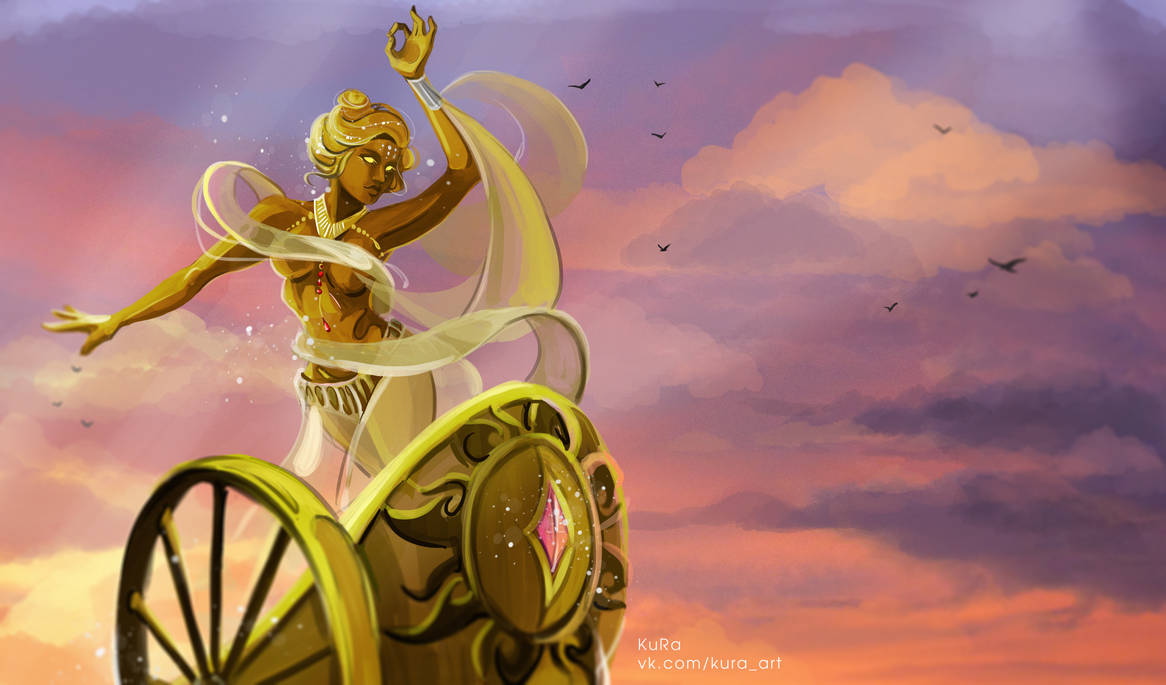
"Ushas is described in Vedic texts as riding in a shining chariot drawn by golden-red horses or cows, a beautiful maiden bedecked with jewels, smiling and irresistibly attractive, who brings cheer to all those who gaze upon her.

"Hymn 6.64 associates her with wealth and light, while hymn 1.92 calls her the "mother of cows" and one, who like a cow, gives to the benefit of all people."

Good so far, but there to this we can add the Greek elements of beauty;

"The dawn goddess Eos was almost always described with rosy fingers or rosy forearms as she opened the gates of heaven for the Sun to rise. In Homer,[27] her saffron-colored robe is embroidered or woven with flowers; while the singer in the Homeric Hymn to Helios calls her ῥοδόπηχυν (ACC), "rosy-armed" as does Sappho; rosy-fingered and with golden arms"

....

"The delicate and fragile beauty of her appearance seems to be in total contrast with the carnal nature that was often attributed to her in myth and literature."

Because the Greek Dawn Goddess is horny on main;

"Eos fell in love with mortal men several times, and would abduct them in similar manner to how male gods did mortal women. Her most notable mortal lover is the Trojan prince Tithonus, for whom she ensured the gift of immortality, but not eternal youth, leading to him aging without dying for an eternity. In another story, she carried off the Athenian Cephalus against his will, but eventually let him go for he ardently wished to be returned to his wife, though not before she denigrated her to him, leading to the couple parting ways."

The same energy seems to have been refracted in different cultures. Especially in the Greek/Roman mythos the original was split, order reason and hope ending up with Apollo, while irresistable beauty leads to Aphrodite, together they consume most of the original god elements leaving only a vague Dawn Goddsee behind.

But what if we had ALL OF THESE TOGETHER? We could have a super-hot golden rosy-fingered, saffron veiled Dawn riding her chariot pulled by red-gold cows across the firmament, upholding reason and order, defeating chaos, but also SUPER HOT and horny as fuck, and jealous, just abducting hot guys and not letting them go until they admit she is hotter than their wives.


THE FIRE IN WATER MYTH - THE WELL OF ETERNITY


"Another reconstructed myth is the story of the fire in the waters. It depicts a fiery divine being named *H₂epom Nepōts ('Descendant of the Waters') who dwells in waters, and whose powers must be ritually gained or controlled by a hero who is the only one able to approach it"

This one doesn't have the same "condesive" power as Sexy Dawn but it does have a particular poetic beauty which I have not seen replicated in fiction.

Fire in general is interesting in the reconstructed Indo-European mythos. 'Eternal flames' are common. The Zoroastrian seem to have inherited one part of that and in middle ages Lithuanian culture warriors for the church said it was easier to shut down the sacred eternal flames than to cut down the sacred groves as the fires gave themselves away by their brightness. Fire is also associated with sacrifice, which is a heavy, heavy strand in the mythos. Reality began with a sacrifice and the sacrifice of animals and animal flesh remains important, usually they are shared with or sent to the gods by fire, the Fire-God forming a kind of link between the mortal and divine realms.

"In one Vedic hymn Apām Napāt is described as emerging from the water, golden, and "clothed in lightning", which has been conjectured to be a reference to fire."

Nechtan of Irish Myth guarded a sacred well;

"Nechtain son of bold Labraid
whose wife was Boand, I aver;
a secret well there was in his stead,
from which gushed forth every kind of mysterious evil.

There was none that would look to its bottom
but his two bright eyes would burst:
if he should move to left or right,
he would not come from it without blemish."


Another well from the same mythos;

"Connla's well, loud was its sound,
was beneath the blue-skirted ocean:
six streams, unequal in fame,
rise from it, the seventh was Sinann.

The nine hazels of Crimall the sage
drop their fruits yonder under the well:
they stand by the power of magic spells
under a darksome mist of wizardry."


And from there to the numerous wells in Norse mythology. The Urðarbrunnr, the Well of Fate where the Norns go to weave the Skien of men;

Two sections of the book Skáldskaparmál reference Urðarbrunnr. The first reference is in section 49, where a fragment of a work by the 10th century skald Kormákr Ögmundarson is recited in explaining how "Odin's fire" is a kenning for a sword. The passage reads "A sword is Odin's fire, as Kormak said: Battle raged when the feeder of Grid's steed [wolf], he who waged war, advanced with ringing Gaut [Odin's] fire." and that Urðr "rose from the well."

and "Mímisbrunnr", the Well of Wisdom which seems to have a similar nature

"High explains that, beneath this root" [of Yggdrasil] "is Mímisbrunnr and that the well contains "wisdom and intelligence" and "the master of the well is called Mimir. He is full of learning because he drinks of the well from the horn Giallarhorn. All-father went there and asked for a single drink from the well, but he did not get one until he placed his eye as a pledge.""


What do we get if we condense all of these? A primal fire, perhaps that of the first sacrifice, hidden beneath water. A deep water it seems, and dark. 

In many versions the three Fates (very common across the Mythos) guard or dwell nearby. In some particular animals live there, the original swans from which all others descend, or the Salmon of Wisdom, who eat the magical Hazel Nuts which drop into the water.

There is always fire or brightness under the water, a God, the flashing of Salmon, or the knowledge of Fate. Probably you are going to lose at least one eye, likely both. Odin sacrifices one to drink from the water, those who look into the well of Nechtain have their eyes melt out. 

A God arises "golden, and clothed in lightning". Apām Napāt in the Vedas and also in early Zoroastrianism. Deep water, bright eternal fire, knowledge of Fate, a connection to the Divine and divine sacrifice, and the sacrifice of eyes for those who look.

Of course both Warhammer and Warcraft have their own 'Well of Eternity'. In Warhammer Tzeetch throws his chief Demon in to discover eternal knowledge and ends up with a mutated Kairos Fateweaver, who can see past and future at the same time, lies and tells the truth at once and who is curiously blind to the present.


(I am out of time for this post but may return to the subject in future).

Tuesday, 2 November 2021

Make It Feel Big

 A response to this comment on a previous post;

semiurge28 October 2021 at 19:40

This is more a comment/response to all your Trailing Corposant posts than this one in particular: 

What do you think is required to make a fictional universe, fantasy or sci-fi or something of both or neither, feel big? 

I remember when I read the Dune series (Frank Herbert og, no Brian) I was weirdly disappointed on some level to learn that Paul's jihad had conquered hundreds or thousands or however many worlds, rather than the 50 or so I had assumed were settled by humanity when I read the original Dune. It simply didn't feel like it "earned" that scale, or had aimed for it, or something of that like. 

I don't have enough exposure to 40k stuff to make a real judgement call either way, having never played the game or read the novels. It seems from your reviews that there's a divide between the galactic-scale events which involve the same few primarchs, gods, emperors, etc., and the planetary-scale, humanizing stories, each with a unique cast. Is it almost ecosystemal, with a few apex predators and innumerable minnows in tiny ponds? Don't know how to end this question. Thoughts?


………………………… 


Put simply - you can't, if you want it to remain sensible and easily comprehensible to the people you intend to sell it to. BUT THERE IS MORE TO SAY AND I WILL SAY IT! 


The Needs of a Story 

The world itself is one thing and the means by which that world is known quite another. 

Most popular large-scale fantastic paracosm are developed for, and known through, stories. (Will look more at Games in the second part*). With a story told for a popular audience; how much time/cognitive dwell hours do you have? How many channels of information do you have? 

Frank Herberts original ‘Dune’ book had a shitload of story-pages plus appendices where he got to discuss the world in a pseudo-historical high-information style familiar to most RPG nerds. Denis Villeneuve has two and a bit hours of attention but many more channels via which to impart information (sound, visuals, the tonality of IRL performances, costumes etc). 

Later, and this comes in as we discuss Games more, there are things like Lexicanium, Wikis, massive online combined effort sources, Youtube videos and so on, but in most cases these come after the initial strike, the first and usually strongest effort that embeds the fiction in the minds of a sufficiently large or dedicated audience that following up on details actually makes sense. 

So, the story is not the world but at least in this first discussion, stories are the medium through which the world is known 


Families and Familiarity

What drives mass storytelling is overwhelmingly characters and families. I mean often “families” in a kind of technical, or more vague sense in that – not just a group of people connected with each other by blood (though that’s always handy), but a reasonably tight and consistent group of main characters who have close and sustained relationships with each other. 

How many “families” can you have in a single story? Dune has two primary families, who in this case are literal families, and you can expand and break that down depending on how deep you want to go; Corrino, the Fremen, the Bene Gesserit etc. 

Game of Thrones has, well at its core, two main families again, the Starks and the Baratheon/Lannisters, (with Danerys you could maybe say three), and again there are a shitload of other families who come in and out of more or less importance according to the episode. 

Star Trek has the family of the core crew and every story will be related to at least one of them, though the range of possible interactions is huge, albeit, with many repeating cultures and structures. 

Point being; there is a budget for how many groups, how many signs, symbols, hierarchies, behavioural elements, unusual motivations etc, you can get in and this budget is as part of an invisible tacit negotiation between the creators and the audience, a negotiation over attention and desire. 

Our real world has no such limit on the diversity of groups and cultures it can present in total. In a point that will likely come up again and again in this post, there is more strangeness and diversity on our planet right now than in most imagined galactic communities. 


Scenes and Structures 

No space in a story is real and no scale in a story is real. A difference made pleasingly tangible to normal people by comparing opening Game of Thrones to end of series Game of Thrones. 

Even without inventing a whole new scale of action (i.e. just doing stories about people on a normal sized planet with known technology), a huge amount of the illusion of scale is created in the WAY in which the story is told, ranging from the smallest possible thing to the deepest structure of the plot. 

Laurence of Arabia - a big long film about big empty spaces. Why does it feel big? and why does it feel bigger if seen in the cinema? One of the many many reasons which come to mind; 

The way the camera is set and the desert captured; (the famous super long scene in which a guy just gets closer and closer in the distance and the camera doesn't look away except now and then at characters who in turn peeeeer into that same distance trying to make out this slowly approaching shadow), this is a long long shot (relative to the cinematic norms and the rest of the film which reasserted those norms). That means if feels long, though in comparison to waiting for a bus in real life, it wasn't. A long shot in a long film full of long shots. 

Wear and tear, emotional distress, logistics, permanence of emotional separation, ease or difficulty of communication, the face of friends when greeting someone who has been a long way away and the response of the group as compared to someone who has been to the shops, the Great Return scene, or the Great Setting Off scene. The they-are-knackered-but-the-challenge-just-increased scene (oh shit we have to go through Moria?? We’ve already been walking the whole film!). 

Fuck it, the Indiana Jones lines on a map scene. WE ARE LITERALLY LOOKING AT A MAP! 

In plays or films, maybe even books, - the point at which a main or expected character enters the scene; 

"hey Shakespearian character- has that message from/for the King arrived?" 

"No I am looking at some offscreen ships and whatever right now and no horsemen have apparated" 

"Ok lets have a comedy interlude" 

half way through, lord grimtides enters - "Forsooth that was a long fucking way from the previous scene guys" 

shocked bit-players - "My lord tis the middle of the night or a party is on or whatever, clearly your arrival is a disruption to the social milieux" 

……………………………………….. 

Indiana  Jones - "Marcus I need to go and find the Lost Ark" 

Marcus - "Do you need to be literally fucking packing for the journey as you are talking to me? It’s the 1930s 5 minutes won’t cost you much." 

Indiana - "Marcus it might be the 1930s but this film is only two hours long and the next scene is in Tibet! I need to signal distance using immediately tangible and available behaviours and actions or they will realise that Tibet is a sound stage about 30ft away from here!" 

I think I've probably only just scratched the surface. 


Relativity in Space Travel – the Imagined Galaxy 

For some reason it seems reasonable for use to imagine Galactic Travel via Faster Than Light engines, but less so multi-galactic travel. It makes intuitive sense according to our sense of what scale is; yes you could link a nation with one technology, and need another to link a continent, or a planet. You could have an Agean Empire with gallies or whatever, and if you develop different ships, an Atlantic or global empire. 

But if you have broken the speed of light, so far as we know, you have already broken a universal constant so surely many galaxies to visit makes as much sense as one? 

But maybe that would be a scale too large for us to easily encompass even as a work of imagination. Like Shakespeare could say; “Hey, there’s this distant, magical island, like the ones you have read about in shipwreck reports”, and the audience might say ok a bit whacky but we will see where it goes. But it Shakespeare had said; “There’s this whole other PLANET” (an idea which, conceptually at least, is as within his abilities as out own), the audience would just have gone what the actual fuck I don’t understand. 

Likewise, we live in an age where we think we can reasonably imagine galactic polities, or polities in galaxies other than our own, but multi-galactic polities seem a bit silly or strange to us. 

Anyway, back to the main point of this section which is that there is no mass popular sci fi setting that I can think of where the way relativity effects storytelling, and in which the conjunctions of multiple characters and different cultures accelerating away from and then towards each other and meeting and interacting across different personal time scales is accounted for. 

You can lampshade it; “as you know this complex thing where time gets weird was addressed by the doop de doop box”, or isolate the crew from a larger culture; (are the crew in the ‘Alien’ films returning to anyone they know?), or just go wo  wooo its warp shenanigans, but to fully integrate it would disrupt the way the story is told so much that it would be a real challenge to get across to a normative audience. 

(Of this generation - there is a slow creeping deepening of sci-fi knowledge in the general audience across generations - look back at old 60s sci fi and see them explain what seem to us pretty basic concepts. There are probably very few normies in the west today who would need the concept of a 'parallel world' explaining to them for instance. So it’s more than possible that one day relativistic storytelling to a mass audience might become possible) 


The Scale Of Time - The Impossibility Of Presenting It So 

Time is more powerful than we are aware of from our histories or our stories. 

Time destroys but stories require that it not do so, or at least not so much. 

I don't know if I am smart enough or well read enough to fully go into this or argue the point but our understanding of History s being broadly coherent, making moral sense according to our values, even "telling a story", and of hanging together as something of a structure, is largely wrong. 

The coherence of history is a semi-illusion created by our obsessive re-investigation and tale telling about those few things we have some data on. In a sense our histories are half-lies, or at least, tacit deceptions, because they are made up only of the fragments of knowledge that have not yet been destroyed by time. 

We have no real way to conceptualise the vast amount of "lost history" there is, all the events which happened to humans we don't know about, and we find it hard to fully describe the intense partiality of history, its fractured and particulate nature, we need it to be a "fabric" to understand it, for moral and perhaps simple cognitive reasons, and it isn't one. 

We can't tell true-seeming stories across insane reaches of time because time destroys stories

and, in relation to scenes and structures bit above, big mass stories for us have to be about the familiar and coherent and the true reaches of time make things unfamiliar and incoherent. 

Imagined Example; 

Author; “Welcome to book six of the Ultimate Super-War saga!” 

Reader; “Hello excuse me, I am a big fan of the Ultimate Super-War Saga” 

Author; “Yes, good. Thank you. Did you enjoy Book Six – Further Ultimate Super-War?” 

Reader; “No! I read the book and the language, characters, moral schema, even the purpose of events, the technology, almost even the spatial structure of things, all of these were completely different! It may as well be a book from a completely different series!” 

Author; “Yes! Its set six THOUSAND years after the previous book in the series (Ultimate Super-War Five; Nightmares of a Darkened Floom).” 

Reader; “So what happened to Leader X and his enemy Supervillain Man, and their great conflict over the Floom Prophecy?” 

Author; “Well.. six-thousand years later all those conflicts are ether resolved and forgotten or unresolved and still forgotten and if you look really really really carefully you will notice in the structure of the societies and moral arguments between individuals in book six, a very slight TRACE of the result and resolution of the Floom Prophecy situation” 

Reader; “This is not what I paid for.”


Ink Blots 

There is probably a limit we cannot perceive, or fully conceptualise, to our ability to imagine new things. 

A drop of ink falls onto a clean page and expands outwards. Every individual drop of ink will be unique, it can expand and expand, making strange and irregular forms, but it’s almost impossible for the original impact point to not be near the centre of the final blot. 

Everything we think and imagine, no matter how intelligent and perceptive we are, or how creative, or how deeply we can cast out minds into the future, all is based on this lived experience, here on this world, in these bodies. 

So we can think and imagine and think and imagine, conceiving of wilder and wilder realities and possibilities, things that, at the point when we began thinking, would seem beyond imagination. 

But no matter how much we imagine we are still constrained by that first drop of ink hitting the page, the point where we begin. It sets a kind of invisible boundary, not so much to how much we can imagine, but to how much we can think about what we can think. We cannot “get ahead” of the expanding boundary of the ink blot and the ink blot is always broadly centred on the point where it first fell. 

Specific example here is that all we know of humanity is from this planet, and so whenever we imagine new stuff, no matter how far or how deep we imagine, THIS PLANET and our experience here remains very close to the centre. 

This actually fits well with galactic-expansion paracosms, because in that case, all human life also comes from here and so the expansion is all from this human norm, but it still has to be imagined by one, or a small number of human minds. So; 

***** how much do you really think you can understand another culture? **** 

As an example; Josh Reynolds a writer who up into recently used to work for Black Library, the Games Workshop in-house publisher. 

He wrote a bunch of books for Age of Sigmar. His 'religious stormcast' Hallowed Knights characters have an unusual life and vibrancy, especially in the way they enact, think about and embody the various forms of faith. 

Why? Probably because he is from the American south and grew up in faith communities. How many other Black Library writers did? I think probably none. In fact I would lay a bet that almost every BL writer is a white male, British, lib-left, university graduate from an upper-lower middle class family, that has never or hardly ever gone to church and who voted Remain. 

So - considering the very slight variation between Josh Reynolds and every other BL writer, something that’s easy to see when looking at a small specific community separate to you; expand that understanding to a general scheme and apply it more widely. 

How much do you really actually think you can understand a different culture? Even one culture? 

It’s probably much less than you think, and even then, you have to present it to a mass audience in a way that is coherent and tangible to them considering their cognitive load and available dwell time, and how do you do that? 

You can't. You have to play upon known stereotypes or familiar constructs, produce theatre-of-difference scenes, have explainer characters, have people mirror their tech and environment in a way they don't always do in real life, and why - because you don't HAVE THE FUCKING TIME. 

Herbert had a huge series of books written specifically for a high-difference-desiring niche audience and even he didn't have the time. 


A Synthesis 

(Herbert did USUSUALLY WELL on a large number of these axis, he failure wasn't really a failure compared to other humans, only compared to the immeasurable scale of the task) 

to make a version of "Dune" that *felt* like it was at the stated scale Herbert would have had to

- tell a super long story with not may connections between parts

- invent even more cultures than he did (and he did unusually well)

- have a whole lot of RANDOM SHIT THAT NEVER CAME UP AGAIN

- have space travel totally fuck time in the ass

- have almost all of the start of the story forgotten by the end (even though YOU the reader have not forgotten, and were kind of hoping for a real story in which the end relates to and rounds off the beginning, which history definitely does not do). 

If I have a synthesis here it’s that the desired scale of epic-style storytelling is in conflict, perhaps fundamental, perhaps simply unavoidable conflict, with the very structures and methods which form the stories, which in turn make up the primary medium through which the scale of the imagined world is sensed. 

Just because its impossible doesn’t mean it’s not worthwhile to try. 

The Audience can change and learn. Like I said, Herbert does unusually well - and him doing that well both expanded the possibilities for others and "trained" his audience to deal with some new freaky shit, and now there is a Dune Movie which is pretty popular, so Feudal Future Sci-Fi is now more possible with a mass audience. So “failed” efforts might advance a culture, or at least present new challenges. 

The needle can be threaded more or less beautifully with more or less skill, and can call upon more or less imagination, more or less power of systemic creation. Example; Tolkien - insanely detailed languages, limited economics. Other writers I'm thinking here of someone like K.J. Parker, might do very well with politics and economics but deal with language in a limited way, so though every human effort might be limited and flawed, they could still be notable and original achievements of unique minds. 

And it’s fun. 


(* In fact, I do not look into games at all because I ran out of steam. Sorry!)


Sunday, 29 August 2021

Ten Years of False Machine

 Yes, at 14:50 (UK time) tonight, it will be ten years exactly since I started the False Machine Blog with this Vampire Table.


I should probably do something for the anniversary, I was thinking maybe a 'clip show' of old posts or something. 

Anyone have any ideas or desires?


Monday, 5 April 2021

Paradoxes of Defence

 A friend sent me this link to a 1599 fencing manual, by George Silver in which the writer SHITS all over the ITALIAN rapier. Because RAPIERS SUCK!


As well as going in very deep on some quite complex time-and-motion studies through entirely verbal means, and talking a lot about the complex interplay of different weapons and methods, it also contains this interesting part about the change in culture brought about by the Rapier;


"That the reasons used by the Italian fencers in commending the use of the rapier and poniard, because it makes peace, makes against themselves.

It has been commonly held, that since the Italians have taught the rapier fight, by reason of the dangerous use thereof, it has bred great civility among our English nation, they will not now give the lie, nor with such foul speeches abuse themselves, therefore there are fewer frays in these times than were wont to be. 

It cannot be denied but this is true, that we are more circumspect of our words, and more fearful to fight than heretofore we have been. 

But whereof comes it? 

Is it from this, that the rapier makes peace in our minds; or from hence, that it is not so sufficient defence for our bodies in our fight? 

He that will fight when he is armed, will not fight when he is naked: is it therefore good to go naked to keep peace? he that would fight with his sword and buckler, or sword and dagger, being weapons of true defence, will not fight with his rapier and poniard, wherein no true defence or fight is perfect: are these insufficient weapons therefore the better, because not being sufficient to defend us in fight, they force us into peace? 

What else is it, but to say, it is good for subjects to be poor, that they not go to law: or to lack munition, that they may not fight, nor go to the wars: and to conclude, what more follows through the imperfect works of the Italian peacemakers? 

They have made many a strong in his fight weak, many a valiant man fearful, many a worthy man trusting to their imperfect fight, has been slain, and many of our desperate boys and young youths, to become in that rapier fight, as good men as England yielded, and the tallest men of this land, in that fight as very boys as they and no better. 

This good have the Italian teachers of Offense done us, they have transformed our boys into men, and our men into boys, our strong men into weakness, our valiant men doubtful, and many worthy men resolving themselves upon their false resolutions, have most willfully in the field, with their rapiers ended their lives. 

And lastly, have left to remain among us after their deaths, these inconveniences behind them, false fencing books, imperfect weapons, false fights, and evil customs, whereby for lack of use and practice in perfect weapons and true fight, we are disabled for the service of our prince, defence of our country, and safety of our lives in private fight."


What has been disrupted here? for, violence is a social relationship, a social activity as much as love and marriage.

Silver talks in the book about the 'true fight' and whatever that is, is very hard to define, especially through the veil of time and the thorns of specialist lore. Let me see if I can glean some basic points;

- Fighters should be able to take their fighting knowledge to the battlefield.

- Fighters should be able to take on unskilled, but athletic men, and unskilled but brave and/or drunk men as well as to take on other skilled and educated fighters.

- Fighters should be taught grappling and " striking with the foot or knee in the cods".

- There is a lot here about 'the Times' and 'the Governors' that I don't really understand but I think generally he is in favour of fighters dancing around less and prioritising hand movements over foot movements I think.

- People should bear weapons of the right size, to take advantage of their bodies movements (I think) and not over-sword by getting into too-long weapons


Someone better read in the social milieux of the time (1599) might be able to tell us something about what is driving these changes. To me it looks like people are taking up fencing at least in part precisely because it is more ritualised, further from the battlefield, less 'common', has less grappling and cod-kicking and ends with less bits chopped off (though still many deaths). At least you die pretty.

The argument about lethality and skill though, that is truly fascinating, it highlights to me something about fundamentally different attitudes to risk, skill, danger and lethality.

The rapier seems to have introduced something like nuclear mutually assured destruction. It is very lethal, often even in unskilled hands, and Silver thinks its more likely to lead to the deaths of both parties.

The fighting he prefers is something else; more skill-based, with different weapons (he favours the short sword) which can also be used on the battlefield, more likely to lead to clear defeat for one party, but, if I am reading this right, easier to control? Easier for the more skilled party to manage and limit the sanguinary nature of the violence?

"..are these insufficient weapons therefore the better, because not being sufficient to defend us in fight, they force us into peace?"

Silver mislikes this because - perhaps safety won through mutual powerlessness before violence, safety won through mutual danger and the equalising, or neutralising of hard-won skills, is not true safety?

Or that it is a poor safety because it is the safety of weak men, bought through fear and maintained through mutual fear and therefore fragile, or corrupt in some way?

Hobbes (who I am also crawling through at the moment) would love this. He might say that men varying in strength but no man being so strong that the weakest might not kill him, it is through mutual fear that men submit to greater authority. and that the rapier has returned these men closer to the state of nature.

It truly is a "paradox of defence".

Monday, 24 August 2020

Flash Gordon and the Bat Sandwich

 Who could have guessed that the greatest enemy of cinema would be;


1 BAT SANDWICH 


In an attempt to lure people back iin, local cinemas have been putting on old favourites at rescued prices. I went to see Flash Gordon, and then bought the first volume of the collected newspaper strips by Alex Raymond.

I enjoyed every minute of the film, the insane pace is accurate to comic, as is a whole lot of everything else; Hawkmen diving, cities riding on ray-beams, baroque rocketships.

In the comic, the whole start with Mongo somehow threatening earth, Flash and Dale in a plane which crashes right next to Zarkovs lab, who then forces them into his counter-attack rocket with a gun for.. reasons? Then a crash-landing on Mongo, all takes place over one page. 

(Flash was a famous *Polo Player* in the original...)

Princess Aura is the best character in the film just as she is in the comic. 

There are loads of mildly-honky effects in the film but no bad shots, lots of very broad performances but no actual bad performances. Maybe the guy playing flash maybe, but he plays a good-natured monodirectional athletic lunkhead pretty well.


The designs in the film, especially the costume designs for Mings Court, are fucking insanely good,  decadence, lushness and questionable transformed Orientalism (the exotic Other!) seen through a lens probably slathered with whatever they used to use in softcore porn shoots.


Not really a surprise that this film did poorly in the U.S. as it’s an extremely, relentlessly, unamerican film in its aesthetic.

In the comic collection the art is lovely, the invention wonderful and the development of Raymonds comic-booking skills charming but even for someone who likes all of that the story is brutally, even oppressively, repetitive.

Flash has gladiatorial duels, fights strange animals, escapes from castles, sneaks into castles, someone has abducted Dale, someone has abducted Flash, friends must battle, enemies learn a new respect for each other, Ming sends out his feudal-tech fleet of ships, a new biome is discovered ruled by a new people with origins in a questionable early 20th century ethnic stereotype.....

Just keep reloading that page basically.


WTF IS MONGO


Presumably this has been explained at some point in the long-running comics, or some fan has build a web.. nope I looked it up and apparently it’s just a planet, which I find quite dull, so will be ignoring that I think.

There seem to be a whole lot of moons and planet-fragments bounding and rolling around each other in some kind of aetheric atmosphere. Is it all happening within the envelope of some attenuated gas giant? Or in some solar bubble, maybe a fractured dyson sphere binding the energies of a dying star?
That would probably make more sense for me, it explains the feudal toybox technology in a way familiar to anyone into D&D. A dying red sun at the centre of a fractured sphere the size of a solar system, with wounds and rents the size of worlds, red light leaking out as if from a hooded lantern.
But still holding enough energy that within its both liveable but also fucking HUGE; why it can reasonably call itself the ruler of the Galaxy.

Also explains where all the post-singularity tech and different quasi-human subspecies came from. Remnants of the fall. Also explains Mings super-intelligence.


THE FEUDAL FUTURE FAMILY TREE


Flash Gordon also feels like a kind of missing link between the 19th Century Theatre-inspired Walter-Scott Expanded Universe and the post-60's pseudo-feudal Deep Future paracosms.

My timeline would be something like this;

17th to 19th Centuries

Printing and mass literacy begin to create the market and mind-state.

Sir Walter Scott (and others) "pulls a Shakespeare" and jams together historical sources and popular storytelling in a manner exciting to the Audience but also informing and reinforcing their cultural identity.

At the same time the orientalist craze ebbs and flows as the industrialising western empires come into deeper contact with a wide variety of non-Western polities.

Many are, or were, richer than the West. The Other who has more money than you is a *decadent empire*. If they have less money than you they are either *savages*, or possibly *noble savages*, indicating that *you* might be the Decadent Empire. (Tacitus there writing a proto TNG episode).
All of this combines with the "hey we discovered ANOTHER strange island" culture, which dates back to the Tempest and Moores Utopia. Utopia being a combination of proto speculative fiction and the recently discovered island culture being a real-life "what if" story.

So the Wests/Anglospheres imaginative landscape of *The Other* is made up of these fancy decadent eastern potentates and mysterious islands with monocultures.

19th Century

That sets the scene for Walter Scott and the Victorian popular novel.

That feeds into Victorian theatre, music hall etc.

Cinema eats the theatre.

1930s

Here comes Alex Raymond with a world based on theatre costumes, circus wear, multicoloured fireworks, rockets, rays, sword fights from theatre and cinema, endless castle escapes and infiltrations from gothic novels and Walter Scott, an evil version of the Chinese Emperor being vaguely but generally ethnically evil, decadence and wealth from a blizzard or orientalist fantasies, single-biome 'worlds' or stage sets like islands in the sea, "primitive" tribes and peoples with Witch-Queens like something from 1000 colonial fantasies and dream versions of real encounters, and, less interesting to Raymond, but more to us, a Feudal social structure combined with super sci-fi Future tech.

Late 1950s/60s

Here comes "proper" Sci Fi, including Asimovs "Foundation", basically "The Fall of the Roman Empire.. in spaaaace". Includes Tech-Priests, predictions of the future, a golden path, and lots of Feudal Empires in space.


1965

Frank Herberts "Dune"

"Dune" is basically a darker-n-edgier Flash Gordon, or an "Alan Moore Does Flash Gordon"
Hey guys guys guys, what if we had an orientalist  19thC lost-desert-prince-returns-to-the-tribes plot _but the tribes were actually the goodies_.

What if we did Asimovs "Evil Psychic Mohammed" plot from the Foundation books, but psychic Mohammed was actually the good guy?

God Emperors, more future visions and crucially, Feudal Space Empires.

And a more clear confabulation of *why* exactly technology and culture produces human-centred Feudal Space Empires and *why* being really good with a knife or sword is more important than having a tank.

Deeper world creation but Walter Scott could have told you why; modern war tech is distant, impersonal, reduces individuality, either annihilates or fails, and broadly, is a fucking nightmare to tell a human-centred story about. Really you need heroes in big families and comprehensible hierarchies fighting with swords over dead fathers and threatened lovers and marriages and crowns and shit, THATS a story buddy!


1977

Star Wars. Lucas does his own Flash Gordon inspired thing. Has some success. Shamefully he takes out the feudal identity structures and swaps 1930s luxury futurism for decayed-new-york worn technology. He does manage to keep the sword fights and the stripe down Hans trouser leg though.

1987

Warhammer. Dune plus Foundation plus Medieval Europe.


JOY


Joy is a valid production of art and very few works of art produce joy. pleasure is an emotion as complex as any, though its engines may be atavistic. A pure response, without much alienation or inner "turning about" is more difficult to consider than a dissonant or multi-tone response, but is just as difficult to produce, (seeing that it is produced well so rarely), and has the same 'depth' as a more-apparently complex response.

Imagine emotion as a light, or as a kind of sonar signal pinging out and echoing back from the hidden trenches of the psyche. A piece of art that produces a complex interplay of signals; a deep corrugated terrain of emotion, memory, experience and intuition, that can be thought of as a deeply textured signal, or a jangly dissonant one, but there is also a response, simple and almost surprising in its lightness, like the sense of locating an unexpected object, finding a whale on your sonar perhaps. 

A chime that comes back, largely unaltered, but not without illuminating the depths of memory and experience and emotion first, only that what it illuminates is harmony, oneness, cohesion, "rightness", maybe even playfulness.

Maybe a metaphor I’m looking for is, that while some art is a sonar ping that echoes back as an image of a murky dark, invisible terrain, other art is like a chime or a bell, that echoes back from a house, or a home or a hidden cavern previously unsuspected or ignored, or forgotten and put aside, but returns as a polyphony, its echoes and responses combining into a return signal more complex than the one put out, but coherent, whole within itself, harmonious , and which could not have produced those effects without being, in some sense, emotionally simple to begin with.


Thursday, 23 July 2020

Binding and Combining

Two big problems inside the mind, neither of which I really understand.

'Binding' which I think is working out what objects are which, and 'Combination' which is about creating the matrix-like world-view which our little homunculus sits inside while riding the body around.

All of this started because I like Louise Sugdens painting style and because I like Dazzle Patterns on ships, and so I began a small investigation into colour, in particular, into colour and mass/shape...

After all, it’s only trying to understand how colour works, and how that combines with our sensation and understanding of mass.. how hard can it be?

Answer - INFINITELY HARD, for the very question opens the doorway to a crystalline dungeon of PRISMATIC MYSTERIES.

The search has taken me through Neurobiology (We Know It When We See It by Richard Masland), Ship Camouflage in WWI (Dazzle - disguise and disruption in war and art by James Taylor), and a deep cut into colour as used by artists (Interaction of Colour by Josef Albers).

We can also possibly add 'Through the Language Glass' by Guy Deushter, about a mild Sapier-Whorff effect in language and colour.


Alllbeeerrrs! HES LOOKING RIGHT AT ME


IS COLOUR THE MOST RELATIVE SENSE?


or just the most obviously relative?

So many scientists, art teachers, philosophers, messing around with coloured thread, coloured sheets of paper, swatches of colour, showing them to people of different nations, in classrooms, in laboratories, to rabbits while a hole has been drilled in their skulls to let the electrodes in, sailing around looking for rare islanders so you can show them the colours and write down what they say. More flags, shining lights, patterns of shade and texture.

Albers would remind us that our understanding of all these colours is massively shaped by context, types of light, (electric, dawn, dusk, passing clouds, albedo), by the arrangement of colours around and within each other, one colour on another, next to another, torn edges, straight edges, curly shapes, blocky shapes, texture on flat and so on and so on, so that he might regard these neurologists and cultural analysts running around as quite mad and pointless.

ALBERS - The most curious and unique of the minds I have witnessed through text. A man with the very tight, intense, highly disciplined brain of a laboratory scientist, a careful, systematic and procedural method to his teaching (learning about colour is *not about self-expression!*). And yet, with the least scientific aim and probably the greatest scepticism towards the systematising, totalising goal of science.

Albers is learning and teaching his students, through the medium of relentless attention and careful systematic analysis, about something he believes is very, very, highly relative. Fluid within perception and within the mind, to the extent that considering colour outside of its context, as an isolated quality, I think to him that would be utterly insane, since that is something it can never be.

Is it really the most relative of sensations? I think probably it is not, but that it is the most *observably relative* because it comes to us always alongside shape, objects and *DIVIDING LINES*, and I think the secret to the perceived relativity of colour is not that it is more relative than touch, smell or sound, but that it is more relative than objects and lines.

The mind is Binding and Combining the shapes of objects and dividing lines between things ("edge detection") all the time, and however it is doing this (we still don't really know), it seems to me that shapes, objects and lines are a lot less relative and debatable (both within the mind and beyond it) than the colours which always are sensed with and alongside them.

We might not all be seeing the same colours, and we can be certain, that in different lights and different times of day, things which register as always having the same colour in our minds, in fact have quite different colours, and that our brain is clearly fudging the issue, but *in comparison* to colour, we can be much more certain that the lines, shapes and objects we perceive, are both coherent to themselves and coherent when discussed and compared between individuals.

"That big rock, is it more yellow or green would you say?"

and never (ok, rarely)

"That big yellow-green thing, rock or sponge, would you say?"

And it is this, the evidently-relative-relativity, if you will excuse an awful phrase, which makes colour more obviously relative than sound or touch, because it lives along side and is always contrasted with, shape and line, which is very much less relative (probably more dominant, earlier maybe, in the binding & combining process).


Neurons! How do they work!


IS THE BLUE I SEE THE SAME AS YOURS


It’s likely. If it’s not exactly the same it’s probably pretty similar, unless you are at the far end of the curve, and most crucially, as Albers would tell you, IT DOESN'T MATTER!

For colour is RELATIVE and exists only relative to its context and therefore all that truly matters is if what you see as blue has the same relative relation to what you see as red green etc as everyone else which it probably does (though maybe not entirely).


COLOUR AND TIME, VISION AND TIME


While I know nothing about any of this I know even less about this part so beware, but it seems to me that vision and in particular the binding and combining of colour and form, and many colours, gives us access to a kind of island of no-time within our own minds.

As Albers would tell us, and here I'll bring in Ian McGilchrist of "The Master and His Emissary", sound is sequential, it can only happen in a row of information (though different sounds can be combined at the same time), touch is a bit less sequential, you can tough something with different bits of yourself, or be touched at once. Movement has a 'moment of movement' but is quite largely sequential, it happens in a row but vision, and the sensing of colour and shape, am I wrong in thinking that it has the least sequential elements?

McGilchrist would say that one part of the mind senses and 'sees' everything in one big burst and the other scans and sequentialises, so maybe sight, vision, has the most complex experience of time within the mind.

When I imagine the binding/combining process, I imagine something with a 'loose moment', a kind of drifting, or indistinct sense of the 'now'. The mind sees, absorbs, identifies, arranges and understands, all happening together. The big blurt of information from the all-at-once scan, the rapid sequential object scanning, the binding and combining shape colour, shade, light, fluid integration and re-integration with the imagined and re-constructed mind-state, both what 'just happened' (the part that makes us think the rabbit is still inside the hat) and the 'about to happen' (that lets tennis stars work out where the ball is *going to be*, all of this, binding and combining, looping and feeding back, continually, whenever our eyes are open.

And so, within the mechanisms of vision are many mutual but simultaneous *perceptions of time*. sequential, global, memory looking back and imagination/modelling looking forward, all happening "at once". The experience of vision is like a kind of time machine, a timeless, or looped moment within ourselves, which we can dip into and experience, slightly, a more or less time-powered moment, variations on what 'now' is.


WHY DO I GET A GIDDY FEELING WHEN PRESSING AGAINST THE EDGES OF THE IDEA?


Perhaps this presentiment of the complex nature of consciousness, vision, time, self awareness, is why when I reach certain points of Albers book, Maslands book and McGilchrists, I get a kind of giddy feeling. That feeling when you are just on the borders of a great idea, the moment before something complex, difficult and indistinct synthesises inside your mind into a coherent whole.

This might just be the borders of my own stupidity.

Or am I pressing against the edge of REALITY ITSELF????


More Albers, you and your GODDAMN SQUARES JOSEF


AM I SMART ENOUGH TO UNDERSTAND THIS STUFF?


Probably not really no.

Masland is pop-sci and at the deeper end I struggle.

Albers, god damn fucking Germanic Albers. First its a book of experiments really, that you are meant to perform, and I didn't. Didn't have the right stuff, time or will. And second he writes in this bloody art-school Germanic hyper-clear style, which because it is hyper clear and has only the correct info in it
is fucking hard to get through. There is no pulse of info/blather for you brain to take a moment to recombine, instead its infoinfoinfoinfo.

Its one of the most interesting books on colour that I have ever read, but again, I found it a struggle, especially towards the end. There were effects and ideas that I found it hard to perceive, model and consider, and so I ended up somewhat, sweeping over the words in a fearful rush. Back in secondary school maths again! fuck!


Ian McGilchrist being a WEIRD DUDE


COLOUR AND MASS, SHADE, SHINE, BRIGHTNESS AGGGHHHHHHH!


God fucking damn it brain, why you have to be so complex. All I wanted to understand was colour and mass.

Well, good news. Brain works out what shape and mass things are about 20 different ways at once. Edge detection and memory probably the most simple, though they exist at different ends of the binding/combining process (probably, we don't really know, and as I theorised above, 'different ends' likely doesn't make much sense in a temporarily fluid process with massive feedback loops).

Other ways - shade, light, texture, gleam, RELATIVE COLOUR. whoop de fucking do, all these things are changing massively, continually, always, depending on light, weather, perceptions, environment, background, movement between objects , movement WITHIN an object (which way will the Zebra jump - dunno as bunching muscles all fucked up by those dang stripes), and everything else.

False weathering patterns on 40k minis, showing you illusory mass one way, comic book style highlights on minis showing you mass another way, fake metal gleams in the non-metallic metal process showing you shape of imaginary metal, Blanchitsu style with decay and deep shadows, and the pale and nacreous skin which is good at showing those gothic shadows, showing you mass another way.

All somehow dealing with mass, or the delusion of mass, enhancing and re-creating the sense of 'shape' using false or simulated miniaturisations of aspects of the real(er) large scale world.

AND ALL DIFFERENT!!!

Especially when considered as different painting techniques, as in you literally need to do and think about a lot of stuff differently to employ each one.

Camouflage probably provides the key to entry to this subject but I have only read one book on it - stuff on 'Dazzle' (which seems like it didn't actually work, looked fucking cool though - raised morale, that counts!

But there are even different techniques and ideas behind kinds of camouflage. Camo for invisibility
for disruption of shape, of movement, counter-shading seems to have been invented, or re-invented by camo people (and oddly enough that is the exact opposite of a mini technique called zenithal highlighting).

Looking into the way camo destroys the understanding of mass and shape as a method for understanding how the eye and mind create and perceive mass and shape seems like a good idea.

More on this later perhaps.