Showing posts with label a bit heavy for most people. Show all posts

Wednesday, 17 May 2023

The Gravity of Cows

Over many a volume of forgotten Lore, through many an hour of Netflix and Disney dreck and many a meltdown over whatever Games Workshop is doing this week, I have pondered the interlacement of the Paracosm, the Corporation, and Autism.

Lets say instead, - 'autistic traits' or 'light autistic spectrum traits'. Strongly Autistic individuals have a very hard time and don't get to do much. Those of us with autistic traits, of whom there are many more, well we have quite a strong effect on, and relationship with, popular culture.

You might even say that we are the collective gravitational force of Genre-based popular fiction.


Part One - Evolution of the Paracosm


But first the Paracosm, the alternate world! Its primordial precursors; most religions, imagined tales of distant lands, stories of a legendary past, 

Then more recently; the philosophical disquisition given concrete form; what if there was an island where this or that happened? Or a country that was ruled this or that way? Lets imagine it in detail, not just the parts relative to the argument but the whole thing. a republic, a Utopia, a perfect king a most awful tyranny.

Then; what if we just imagined such a place but there was no (direct) political argument to it? Or at least, it did not primarily rest on such an argument. This is not, legend, history, argument or scripture, it is directly stated fancy, a fiction. A creation of the imagination, and called so,
but described as if it were a real place.

Then; when does it become a full Paracosm? When it is shared between multiple people? If so then the earliest I can think of is Glassland, the imaginary world cooked up by the Brontes. 

There must be a deep forgotten history of the Paracosm because it emerges so naturally from the play of children in friendship groups and families.

E.R. Eddison, writer of The Worm Ouroboros had one with his own brother I think, which is where many of his stories were set. The serial scientific and fantastic fictions of the late 19th and early 20th century were Paracosm, but owned by their author, and usually made purely as a vector for stories, the linked stories by various authors in 'Strange Tales' in particular

The vast, many-peopled Paracosm as we understand it I think really took root in the 70s and is closely related to D&D and corporate ownership.


Part Two - Corporate Power


for a Paracosm to be projected across a vast range of people, and for those people to be able to interact in a regular and systemic way with it, and for those systems to be unified and universally communicated, requires industrial production, complex communication and organisation.

A substantially large organisation must do this. Something bigger than just a small business, and for a substantially large organisation to do this there must be a substantially large reward. At minimum enough to pay for the industrial reproduction, communication and organisation. So the beast becomes something that feeds upon itself. The more industrial reproduction and systemisation spread the Paracosm, the more people interact with it, which feeds back into greater profits, which can go into more industrial production.

But more. As we consider the Paracosm though time, (and the most active ones have not been active that long), like land, if you want it to remain coherent, that is; stable in use and nature, then it must have an owner of singular identity, but one much longer lived than any individual person.

Historically the owners of land have been; an aristocratic family, the Church, a religious order, the King etc.

To which we may now add the corporation. The aristocratic houses of our modern day, and the Paracosm a virtual barony, which, like a stretch of agricultural land, can be conserved, developed, sold off, reduced to ruination and treated in many ways as a real place.

Now the Corporation, a 'virtual' aristocratic house, has its own virtual kingdom, a place sustained and made real by the interest and investment in it.

Something happened in the late 60's and 70s. Something to do with the growth of genre, the power of information technology and industrial production, free time for nerds and corporate interlacement with the imagination.

The 60's - Star Trek, Tolkeins major growth. Marvel and DC get a boost here and are re-integrated as Paracosms though they have been running for a while.

The 70s - Star Wars, Dungeons and Dragons

The 80's - the Warhammers 

So we have a synthesis; the Paracosm, an imagined barony, and the Corporation, an imagined and potentially immortal individual. The Corporation can own a Paracosm ... forever perhaps, and can theoretically maintain a profit on it forever, and it is that profit that allows the Paracosm to keep developing. The corporation is not an author, it has no single use in mind for the Paracosm
but far from it, desires as many uses as possible across as many systems of production as possible. 


Part Three - Autistic Traits


The interest in a Paracosm is not the same as the interest in an individual book or film but is renewed and remade through books, films, comics, television, animation, games, toys, models, props, bought costumes, embodied in acts of shared social play and through gatherings. All of these methods united by their shared love for and expression of, a place, or a reality, which is not real, yet is still shared and experienced by a great many people.

  • DEPTH of interest.
  • love of DETAIL.
  • Love of OBJECTS.
  • SYSTEMISATION of shared communion.
  • DISCUSSION and ARGUMENT over details.

And chief and ruler of these passions, desire to be POSESSED BY THE IMAGINED WORLD

None of these are necessarily the product of light autistic traits, but as a whole they synthesise with those traits, and with the pressures and coping strategies they produce, perfectly.

And from hence comes the great and terrible danger and most subtle trap of the Paracosm, the need to MILK THE COWS, for the cows are we.


Four - The Milking Process


Those who are drawn to the Paracosm tend to have autistic traits and of those who are drawn, there is something of a curve.

Cows.
Cows is what we are.

But imagine you owned a field of cows, and some cows you could only milk once a day, or even once a week, and you had to go and round them up to do it.

But there were other cows, a minority, who you could milk twice a day, three times a day, more. And you don't have to go round them up. Instead they come to you, constantly, and in fact they get quite violent if you refuse to milk them.

So originally you start out with a Dairy Farm, as we would understand it, but what you end up with is quite different. It’s a milk factory . Which, yes a Dairy Farm is a milk factory. The difference is in the proportion of attention and resources you give to each part.

By the end, the factory is the main thing and you have forgotten you even had fields. There are fields out there sure, the cows live there, but most of your time is taken up with the very productive cows
and even more with those small minority of hyper-productive cows.

Really, as accounting goes, and as your milking operation improves, becoming more and more efficient, your fields decay, and this is inevitable.

Hence the life-cycle of the Paracosm


Five - The Natural Life-Cycle Of The Paracosm


Now, we don't know a lot of this for certain. The Paracosm that most neatly fit our definition have only been going since the 30s , so even the oldest are less than a century old, nor can we guess how they will respond to copyright laws which usually max out after about 100 years, but within that time period we can see a continual process, a pulse of growth and die-back.

Following the cows.
Always follow the cows.

............

(It’s beyond curious to me that after Marvel and DC essentially bricked themselves into the Comic Book stores, to milk the cows of course, and maybe 40 years later, Disney/Marvel finds itself doing exactly the same thing, bricking itself back up inside Disney Plus.

It costs less outlay, less terrifying risk and the cows come to you.

At the same time Games Workshop attempts its own Streaming Service.

There are echoes here of the Comic Shop but also of Apples 'walled garden', of a lifestyle brand where every widget and thingy integrates with every other whatever, and where you can charge people a LOT, for entrance to that garden because, in Apples case, you are essentially guarding entrance to the globalised middle class.

None of the Paracosm-guardians have managed that yet, and likely nor shall they, (because of the Autistic Traits))

............

I will venture this as a thesis; every corporate-owned Paracosm, (which is to say nearly every major Paracosm), is at any point, somewhere in this long orbit between states.

Its natural arc is to slowly decay into a nightmare milk factory.

Then once that collapses, the milk factory will be razed and the clean open fields of a fresh new farm to be opened (with the ruins still lingering beneath the soil).

Then the whole process will begin again.

At times Paracosm can be pulled back and forth between the poles. Sometimes they can totally collapse and be regenerated, either by being newly acquired or even through 'community action', but they are always somewhere between these two points and defined by the gravitational pull between milking the cows and luring more cows. Those are the tectonic forces of imaginary worlds. The Gravity of Cows.

Wednesday, 21 September 2022

I Developed a theory of Consciousness While Cycling

 Out cycling in the rain I started daydreaming about a theory of the development of self-awareness.

USUALY, when I have what I think is a 'clever' idea, some or many other people have had it first or its been disproven somehow or just doesn't work that well. 

Whatever, put it in the comments if you like so long as you are not writing stuff about octopi.


INTERLOCKING NETWORKS THEORY OF CONSIOUSNESS

Particular problems create the potential for highly complex networks to deal with them. If the solution to the problem has a high enough payoff then probably a network will grow around dealing with it.

Many of these networks create, almost by the spread of their functions a nascent, silent 'I', of varying depth, continuity and complexity.

Over time these networks interpenetrate, interacting with and pushing against each other and as a result of this interaction, this nascent, potential 'I', really more a potential informational space between networks, deepens in capacity.

Like branches from different trees reaching towards each other, ultimately creating a place where many and most branches meet and interact. This spot in particular ultimately, slowly growing an identity itself as the complexity of so many different networks, approaching and intermingling from many different directions, shapes this space, and then finally (or just currently) the sheer need to both solve the problems the networks are designed for individually, but the meta-governance need for management of the interactions of the networks and this weight or need being so great, and/or so fruitful if resolved, that an evolutionary system will invest the huge amounts of resources needed to create it.


"I" IS COSTLY

Self awareness at any level is evolutionarily expensive, like a boutique tool or mechanism. It has to be worth the expense. It has to do something very useful and if not, just use instinct or non-self-aware intelligence.

At every juncture, every single increase in the complexity of these nascent 'I's is going to cost proportionally more than the one before, and if we adopt a human centric model (for the sake of utility in explanation, I will go into more detail at the end about what happens beyond this conception), then to "get to the goal" that full house or high level flush you need to advance not just in one suite but in many and each separate advance has to pay off big for the amount of energy/complexity invested in it, which is why few things are self-aware, or not very self-aware.


TERRAIN - FISH HAVE NO "I"

Little terrain in the Sea. Few complex escape/pursuit choices. Everything is down to pure sensory power, escape velocity. Infinite opportunity of movement and almost NO "objects", or "terrain", little to hide behind, go around, climb, get under etc, means few complex choices and little to no benefit in being able to predict the decision pathways of either predators or prey.

The most self-aware creatures in the sea look to be mammals who are basically importing a complexity gained on the surface and returning it to the ocean, apparently making use of the, in particular, advanced social organisation systems they gained on the surface.

But if they had stayed in the sea, would they have anything similar?

Two points, fish schools and octopi.

What is the difference between the awareness of a school of fish, acting sometimes in a very highly complex pattern, and  school or whatever of dolphins or Orca, which exhibit les hyper-complexity of form in the general gestalt but we would assume, more inter-communication between 'selves'.

(I suppose a good question here is; "Why don't the creatures of coral reefs have more complex sense of self?)

Secondly Octopi and that whole group often seem pretty smart, what the hell to think about them I don't know. Some who have worked with octopi say the smartness is inconsistent and overrated, strong problem-solving capacity but intermittently employed and often forgotten between events.

(Maybe because the Octopi has no 'self' to remember for? Selfhood as continuity and retention of complex problem solutions over time? The 'I' of memory?)

Please don't comment repeating common octopi stories about them escaping ang getting across the room or whatever unless you are one of the very few people with a non-pop-culture and representative overview of their relative intelligence and capacities. Like if you work in a lab with octopi or have studied octopi then you can comment about the octopi but if you have maybe read a reddit thread about them or seen a documentary once please don't.


FLATLAND

Complex three-dimensional environment; now there are not just directions but terrain, paths, and highly complex decisions to make. Not just how fast do I run or do I swim up or down but, do I go over this rock or around it, up this tree or past it, hide in the grass, moving slowly, or run along the bare ground fast, now, being able to predict, not just how fast something will attack you or flee from you, but the kind of  decisions it will make, becomes useful and if the environment is complex enough and bountiful enough then this can become an arms race.


THE EMPTY SPACE BETWEEN PREDATOR AND PREY

If you only have one job then "I" will probably cost too much, if you are only prey and never predate, or if you are only predator but never prey, even though it might help to develop highly complex theories or models of something else’s mind (the thing chasing me will do this" or "the thing I want to chase will act like this), "I" will still cost a lot.

The self is silent, or quiet, as all it needs to do is act or react to that one particular type of situation, the only axis of combination I Can think of is between the system which is modelling the target, that moving your own body around so in the interstice between those two systems is the vague shadow of a protoplasmic "I"

But..

When you are BOTH predator and prey, when at any time, any particular action might give you access to an active, living and reacting prey and/or  make you vulnerable to an active, living and reacting predator, THEN - the interstice between these two powerful and complex systems, one designed to provide you opportunity, the other to save you from destruction, both modelling the behaviour of complex organisms that are not you, now the shadow of the "I" between these two systems becomes thick and almost tangible. As if there were two complex networks whose branches crossed and whose reward/punishment systems interrelated, or like two lamps shining on a dull, matte black space, triangulating its shape and form.

The creation of the living concept of "prey" and that of "predator" at the same time, nearly necessitates an almost explicit but still silent construction of "I" even if only by absence, or the locus and continuation of the reward/punishment systems.


SOCIETY

Theory of mind of theory of mind of theory of mind, and a bottlenecking of a species which can be successful, but only as a group.

Fuck do I really need to go deep into this?

Its immensely complex and I feel like for an educated audience there is little I could say about social organisation being very very important for the success of humans as a species, and that these social organisation issues become more and more and more complex yet can pay of more and more and more fruitfully as the size and complexity of the society they allow grows.

Probably this is the most important one as the 'Social I' has the greatest amount of triangulation between different conceptions of 'I', the most layers of potential trust or distrust, of revealed and unrevealed knowledge.

And the social 'I' strongly advances a highly complex theory of mind which, the better it works and the more complex the society it works in, the more resources you get and problems you avoid.

Once this complex theory of mind starts to exist, as a first element of the process of colonisation/synthesis, it can be turned upon the object doing the analysing, creating the formal abstract concept of self, the last 'I' achieved (so far) but the cornerstone of the colonisation/synthesis process described below.


EMERGANCE AND COLONISATION

At some point, some system or combination of systems becomes so necessary, so complex and so dominant, that it can, or has to, invade or "take over" or at least become fully aware of, a whole bunch of other networks.

Probably this involves the complex theory of mind network, driven by complex and competing social needs and provoked both through language and interaction, turning on 'itself', analysing itself as if it were another person.

(If people don't ever have a spoken language, or words by either sign or symbol, do they have an 'I'? I would say yes but I suspect a very different, by our standards a duller, less-focused version.)

But what exactly is 'itself'?

Well snap, that concept must be created and formalised and there is your spark.

Now comes a vast interrogation, maybe consumption and colonisation, maybe just awareness, of all those other nascent networks; the basic bodily continuation system that even fish have, the advanced tactical systems for navigating complex ground based environments, the long-term environmental prediction stuff, the predator/prey tactical and strategic theory of mind system, even the basic bodily awareness/positioning system, all are consumed, or assumed, by this core collection of advanced theory of mind complex social systems which themselves centralise and "grow" in power as they comprehend and absorb more systems


NOT THAT SELF-AWARE

As humans we know that though we strongly intuit we are self-aware we have also learned that we are not quite as self-aware as we think

We can fiddle with our pain feedback system to an extent, sometimes, for surface pain, but in all cases deep body pain seems to totally go above and around our awareness. Some rapid decision paths go in advance of our consciousness. Decisions and reactions can take place before and after we think they do or did, our self-interrogation for complex decisions and events - we know is fudgy and often our left hemisphere, , well basically it will tell us whatever answer comes to hand, and if it doesn't really know it will still give us whatever answer comes to hand. We can meditate to become super duper self-aware and highly lucid about our intuitions and response, but if we do this a LOT, like a LOT A LOT, then in many cases we seem to lose actual useful life abilities like making difficult decisions in complex environments very fast making sometimes necessary aggressive actions to defend out lives, those of others or vital principals, becoming very empathic but almost passionless, so our empathy has little practical effect and no longer investigating or working in the world, and so no longer discovering unknown physical things.

Point being; we are probably self-aware and probably the most self-aware thing on the planet. Though its true to say we are never as self-aware as we think we are. Curious that self-awareness has trouble with its own limits.

Being self-aware is probably good, useful and necessary. For the sheer amount of energy our bodies dump into our brains and that our culture dumps into self-awareness.. if it is not useful, or isn't really happening, then life on this planet is a kind of crazy joke. Which if you are Peter Watts or like a mid 2010s atheist sure it could be so, but the idea of a species becoming hyper-successful through the (INCREADIBLY EXPENSIVE) delusion of self-awareness is way more stupid than the idea of a species becoming hyper successful via self-awareness.

Alien Commentator; "I, or the epiphenomenon labelled 'I' see that the humas have dumped a super Quintilian Jules into the 'self-awareness' project, how do you think that is going for them?"

Other Alien - "Actually they haven't but they think they have and its actually working great."


FEW POINTS;


WAKING UP MAY BE WAKING UP

A bit like the development of foetuses from various species mimics or leaves a strange combined map of the unified origins of life, very likely the process of waking up each morning, is, in abstract, and highly compressed in time, probably a general sketch map of the process of humanity becoming self-aware. 

If we could read in detail the way in which movement, awareness, memory, self-hood and self-awareness come "on-line" or mutually integrate when a human being wakes up and goes about their day we would probably have an 'embryo' of consciousness if you will. 


MAN IS INEXTRICABLY LINKED TO EMBODIED AND SOCIAL LIFE

Self-awareness as we understand it probably isn't like a programme or a line or code or a quality that can be imported even into a complex system, a bit like the Ted Chiang story "The Life Cycle of Software Objects", those systems can probably produce something but its probably not going to be self-awareness as we understand it and most likely will probably be Bostromian highly-intelligent non-self-aware systems like super chat-bots of the kind encountered in Peter Watts Blindsight.

Of course its possible they might become self-aware in ways we don't understand and can't perceive, but, that being the case, what could it mean to us? and what difference would there be to us between a really-strange AI self aware in a way we don't comprehend and a superinteligent AI that isn't self-aware?

Making something we understand as self-aware, enough like us that we can communicate with it, but different enough for that to be interesting, will likely be more like that Ted Chaing story, or even more like Commander Data, or even Johnny 5, than we probably assume from super-brain sci-fi movies, more human, comfortable and social.

Interacting with a complex society in a complex 3d ground based environment with something like human social desires and - since we are the only things we know of that can do that or provide that environment, it will likely happen in "real time" and either complex virtual worlds or simply in real space.

If we want to create a complex self-aware synthetic intelligence then it is probably going to want to care about going to parties, getting a job, having friends etc. It may need to ultimately fear poverty and social estrangement for these are powerful and subtle reward/punishment systems in our own minds which help to create the triangulated shadow of "iI"


THE PROCESS IS SLOW AND ONGOING

This means that self-awareness, rather than being the super-explody bit of a hyper-brain sci fi film is something integrated into our society and into the complexity of our society, and has been developing, slowly, invisibly slowly, and is developing and will continue to develop with our mutual society and all the complex things it can do, and ways it can be.

It’s not really a deck of cards with humanity having the trump hand, but perhaps an, if not infinite, than perhaps ever-expanding deck of cards where you get the royal flush but then they have invented or evolved a new card above the king so new hands are possible at every level of the game. 

Strange new forms of self-awareness.

Thursday, 23 June 2022

We need to be churning more oceans!


We need to be churning more oceans! We need to be fisting more demons! We need to be killing more sons! We need to be hurling more weapons!

Part three of a short series about the elements of Proto Indo-European Mythology that haven't made it into the fantasy noosphere, or haven't made it as much as one would think, or have made it quite a lot but still a look at the reconstructed "originals" can be illuminating.


WE NEED TO BE CHURNING MORE OCEANS


"Although the concept of elevation through intoxicating drink is a nearly universal motif, a Proto-Indo-European myth of the "cycle of the mead", originally proposed by Georges Dumézil and further developed by Jarich G. Oosten (1985), is based on the comparison of Indic and Norse mythologies. In both traditions, gods and demons must cooperate to find a sacred drink providing immortal life. The magical beverage is prepared from the sea, and a serpent (Vāsuki or Jörmungandr) is involved in the quest. The gods and demons eventually fight over the magical potion and the former, ultimately victorious, deprive their enemy of the elixir of life."

Already something of a failure because this concerns not an element of PIE Myth that hasn't been covered by the Genres but one that fits almost too-well into D&D specifically.

Elixirs and potions are happily set within the D&D cosmology so the idea of a super, super super divine level potion fits right in. After all if you can make a potion of this or that of various strength and effectiveness then why not have there be a potion of immortality which made the deathless gods what they are? And a highly interpretable boundary between powerful mortals and gods is something D&D handles pretty well.

I can imagine a 'potion of ageless immortality' being a super-high-level item, combine it with a potion of eternal regeneration and boom, you've got yourself a god.

BUT, one element that’s missing is the potions cosmological nature; it’s not just some potion that came from wherever - it was made through the combined efforts of a super-serpent, plus the beings we now call gods, plus the beings we now call demons - they made it together through some incredible process that neither group could have done alone.

And then the gods stole it, or tricked the Demons into not drinking it, and that’s where 'Gods' and 'Demons' come from, the trickers and the tricked.

Gods as original adventurers indeed.

Of course if we view this from inside the resulting mythos then the Demons were very bad and the Gods HAD to do what they did - BUT THEY WOULD SAY THAT WOULND'T THEY??? Reading back the difference between what would be gods and what would be demons looks more like the difference between two street gangs

What does it mean, or what would it mean in an imagined world, this war between the deathless trickers and the, not-quite-mortal, but definitely not deathless or ageless, tricked?

While the sacrifice myth gave the roots of reality as a kind of annihilation of self/twin, the churning elixir myth gives the roots of divine order as a kind of scam, in which we applaud the scammers because they were more clever and because they were/are sort-of on our side, or at least more on our side than whatever 'Demons' are.

The benefits of this crime being an escape into deathlessness, into eternity.

I suppose the requirement of the unified action of Gods and Demons explains why they are no longer making the 'good' version of the immortality potion - that lot will never work together again. yet at the same time it suggests a way of making more; by some third party, (the adventurers or main character of the story) tricking both groups into once again churning the cosmic ocean.


WE NEED TO BE ACCIDENTALLY KILLING OUR SONS (AND POSSIBLY BURNING OUR FORTS)


"In the Ulster Cycle, Connla, son of the Irish hero Cú Chulainn, who was raised abroad in Scotland, unknowingly confronts his father and is killed in the combat; Ilya Muromets must kill his own son, who was also raised apart, in Russian epic poems; the Germanic hero Hildebrant inadvertently kills his son Hadubrant in the Hildebrandslied; and the Iranian Rostam unknowingly confronts his son Sohrab in the eponymous epic of the Shāhnāmeh. King Arthur is forced to kill his son Mordred in battle who was raised far away on the Orkney Islands; and in greek mythology an intrigue leads the hero Theseus to kill his son Hippolytus; when the lie is finally exposed, Hippolytus is already dead. 

....

According to Mallory and Adams, the legend "places limitations on the achievement of warrior prowess, isolates the hero from time by cutting off his generational extension, and also re-establishes the hero's typical adolescence by depriving him of a role (as father) in an adult world"."

It might be bad to be a PIE hero but if you are the son of a PIE hero.. run! Run for the hills! Except don’t because you will fall over and lose your memory, be raised by hill people and become their hero, try to free them from the tyranny of the river-valley lord and fight him in single combat only to die and fall over again, mooning him, revealing the birth mark on your arse that confirm that yes, he just killed another son, sky-father damn it!

A key point for us is that killing the son, in Indo-European terms, is like 'killing the parents' in children’s fiction; it enables the adventure.

Sane parents stop their children going on adventures so for the story, or game, to happen, and for the Hero to happen, they need to be missing, powerless, incompetent or dead. (Like most Disney parents).

Likewise the D&D adventurer will ultimately 'age out', (though in practice they remain near-psychotic self-driven loners in otherwise communal societies), but if they were real they would probably gain families and embed themselves in a socio-political milieux, as people tend to do as they age.

How then may they adventure? You can do socio-political court dramas, but how can they meat-and-potatoes, risk-and-exploration adventure?

Clearly by accidently killing their son and/or heir in tragic and fated circumstances, this then ending their 'family line' (assuming a patriarchal society) this disconnects them from the world of line-building, politics and embedded power structures - a good time then to go on a grief-stricken old guy adventure.

How to do this with an entire adventuring party? Simply have them ALL accidentally kill each others children in the same fated event and/or situation. It’s an utterly batshit idea but not that much more batshit than the sheer number of accidental son-murders in the Eurasian mythos.

Alternate versions could be the accidental but fated self-destruction of whatever it was the adventurers invested in that bound them to society - a fort, wizards college, thieves guild or whatever.


WE NEED TO BE FISTING MORE DEMONS WE NEED TO BE BINDING THINGS MORE IMPOSSIBLY!


I am sorry I could not find any examples of Jamshid fisting Ahriman, I feel as if I have let you down


"In both accounts, an authority figure forces the evil entity into submission by inserting his hand into the being's orifice (in Fenrir's case the mouth, in Ahriman's the anus) and losing it"

Firstly people aren't being swallowed by monsters enough, instead of just killed.

Secondly the idea of immobilising a way too high level being by SHOVING your hand UP INSIDE IT (an ex-friend once told me if I was bitten by a Pitbull, "just shove your finger up its arse and it will let go", I never had a chance to try it out), allowing the creature to be bound or the victim extracted.

Then - disastrously but perhaps predictably, it goes (slightly) wrong, resulting in the loss of only one hand. This feels like a good and appropriate mythic level beginning for a low level hero, a level-one adventure even. You get a major win over a too-high-level foe but at the cost of a major sacrifice and a big name-imbuing mythic incident to start of your career.

"leprosy hand guy who bound that monster that time"

"stank hand who fisted a demon and trapped it"

Combine this with the arrival of a fated weapon, with some truly exciting powers but probably also a doom (almost certainly involving killing your own son by mistake), and you have a very nice set up for a P.I.E hero - one hand, magic mace or sword, binder of monsters, fated doom.


Furthermore, investigation of the binding of Fenris myth (where Tyr got his hand bitten off), lead me to another mythic fragment; 

"The Gods had attempted to bind Fenrir twice before with huge chains of metal, but Fenrir was able to break free both times. Therefore, they commissioned the dwarves to forge a chain that was impossible to break. To create a chain to achieve the impossible, the dwarves fashioned the chain out of six supposedly impossible things:

  • The sound of a cat's footfall
  • The beard of a woman
  • The roots of a mountain
  • The sinews of a bear
  • The breath of a fish
  • The spittle of a bird

Therefore, even though Gleipnir is as thin as a silken ribbon, it is stronger than any iron chain. It was forged by the dwarves in their underground realm of Niðavellir."


And this reminded me of a half-memory of something from Hinduism which I remembered as being a hero binding a demon with sea-foam. I searched for this for literally minutes and found that actually it was Indra, and not binding but a weapon;

"In the epic, there is a very brief description about the story of Namuchi and Indra. According to the story, once Namuchi hid himself in the rays of Surya due to fear of Indra.

Indra then promised him that he will not kill him in day or night, or with any weapon which is wet or dry. However on a foggy day, Indra chopped off Namuchi's head using foam of water.

From that day onwards, Namuchi's head followed Indra reminding him that he was killer of a friend. Indra then went to Brahma to find solution for this problem.

Brahma told him to bathe in the holy water of Aruna river which was purified due to confluence of river Saraswati. Indra then did the same and got rid of this sin."


The concept and gameability of the impossible binding is not something I remember seeing much in fiction or games. (It feels familiar, but, like with early wizards towers, when I look in my memory for specific examples I can't find much).

This also seems like it would be a good fit for D&D, for the 'paradox binding/assembly' the collect-these-impossible-things is essentially a fetch quest which could range from very high magic to cunning folk trickery depending on how you approached it. For the sea-foam equivalent impossible natural binding, you need to find a wonder-worker, or super-smith (who probably stole their powers from a devil or demon, that’s another possible PIE myth), who can bash together the wind and rain or whatever it is you need to make your thing.

I am interested if anyone in the comments has any other versions of the impossible binding motif or ideas about how it could be used.


WE NEED TO BE HURLING OUR WEAPONS INTO THE SEA


"In the Ossetic Nart saga, the sword of Batradz is dragged into the sea after his death, and the British King Arthur throws his legendary sword Excalibur back into the lake from which it initially came. The Indic Arjuna is also instructed to throw his bow Gandiva into the sea at the end of his career, and weapons were frequently thrown into lakes, rivers or bogs as a form of prestige offering in Bronze and Iron Age Europe."


More magical weapons should be loaners imho, you get access to them by completing a quest, or by fulfilling some other strange circumstance, and get to keep them till thy work is done - this also means you can have more hot babes levitating and emerging from water. Probably the clear reflective water is a gate to the Otherworld and as somewhat god-imbued things, many weapons both come from and return to that place.

In-game the fact that it’s a 'loaner' limits the PCs freedom, but hopefully in a specific and self-selected way so that it’s still interesting.

The question of when to 'throw back' the sword, in game, is interesting. In legend it seems to happen around the point of death; the heroes whole life was the mission and it wasn't just one thing, like "kill this dragon/monster" but a more-grand 'restoration of order' deal, like with Arthur, or Arjunas taking part in the Kurukshettra.

The quest of disposing or returning the magic weapon of a hero, (without using it), is an interesting one, and the idea of the heroes super-weapon turning into an adhesive cursed weapon if it is kept too long or mis-used.

And of a PC being given a way too powerful weapon at the start of their career, which they have to 'grow into' and which they can only keep so long as they fulfil its purpose, which will also lead them to some sort of doom

really every magical weapon above a certain level should have a specific end that it has to have once it has fulfilled its purpose


"Reflexes of an ancestral cult of the magical sword have been proposed in the legends of Excalibur and Durandal (the weapon of Roland, said to have been forged by the mythical Wayland the Smith). Among North Iranians, Herodotus described the Scythian practice of worshiping swords as manifestations of "Ares" in the 5th century BC, and Ammianus Marcellinus depicted the Alanic custom of thrusting swords into the earth and worshiping them as "Mars" in the 4th century AD."

Should our heroes be worshipping their swords? If they all have a bit of the war-god, or death, the Twin, inside them, and if they are related to the Otherworld and made by the power of the Smith who tricked the Devil, then are they not themselves sacred things? And is shoving one into the Earth-Mother then not essentially making a kind of shrine? A sword is after all a kind of boundary between this world and the Otherworld, opening the gate between here and there, it surface shining just like the lake you will one day throw it into.


Tuesday, 14 June 2022

Murder at the Dawn of Time

 
The stories start to vary right from the start but one thing that links them all together is the killing of a brother and their butchering, the spilling out of bones and organs, as an act of creation with which reality was made.

"as the result of the original dismemberment of Yemo: his flesh usually becomes the earth, his hair grass, his bone yields stone, his blood water, his eyes the sun, his mind the moon, his brain the clouds, his breath the wind, and his head the heavens."

Probably you are so familiar with this concept from mythology that you haven't stopped to think about how utterly strange it is. But to go a bit deeper;

You are moving though a void, a placeless place 

"neither non-being was nor being was at that time; there was not the air, nor the heaven beyond it... Neither death was nor the immortal then, nor was there the mark of night and day...". 

You are not alive for nothing has ever lived nor are you dead, for nothing yet has ever l died. Neither are you immortal, like the gods, for there are none.

You simply are. Yet you are not alone for beside you is another. They are blood of your blood. A brother. Often they are the only other thing. (Sometimes there is a third and also a cow, but we will get to that later). Sometimes they are a giant, sometimes an hermaphrodite or multi-gendered being, but the one they they always are is your twin. Their name in fact is 'twin'. Yours is 'Man'.

Amidst this absolute nullity you turn on your twin, your other self, the only other thing there is, and you kill them. Then you cut them open, or since there is nothing to cut with perhaps you tear them open, and you reach into their body, steaming with blood, which is creation, and you butcher them, pulling out organs, bones, blood, tendons, hair, eyes, brain. And you cast or place these things into the nothingness and now instead of nothing there is reality. Earth, sky, sea, air, sun, moon, stars, grass and animals, all of this is built or formed from the flesh of your slain twin. And amongst all this you walk, the first man, who is also the first priest, for you made the first sacrifice and that is the nature of a priest, amidst a reality made from the corpse-flesh of you dead twin.

Of all the world creation myths, this one might be the most insanely fucked up, its also a common root or tributary concept for a bunch of cultures across the Indo-European range. For the Norse the twin was Ymir, father of giants. The Romans likely historicised their own version into Romulus and Remus, and the first romans considered themselves Remans, children of Remus, not of Romulus. In the Vedic and Persian versions the twin is Yemno, another derivative of 'Twin', and becomes the lord of the underworld, first to die and god of the dead. The killer is Manu and yes it does look like we named the species after this one guy.

"The association of Mánu with the ritual of sacrifice is so strong that those who do not sacrifice are named amanuṣāḥ, which means 'not belonging to Mánu', 'unlike Mánu', or 'inhuman'."

I think about how terrible it must be to kill your brother, the only other person who exists, the only person who can truly recognise you, and then to walk through a cosmos made of their sacrificed flesh.

It makes sense if you imagine a herding people where cattle are wealth and the most valuable and immediate source of survival. Cutting open an animal on the empty steppe, its blood steaming in the air while the butcher spreads out the parts on the hide and hands this part and that to this or that kin. Truly life through sacrifice.


Variations;

There is a third guy there, and possibly also a cow. At some point the cow gets stolen and the third guy goes and steals it back. Honestly it sounds better in the original versions.

The ritual cow stealing seems to be a restoration of order motif and the third guy is the first Warrior, with the Cow sometimes symbolising the peasant or 'grower'.

So now we have a traditional proto Indo-Euopean tripartite division of Priests/Warriors/Peasants, or if we are feeling funky, Kings (Yemno was the first king)/Priests/ Warriors/Peasants.

Sometimes 'Twin' is multi-gendered or you both are, or you are somehow the same being; 

"Some scholars have proposed that the primeval being Yemo was depicted as a two-fold hermaphrodite rather than a twin brother of Manu, both forming indeed a pair of complementary beings entwined together. The Germanic names Ymir and Tuisto were understood as twin, bisexual or hermaphrodite, and some myths give a sister to the Vedic Yama, also called Twin and with whom incest is discussed. In this interpretation, the primordial being may have self-sacrificed, or have been divided in two, a male half and a female half, embodying a prototypal separation of the sexes."


WHAT CAN WE DRAW FROM ALL THIS?

Its all quite familiar from mythology, or from the mythology of fantasy. There are probably hundreds of fantasy paracosms which begin with some binary separation between different opposites.

Quite a lot of deep viscerality has been lost and we never get to see this from the first person perspective.


Viscerailty; 

its quite different if you think deeply about what it would actually be like to physically destroy your own twin, your own blood, the only thing that is like you and that can know you as totally as you know them.

And to think about the blood and the guts of the matter. The butchered body cooling on the steppe, everything around you being made of the body of the sacrificed twin. Imagine what it would be like to fully believe that as your cosmic mythology - every time you look at any material thing, you are looking at the flesh of some unknowable corpse, to which you are distantly related. An uncle long removed.

Man is the first Killer and Killing is creation.

and what does it say about a culture that this primal violence lies close to its root, or what does it say about this primal self-destroying, bloody violence and butchery that it can help to form a culture that goes on to influence so much

its a pretty powerful and irresolvable moral maelstrom

The only part of current culture which I'm familiar with which deals with butchery, and especially the sacrifice and butchery of humans, is serial killer fiction 

specifically one of the first things that came to mind was From Hell, the very upsetting scene where we watch Jack the Ripper take the body of his victim apart and lay out the pieces in ritual formation while mumbling and going mad/embarking on an act of ritual magic which allows him to walk though the walls of reality

of course, if all creation is made of sacrifice, then any such sacrifice is an act of sub-creation, and it makes sense that it would act as a kind of spell or prayer - altering or sustaining reality depending on perception


Manu as a Character;

We have a shitload, really an epically insane shitload of Storm Gods, Sky Gods, Sky Fathers and their derivatives, and even more, truly a cornucopia of 'Strikers', the thunderbolt wielding hero who goes around killing monsters, releasing the waters etc.

I don't think I've ever seen a story where the Manu figure, the first Priest and the first Sacrificer, who made the world from the body of 'Twin', is even in the story, let alone the main character. 

What would that story even be like? Or that game?

Being the first Priest in a reality which you essentially part-created with the flesh of your Twin and teaching all these.. descendants? The children of Manu? Made up partly of your seed and partly of the flesh of Yemno, all about the Truth of Sacrifice and how Lord Yama, who takes the souls of the Dead in his place beyond the Canine Guardian and the River, is actually kind of the spirit(?) of your Twin, whose body made Reality and you also small man. 

(I'm still kind of tripping that we didn't change the name of the species in all that time. Must be one of those Querty-Keyboard situations where its just too much bother once you start.)

"Oh yeah say hello to the spirit of my twin on his throne below. You know he's the only reason you can die? He was the first one to do it, which allowed time and stuff to start. I killed him. We are walking on his guts atm actually. Anyway say Hi when you see him."


More Cattle Raids;

Seems like there should be a lot more cattle raiding in both fantasy and gaming. Its absolute bedrock for the Indo-European tradition and has carried over all the way from the steppe to a few centuries ago.

But when have I seen a D&D module or adventure or a computer game, or even a scene in a fantasy novel where "Hey we have to do a cattle raid. Partly to re-enact the core of our ancient creation myth but also just to steal cows." - NEVER. Not once.


More Sacrificing;

Neither have I seen (much) sacrifice in either games or fantasy. I will grant you there is the pretty-common evil-human sacrifice which the Heroes need to stop. That one is a classic. And bits and pieces of soothsaying from the Roman/Euro tradition, but its not common to see sacrifice as a thing which the protagonists are doing, or have to do, really want to do and consider not only normal but even sacred/magical. 

As the children of Manu we really should be sacrificing more. A LOT more. Gotta get those numbers up.

If all of reality is the result of sacrificing some essential meta-being, then surely lesser sacrifices can create, or change, lesser aspects of reality? After all, butchery is genesis.

Tuesday, 31 May 2022

Gilding the Shadow

- yanking the less-used parts of the Indo-European Mythos for our Frankenstein version of the same.


We seem to have accidentally/on purpose reconstructed elements of the proto Indo-European mythos in our current fantasy worlds. 

It happened strangely. The tides of history rolled over cultures, avoiding some until late, preserving others. We have the Norse myths, largely textualised by Christians, the Roman myths left behind after the Empire receded. We have fragments of pseudo-celtic myth through the Arthurian stories and we have very late additions, fragments of the old pagan religion of Lithuania wiped out close to the renaissance.

And we have the 'key to all mythologies' the Indian Vedic religion, which the west largely has access to due to European empires bumping into India. And we have the Iranian stuff and a bunch of other smaller things I forgot.

But in the anglo-influenced 'western' worlds of fiction the big ones are Greece, Rome and 'Vikings'. Plust maybe a dab of King Arthur. The Greek and Roman mythos are the safe spaces to play in fiction during the Renaissance, I think the Norse comes in later and well, to cut a long story short; Mallory > Sir Walter Scott > a jewish depression baby in New York making comics about King Arthur because he saw him in movies growing up and that means he's American Culture.

Add in another major point of fissure and reconstruction in the 60s probably and bobs your uncle. Or to be more precise; Sky Father sees all, Earth Mother nourishes, the hammer/lightning wielding hero fights the serpent and releases the waters (thanks), elves or whatever come from the otherworld which might also be the land of the dead, guarded by a river and a big dog (don't forget your ferryman coins), and that land is ruled by a grim dude who might be the Sky Fathers brother, who he may have also killed to start the world, and that sacrifice was witnessed by the first priest who might kind of be the first man? His name was Manu anyway. Regardless, the world will end in a giant super-fight between an Archdemon and a another hero of some kind but before that happens remember to praise the dawn, be careful around snakes as they are immortal, respect the spirits in trees and throw your sword, or bronze axe or whatever, into a pool of water because those are also gateways to the Otherworld. Also rivers have sexy spirits in them.

All of the above paragraph are from the reconstructed Indo-European mythos (accuracy levels = unknown without time travel but fuck it), and all were essentially divided up by the inheriting and influenced cultures, who respectively went super fucking hard on different aspects, a well as altering, swapping back and forth etc.

Basically imagine that the Indo Europeans cooked a bunch of cultures a meal (probably a nightmare banquet), and then every subsequent culture started adding to and changing parts. Some cultures grew, or their own cultural influence was vast, affecting many people, though they changed a lot, others were small but relatively unchanged. Most were lost.

Then from about 1500 to 1900 a Euro-oriented culture says "Fuck this", takes every remaining fragment they can find, puts it all in a blender, mixes it and starts telling stories based on the resulting taste.

And oddly enough, a lot of fictional properties.. end up producing bizarre ghost-echo facsimiles of the original myths.

Lot of mixed metaphors there and a long explanation for what's a simple essential concept; since we are in some way vibing with the shadow of the Indo-European mythos, I would like to reach back to find a few of the less-popular fragments of the assumed original and to bring them back to gild the shadow of our stately dreams.


HORNY DAWN


What if Apollo was a hot babe who was also kinda sexually predatory? Well! By frankensteining various derivations of the Dʰuǵh₂tḗr Diwós, "Sky Daughter", child of the Sky, and merging them into one horrific glorious post-indo-european whole, we can do just that!

From the Vedas we can take the positive light-bringer elements that later got appended to Apollo in the west;

"Ushas (Vedic Sanskrit: उषस् / uṣás) is a Vedic goddess of dawn in Hinduism.[1][2] She repeatedly appears in the Rigvedic hymns, states David Kinsley, where she is "consistently identified with dawn, revealing herself with the daily coming of light to the world, driving away oppressive darkness, chasing away evil demons, rousing all life, setting all things in motion, sending everyone off to do their duties". She is the life of all living creatures, the impeller of action and breath, the foe of chaos and confusion, the auspicious arouser of cosmic and moral order called the Ṛta in Hinduism."


"She dispels darkness, reveals treasures and truths that have been hidden, illuminates the world as it is.  ....  She symbolizes reality, is a marker of time and a reminder to all that "life is limited on earth". She sees everything as it is, and she is the eye of the gods, according to hymns 7.75–77."

Not only that but we can add that classic Indo-European element - COW POWER.

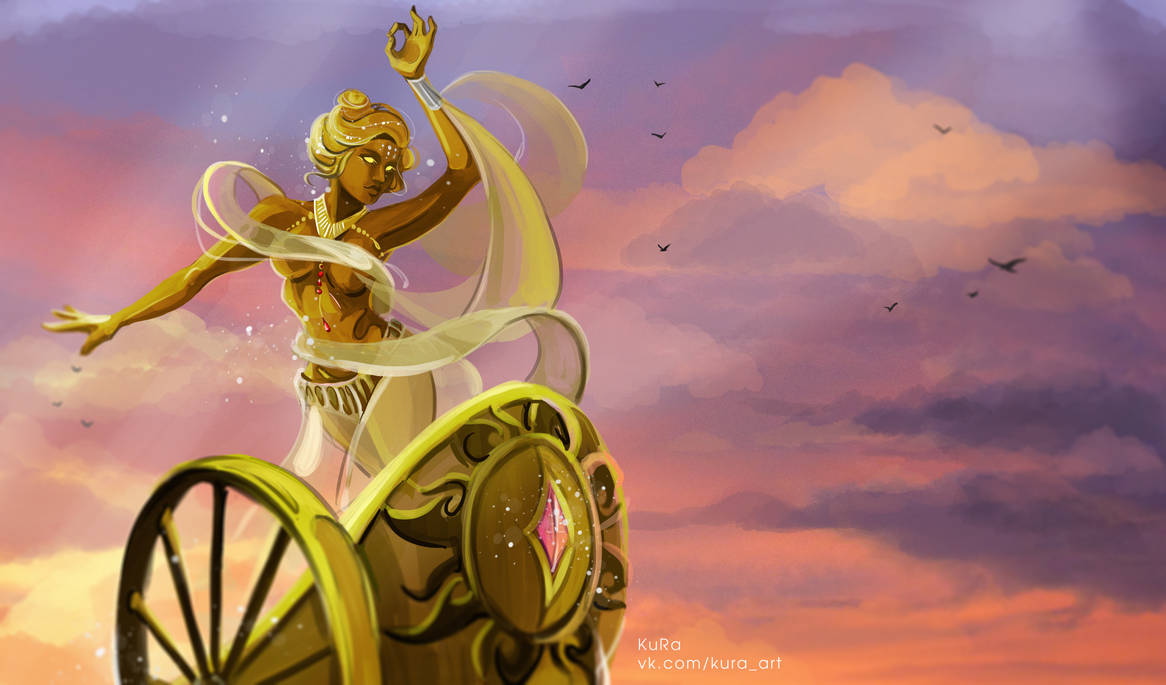
"Ushas is described in Vedic texts as riding in a shining chariot drawn by golden-red horses or cows, a beautiful maiden bedecked with jewels, smiling and irresistibly attractive, who brings cheer to all those who gaze upon her.

"Hymn 6.64 associates her with wealth and light, while hymn 1.92 calls her the "mother of cows" and one, who like a cow, gives to the benefit of all people."

Good so far, but there to this we can add the Greek elements of beauty;

"The dawn goddess Eos was almost always described with rosy fingers or rosy forearms as she opened the gates of heaven for the Sun to rise. In Homer,[27] her saffron-colored robe is embroidered or woven with flowers; while the singer in the Homeric Hymn to Helios calls her ῥοδόπηχυν (ACC), "rosy-armed" as does Sappho; rosy-fingered and with golden arms"

....

"The delicate and fragile beauty of her appearance seems to be in total contrast with the carnal nature that was often attributed to her in myth and literature."

Because the Greek Dawn Goddess is horny on main;

"Eos fell in love with mortal men several times, and would abduct them in similar manner to how male gods did mortal women. Her most notable mortal lover is the Trojan prince Tithonus, for whom she ensured the gift of immortality, but not eternal youth, leading to him aging without dying for an eternity. In another story, she carried off the Athenian Cephalus against his will, but eventually let him go for he ardently wished to be returned to his wife, though not before she denigrated her to him, leading to the couple parting ways."

The same energy seems to have been refracted in different cultures. Especially in the Greek/Roman mythos the original was split, order reason and hope ending up with Apollo, while irresistable beauty leads to Aphrodite, together they consume most of the original god elements leaving only a vague Dawn Goddsee behind.

But what if we had ALL OF THESE TOGETHER? We could have a super-hot golden rosy-fingered, saffron veiled Dawn riding her chariot pulled by red-gold cows across the firmament, upholding reason and order, defeating chaos, but also SUPER HOT and horny as fuck, and jealous, just abducting hot guys and not letting them go until they admit she is hotter than their wives.


THE FIRE IN WATER MYTH - THE WELL OF ETERNITY


"Another reconstructed myth is the story of the fire in the waters. It depicts a fiery divine being named *H₂epom Nepōts ('Descendant of the Waters') who dwells in waters, and whose powers must be ritually gained or controlled by a hero who is the only one able to approach it"

This one doesn't have the same "condesive" power as Sexy Dawn but it does have a particular poetic beauty which I have not seen replicated in fiction.

Fire in general is interesting in the reconstructed Indo-European mythos. 'Eternal flames' are common. The Zoroastrian seem to have inherited one part of that and in middle ages Lithuanian culture warriors for the church said it was easier to shut down the sacred eternal flames than to cut down the sacred groves as the fires gave themselves away by their brightness. Fire is also associated with sacrifice, which is a heavy, heavy strand in the mythos. Reality began with a sacrifice and the sacrifice of animals and animal flesh remains important, usually they are shared with or sent to the gods by fire, the Fire-God forming a kind of link between the mortal and divine realms.

"In one Vedic hymn Apām Napāt is described as emerging from the water, golden, and "clothed in lightning", which has been conjectured to be a reference to fire."

Nechtan of Irish Myth guarded a sacred well;

"Nechtain son of bold Labraid
whose wife was Boand, I aver;
a secret well there was in his stead,
from which gushed forth every kind of mysterious evil.

There was none that would look to its bottom
but his two bright eyes would burst:
if he should move to left or right,
he would not come from it without blemish."


Another well from the same mythos;

"Connla's well, loud was its sound,
was beneath the blue-skirted ocean:
six streams, unequal in fame,
rise from it, the seventh was Sinann.

The nine hazels of Crimall the sage
drop their fruits yonder under the well:
they stand by the power of magic spells
under a darksome mist of wizardry."


And from there to the numerous wells in Norse mythology. The Urðarbrunnr, the Well of Fate where the Norns go to weave the Skien of men;

Two sections of the book Skáldskaparmál reference Urðarbrunnr. The first reference is in section 49, where a fragment of a work by the 10th century skald Kormákr Ögmundarson is recited in explaining how "Odin's fire" is a kenning for a sword. The passage reads "A sword is Odin's fire, as Kormak said: Battle raged when the feeder of Grid's steed [wolf], he who waged war, advanced with ringing Gaut [Odin's] fire." and that Urðr "rose from the well."

and "Mímisbrunnr", the Well of Wisdom which seems to have a similar nature

"High explains that, beneath this root" [of Yggdrasil] "is Mímisbrunnr and that the well contains "wisdom and intelligence" and "the master of the well is called Mimir. He is full of learning because he drinks of the well from the horn Giallarhorn. All-father went there and asked for a single drink from the well, but he did not get one until he placed his eye as a pledge.""


What do we get if we condense all of these? A primal fire, perhaps that of the first sacrifice, hidden beneath water. A deep water it seems, and dark. 

In many versions the three Fates (very common across the Mythos) guard or dwell nearby. In some particular animals live there, the original swans from which all others descend, or the Salmon of Wisdom, who eat the magical Hazel Nuts which drop into the water.

There is always fire or brightness under the water, a God, the flashing of Salmon, or the knowledge of Fate. Probably you are going to lose at least one eye, likely both. Odin sacrifices one to drink from the water, those who look into the well of Nechtain have their eyes melt out. 

A God arises "golden, and clothed in lightning". Apām Napāt in the Vedas and also in early Zoroastrianism. Deep water, bright eternal fire, knowledge of Fate, a connection to the Divine and divine sacrifice, and the sacrifice of eyes for those who look.

Of course both Warhammer and Warcraft have their own 'Well of Eternity'. In Warhammer Tzeetch throws his chief Demon in to discover eternal knowledge and ends up with a mutated Kairos Fateweaver, who can see past and future at the same time, lies and tells the truth at once and who is curiously blind to the present.


(I am out of time for this post but may return to the subject in future).

Thursday, 23 July 2020

Binding and Combining

Two big problems inside the mind, neither of which I really understand.

'Binding' which I think is working out what objects are which, and 'Combination' which is about creating the matrix-like world-view which our little homunculus sits inside while riding the body around.

All of this started because I like Louise Sugdens painting style and because I like Dazzle Patterns on ships, and so I began a small investigation into colour, in particular, into colour and mass/shape...

After all, it’s only trying to understand how colour works, and how that combines with our sensation and understanding of mass.. how hard can it be?

Answer - INFINITELY HARD, for the very question opens the doorway to a crystalline dungeon of PRISMATIC MYSTERIES.

The search has taken me through Neurobiology (We Know It When We See It by Richard Masland), Ship Camouflage in WWI (Dazzle - disguise and disruption in war and art by James Taylor), and a deep cut into colour as used by artists (Interaction of Colour by Josef Albers).

We can also possibly add 'Through the Language Glass' by Guy Deushter, about a mild Sapier-Whorff effect in language and colour.


Alllbeeerrrs! HES LOOKING RIGHT AT ME


IS COLOUR THE MOST RELATIVE SENSE?


or just the most obviously relative?

So many scientists, art teachers, philosophers, messing around with coloured thread, coloured sheets of paper, swatches of colour, showing them to people of different nations, in classrooms, in laboratories, to rabbits while a hole has been drilled in their skulls to let the electrodes in, sailing around looking for rare islanders so you can show them the colours and write down what they say. More flags, shining lights, patterns of shade and texture.

Albers would remind us that our understanding of all these colours is massively shaped by context, types of light, (electric, dawn, dusk, passing clouds, albedo), by the arrangement of colours around and within each other, one colour on another, next to another, torn edges, straight edges, curly shapes, blocky shapes, texture on flat and so on and so on, so that he might regard these neurologists and cultural analysts running around as quite mad and pointless.

ALBERS - The most curious and unique of the minds I have witnessed through text. A man with the very tight, intense, highly disciplined brain of a laboratory scientist, a careful, systematic and procedural method to his teaching (learning about colour is *not about self-expression!*). And yet, with the least scientific aim and probably the greatest scepticism towards the systematising, totalising goal of science.

Albers is learning and teaching his students, through the medium of relentless attention and careful systematic analysis, about something he believes is very, very, highly relative. Fluid within perception and within the mind, to the extent that considering colour outside of its context, as an isolated quality, I think to him that would be utterly insane, since that is something it can never be.

Is it really the most relative of sensations? I think probably it is not, but that it is the most *observably relative* because it comes to us always alongside shape, objects and *DIVIDING LINES*, and I think the secret to the perceived relativity of colour is not that it is more relative than touch, smell or sound, but that it is more relative than objects and lines.

The mind is Binding and Combining the shapes of objects and dividing lines between things ("edge detection") all the time, and however it is doing this (we still don't really know), it seems to me that shapes, objects and lines are a lot less relative and debatable (both within the mind and beyond it) than the colours which always are sensed with and alongside them.

We might not all be seeing the same colours, and we can be certain, that in different lights and different times of day, things which register as always having the same colour in our minds, in fact have quite different colours, and that our brain is clearly fudging the issue, but *in comparison* to colour, we can be much more certain that the lines, shapes and objects we perceive, are both coherent to themselves and coherent when discussed and compared between individuals.

"That big rock, is it more yellow or green would you say?"

and never (ok, rarely)

"That big yellow-green thing, rock or sponge, would you say?"

And it is this, the evidently-relative-relativity, if you will excuse an awful phrase, which makes colour more obviously relative than sound or touch, because it lives along side and is always contrasted with, shape and line, which is very much less relative (probably more dominant, earlier maybe, in the binding & combining process).


Neurons! How do they work!


IS THE BLUE I SEE THE SAME AS YOURS


It’s likely. If it’s not exactly the same it’s probably pretty similar, unless you are at the far end of the curve, and most crucially, as Albers would tell you, IT DOESN'T MATTER!

For colour is RELATIVE and exists only relative to its context and therefore all that truly matters is if what you see as blue has the same relative relation to what you see as red green etc as everyone else which it probably does (though maybe not entirely).


COLOUR AND TIME, VISION AND TIME


While I know nothing about any of this I know even less about this part so beware, but it seems to me that vision and in particular the binding and combining of colour and form, and many colours, gives us access to a kind of island of no-time within our own minds.

As Albers would tell us, and here I'll bring in Ian McGilchrist of "The Master and His Emissary", sound is sequential, it can only happen in a row of information (though different sounds can be combined at the same time), touch is a bit less sequential, you can tough something with different bits of yourself, or be touched at once. Movement has a 'moment of movement' but is quite largely sequential, it happens in a row but vision, and the sensing of colour and shape, am I wrong in thinking that it has the least sequential elements?

McGilchrist would say that one part of the mind senses and 'sees' everything in one big burst and the other scans and sequentialises, so maybe sight, vision, has the most complex experience of time within the mind.

When I imagine the binding/combining process, I imagine something with a 'loose moment', a kind of drifting, or indistinct sense of the 'now'. The mind sees, absorbs, identifies, arranges and understands, all happening together. The big blurt of information from the all-at-once scan, the rapid sequential object scanning, the binding and combining shape colour, shade, light, fluid integration and re-integration with the imagined and re-constructed mind-state, both what 'just happened' (the part that makes us think the rabbit is still inside the hat) and the 'about to happen' (that lets tennis stars work out where the ball is *going to be*, all of this, binding and combining, looping and feeding back, continually, whenever our eyes are open.

And so, within the mechanisms of vision are many mutual but simultaneous *perceptions of time*. sequential, global, memory looking back and imagination/modelling looking forward, all happening "at once". The experience of vision is like a kind of time machine, a timeless, or looped moment within ourselves, which we can dip into and experience, slightly, a more or less time-powered moment, variations on what 'now' is.


WHY DO I GET A GIDDY FEELING WHEN PRESSING AGAINST THE EDGES OF THE IDEA?


Perhaps this presentiment of the complex nature of consciousness, vision, time, self awareness, is why when I reach certain points of Albers book, Maslands book and McGilchrists, I get a kind of giddy feeling. That feeling when you are just on the borders of a great idea, the moment before something complex, difficult and indistinct synthesises inside your mind into a coherent whole.

This might just be the borders of my own stupidity.

Or am I pressing against the edge of REALITY ITSELF????


More Albers, you and your GODDAMN SQUARES JOSEF


AM I SMART ENOUGH TO UNDERSTAND THIS STUFF?


Probably not really no.

Masland is pop-sci and at the deeper end I struggle.

Albers, god damn fucking Germanic Albers. First its a book of experiments really, that you are meant to perform, and I didn't. Didn't have the right stuff, time or will. And second he writes in this bloody art-school Germanic hyper-clear style, which because it is hyper clear and has only the correct info in it
is fucking hard to get through. There is no pulse of info/blather for you brain to take a moment to recombine, instead its infoinfoinfoinfo.

Its one of the most interesting books on colour that I have ever read, but again, I found it a struggle, especially towards the end. There were effects and ideas that I found it hard to perceive, model and consider, and so I ended up somewhat, sweeping over the words in a fearful rush. Back in secondary school maths again! fuck!


Ian McGilchrist being a WEIRD DUDE


COLOUR AND MASS, SHADE, SHINE, BRIGHTNESS AGGGHHHHHHH!


God fucking damn it brain, why you have to be so complex. All I wanted to understand was colour and mass.

Well, good news. Brain works out what shape and mass things are about 20 different ways at once. Edge detection and memory probably the most simple, though they exist at different ends of the binding/combining process (probably, we don't really know, and as I theorised above, 'different ends' likely doesn't make much sense in a temporarily fluid process with massive feedback loops).

Other ways - shade, light, texture, gleam, RELATIVE COLOUR. whoop de fucking do, all these things are changing massively, continually, always, depending on light, weather, perceptions, environment, background, movement between objects , movement WITHIN an object (which way will the Zebra jump - dunno as bunching muscles all fucked up by those dang stripes), and everything else.

False weathering patterns on 40k minis, showing you illusory mass one way, comic book style highlights on minis showing you mass another way, fake metal gleams in the non-metallic metal process showing you shape of imaginary metal, Blanchitsu style with decay and deep shadows, and the pale and nacreous skin which is good at showing those gothic shadows, showing you mass another way.

All somehow dealing with mass, or the delusion of mass, enhancing and re-creating the sense of 'shape' using false or simulated miniaturisations of aspects of the real(er) large scale world.

AND ALL DIFFERENT!!!

Especially when considered as different painting techniques, as in you literally need to do and think about a lot of stuff differently to employ each one.

Camouflage probably provides the key to entry to this subject but I have only read one book on it - stuff on 'Dazzle' (which seems like it didn't actually work, looked fucking cool though - raised morale, that counts!

But there are even different techniques and ideas behind kinds of camouflage. Camo for invisibility
for disruption of shape, of movement, counter-shading seems to have been invented, or re-invented by camo people (and oddly enough that is the exact opposite of a mini technique called zenithal highlighting).

Looking into the way camo destroys the understanding of mass and shape as a method for understanding how the eye and mind create and perceive mass and shape seems like a good idea.

More on this later perhaps.


Thursday, 18 June 2020

Amish in Space

I've watching Star Trek TNG Series 3 for a while during lockdown.

It's interesting. I saw these first when I was maybe 13, watching at home. Fascinating to see them through the mirror of my own memory. There are lots of relatively subtle adult interactions and themes. Im sure I missed a lot when I was younger and now I try to understand how much I understood and what I half understood.

The family episode where Picard goes back to his brothers vineyard after the Borg, I knew even young that something complex and dark was happening, that Captain Picard was upset! he cried! Now I can see that but, I think more than anything else what adulthood brings me is an awareness of all the complex, invisible social language going back and forth between the characters. I think now I understand just how insufferable a young Jean Luc Picard must have been to his brother and how much Robert must have resented him, and how much he both regrets that and still does resent him.

Anyway.


PURITAN HUMANISM


I know the imagined tech of Star Trek is based more on extrapolations from the current tech of the time of its production AND that its chimeric synthesis of technologies and society is made both to take account of the possibilities at hand, and to communicate the stranger elements of the show through a matrix that a mass audience will understand, so don't @ me.

BUT

I am interested in thinking about what if, even considering the current direction of technology, the Star Trek tech is/were/will be an actually-real thing? I mean in a cultural sense. Because, while from its original perspective, Star Trek is very technologically aspirational and humanist, if you imagine it in relation to current developments in technology then Star Trek is obsessively, puritan about its Humanism even anti-technology, bordering on Luddite, at least Luddite-restrictive rather than Luddite-destructive.


AI


The ships A.I. is basically super-Siri. Little more than a database with a complex search function and a range of cybernetic control algorithms which aid with the running of the ships complex processes.

But all of these are designed specifically to plug into human and humanoid inputs, to 'keep a man in the loop'. From the perspective of a far future systems designer, this is slightly maniacal. Building this complex system of subtle technology and leaving in these gaps which can only be filled by organic semi-independent beings, all of whom perform more slowly, and with less accuracy than a computer.

But it also makes sense from a societal perspective. If you imagine a really intensely puritan humanist culture, one absolutely dedicated to the idea that space exploration, and culture generally, are *for humans*to the extent of throwing away, restricting or banning powerful technologies, even when they might provide a distinctive edge.

This does seem dumb.

But - consider the political and cultural argument after the battle of Wolf 359, and the just in time destruction of the Borg Cube in the Sol System.

One side might say - hey we really need to and should have, woken up the AI's on this one. No-one wants humanity to become a slave to its own machines but if we have to choose between a risk of that and total annihilation then - yeah, wake em up, use a full-scale general intelligence.

But then the counter-argument is - no, the existence of the Borg, and what they just did to us shows absolutely that we can never wake up the AIs and have to do things our puritan humanist way, even if it might mean our destruction.

Because that - the Borg, is what happens to you if you fuck the computer too much. Either the AI's absorb you, or you have to form a giant Borg mind just to control the AI's and turn into that. Maybe that’s how the Borg were created, maybe they are just a distant version of the Federation who faced an impossible threat and adapted to survive.


DATA


The only Synthetic General Intelligence the Federation will even allow to exist is Data, a creature *specifically designed* to look human, bound in a human form and to *desire to be human*, and to be largely unable to fulfil that desire.

And on a few occasions, Data still goes full Skynet and illustrates that even limited as he is, with the right prompting, he could still take over the ship, as he does at least.

Think about how intensely focused/repressed a culture needs to be to be able to conceive of an AI, but only willing to make one, (on the borders of its own power, and half off the books),when the existence of that AI is so closely bound to the conception of humanity that its almost enslaved by its own desires.


GENETICS


The federation actually finds it easier to accept aliens that to deal with genetically altered humans.

Which again makes perfect sense because the Federation is a humanist meritocracy, or trying to be one, and if genetics is anything, it’s the science of human inequality, and worse than that, of *predictive* human inequality, and worse than that, if you bring heritable alterations in, the science of inherited class-based human inequality.

And that makes it kryptonite for a scientific, rationalist, egalitarian and humanist society. A society which simultaneously believes deeply in science and reason, and has no magical source which legitimises its belief in equality, (God didn't make everyone in his image, souls aren't real)

Well here comes science to tell you with increasing and terrifying precision exactly how unequal people are and, with the big data and high end algos (which you may be deciding not to use),to predict their lives and outcomes with increasing and terrifying accuracy. And also to put directly into your hands the ability to produce improved and better humans, or at least, better by all those standards you claim to value, more healthy, more intelligent, more reasonable, kinder.

So if you really believe in humanism, and in reason, why can't you produce improved humans? In fact how can you excuse *not producing them*?

And if you do produce improved humans, is there even any way to do it without essentially bleeding the current social and global technology and resource hierarchy into the very bloodline of the species?

Probably there is not.

In the star trek universe this leads to a genetic world war, and then they discover chill aliens and interstellar travel, and so the Federation is = Aliens Good - Genetic Engineering - FUCK NO.

But this is also because the process rests on an irresolvable fault line in their society and philosophy.


SOCIETY


An egalitarian society with Quasi-Military Hierarchies, Standard nuclear families, adapted relationship rituals with historical continuity.

The society of the Federation is more obviously odd when seen from its out point in time, as society has changed a LOT more than technology since TNG was broadcast. All of the tech is comprehensible, slightly archaic, but the hatred of torture, the traditional roles and archetypes and the 1990's views on sexuality etc all feel very archaic.

But it makes sense if these people are Amish. Individuals living with borderline singularity technology and, from our perspective, infinite resources*, but living in some hyper-constrained version of 20/21st century society _because that society keeps you stable_.

It keeps you safe. It prevents the singularity and it prevents the fracturing and dispersal of humanity into a hundred thousand different lines of gene manipulation, cybernetic alteration, cultural drift etc etc.

(*There is no cornucopia, human desires expand to consider any available resource and human conflicts and ambitions can take place over matters that would seem mad and ethereal to older generations.)


DESIGN


There are no neural-network designs visible in the Star Fleet aesthetic. I'm thinking here in the difference in the arrangement of form, space and technology between a kind of post WWII human industrial thing and the kind of flowing, near-incoherent designs you seem in a handful of hyper-modern buildings, and in other places.


There is a train station in near me based on a 19th century red-brick industrial base, but the roof of the station was designed in a computer and could only have been designed in a computer, with 3d modelling software, flowing, irregular bespoke elements. It looks pretty strange.

This is it. Don't know it it gives you the impression I described here.


Consider also the architecture of both spaces and technological processes designed by neural nets, the kind of tech where, it works really well, but we can’t define *how* it works, and the kind of technology where a box does something complicated but we can't really open the box and fiddle with it because it’s too strange to our limited ability to do. We can get you a new box real easy, we can manufacture them by the 1000s in our super-factories to a design given to us by a monodirectional AI, but you can't open the box and fix it.

Which, compare to a mid 20th Century car, where its big and lumpen but you can open it and fix it and access every part ultimately. (Except maybe some parts sealed inside the engine block?). Because everything in the machine was put there by human hands and arranged to a plan literally, literally directly draw, on paper, in ink, by a human hand, by a guy with a slide rule.

So every part of that technological construction process directly involves human hapsis and ideas and concepts and plans which can be directly conceived of by the human mind and, though highly specialised, can be passed between human minds in base reality.

Star Trek tech, even when miniaturised is clearly designed to be accessible in this way. Something you can repair rather than throw away, something you can read a manual to understand. Something where you understand the principals of how it works and, in theory, could follow all those back till you understood the whole thing.

And again yes there are storytelling and era-relevant reasons for this in the fiction.

However - consider it as a real thing. A society which has the theoretical capacity to create post-future designs but which simply chooses not to.


GOT IT OFF THE VULCANS


For diegetic reasoning as to why this might be so, well I imagine that in the Star Trek universe, species that go hardcore for technology or self-alteration either sublime beyond the point where they can be conceived of as people in the same way as most ST races, like they go off and become interdimensional gods like the Q or the wormhole dudes. Or they become homogenising swarms like the Borg, or hyper-stable genetic tyrannies like the Dominion or they just sit on their planet being mysterious and all-knowing and/or decadent (waiting for a Starfleet Captain to turn up).

But it looks like in the Alpha Quadrant there are a whole cluster of species which gained technology at roughly the same time in galactic terms, and which have also adopted this highly conservative philosophy to quite an extreme degree as even in conflicts with each other they strongly resist any progress towards the Singularity.

(Its mildly amusing to think about the different reasons each species might have for limiting their own technology, even when in conflict with each other. Klingons – not honourable. Romulans – don’t make a machine smarter than you are.)


So..


 interesting thing about the differences in Star Trek between when it was made and when it was seen

When made, its very much about the future, possibility, and bleeding edge tech, and about humanity and humanism. But when seen, from now, if taken as real, the balance has shifted and the same stories are now about being very conservative with technology, stories about controlling and limiting the role of technology about not proceeding towards the singularity, and about bending the arc of tech so that it serves the needs of a people, species and community conceived of in *very* conservative terms.

Compared to even some modern societies, the TNG Cast are like the Amish in space