Monday, 6 November 2017

not so good of deeds as great of name - FQ Book 2 Canto 2

From Giallo to Sitcom today in a thankfully brief Canto.

Guyon delivers to the Baby a classically medieval speech about how terrible life is and then sets down to wash his little bloodstained hands in the spring.

(There is also this line;

"(So love does loath distainfull nicitee)"

Which is maybe the third reference to how those of true noble feeling are not afraid to get their hands dirty doing stuff, which is interesting. Its turning out to be a minor obsession with Spenser and is always delivered in this semi-authorial aside.)

Anyway, the blood WILL NOT WASH OFF..

"The which him into great amaz'ment drove,
And into diverse doubt his wavering wonder clove."

Which is the most delightful description of confusion I have ever read.

Guyon freaks out a little at this and wonders if its divine vengeance or just super-poison in the blood but his Palmer calms him with some exposition, which apparently he knew all along;


  • Most spring are magic one way or another.
  • This spring used to be a Nymph. (2nd of those in the poem)
  • Its magic is relatid to how it became a stream. (like the last one)
  • This Nymph was out hunting and ended up running away from a horny rapist. (jesus fucking christ Spenser again?, this is like an Alan Moore comic)
  • She appealed for divine help to keep her chastity, got turned into a rock and this stream is her rape avoidance tears which are so chaste they will not "with any filth be dyde" so that's why they won't wash off blood.

So they move on and it looks like Sir Guyons horse has been stolen. They carry the baby on foot. Knight, Palmer, Bloodstained Baby, this is how you know you are in a Chivalric romance.

............................

Part Two is a castle divided amongst three sisters who are all in conflict with each other.

Really its the eldest and youngest against each other and against the middle one as this is a Goldilocks Castle, everything comes in threes and the two on the end are crazy bitches and the one in the middle is just right.

Guyon meeds with the middle sister Medina, and they get on very well, it seems like maybe a very temperate romance might possibly be on the cards, eventually.

But the other sisters each have a knight that's into them. The youngest is into Sans-Joy, who you will remember as the attempted rapist of Una in the last canto and who apparently survived his combat with Satyrine.

The other is, amazing;

"He that made love unto the eldest Dame,
Was hight Sir Huddibras, an hardy man;
Yet not so good of deeds as great of name,
Which he by many rash adventures wan,
Since errant armes to sew he first becan;
More huge in strength, then wise in workes he was,
And reason with foole-hardize over-ran;
Sterne melancholy did his courage pas,
And was for terror more, all armed in shining brass."

These two hear about Sir Guyon arriving, both come out to challenge him, but on the way they run into each other and start fighting.

"The noyse thereof calth forth that stranger knight,
To weet, what dreadful thing was there in hand;"

Guyon being Guyon, the first thing he does is to try to seperate them and calm them down, because you know, Temperance.

"But they him spying, both with greedy force
Annonce upon him ran, and him beset
With strokes of mortal steel without remorse,"

Sir Guyon fights them off and pushes them both back. They start fighting each other again. He tries to stop them, They fight him.

"So boldly he him bears, and rutheth forth
Between them both, by conduct of his blade
Wondrous great prowesse and heroic worth
he shewd that day, and rare ensample made,
When two so mighty warriors he dismayed:
Attonce he wards and strikes, he takes and pays,
Now forced to yield, now forcing to invade,
Before, behind, and round about him lays:
So double was his pains, so double was his praise.

Strange sort of fight, three valliant knights to see
Three combats join in one, and to darraine
A triple war with triple emnitee,"

Eventually Medina comes out with her chest bare (2nd time for this in the Poem) and persuades them all to calm down with a speech about self control and and just cause which is pretty much the death of knight errantry.

We finish with a meal with Erissa_=, the eldest;

"Such entertainment base, ne ought would eat,
Ne ought would speak, but evermore did seem
As discontent for want of mirth or meat;"

A woman after my own heart. And the youngest sister;

"But young Perissa was of other mind,
Full of disport, still laughing, loosely light,
And quite contrary to her sisters kind;
No measure in her mood, no rule of right,
But poured out in pleasure and delight;
In wine and meats she flowed about the bank,
An in excess exceeded her own might;
In sumptuous tire she joined her self to prancke,
But of her love too lavish (litle have she thancke.)"

Guyon tells his story - he comes from the Fairy Queen and has the order of Maidenhead, and has been sent to take down Acrasia.

Then we get a lunar metaphor (Guyon seems to get these rather than Solar ones. We will see if that goes on) and everyone goes to sleep.


Sunday, 5 November 2017

TEMPERATE TO THE MAX!!! - The Legend of Sir Guyon FQ Book 2 Canto 1

How the hell do you tell a story where the main character is Mister Reasonable?

Add sex, drugs, dead girls and blood-smeared babies.

Think this is Walter Crane

We start this Canto with Archimagos escape from prison, his finding of Duessa (she's living in caves and wearing moss) and their scheme to, yet again, dick Redcrosse around;

"And forth he fares full of malicious mind,"

BUT - things do not go the customary way for Archimago, as we shall see.

Firstly - Redcrosse is now slightly less stupid;

"By now so wise and wary was the knight
By triall of his former harmes and cares,
That he descride, and shonned still his slight:
The fish that once was caught, new bait will hardly bite."

After his experience with Spensers killer Dming Redcrosse has presumably either graduated to the safety of storygames or is just murdering every suspiciously innocent old man he meets.

So, Archimago (also, I recently found out that Wikipedia thiks this is the first use of 'Archmage'. Spenser probably meant it to mean 'First Image' or something like it, and its probably/possibly a metaphor for the Catholic church. So that's where 'Archmage' comes from) Archimago can't fool Redcrosse any more but he can find some other mark.

Enter Guyon.

There is nothing physically interesting or remarkable about Guyon so far, except that he travels with an Aged Palmer who finds his way slowly on foot, with a staff;

"And ever with slow pace the knight did lead,
Who taught his trampling steed with equal steps to tread."

Not sure of the Artist
Oh Archimago

We then get a classic Archimago/Duessa scene where they try to get Guyon to attack Redcrosse.

Which almost works. But at the last minute Guyon decides he can't strike the image of the cross on Redcross's shield, and Redcrosse recognises Guyon and can't strike the image of Mary on his shield. So they stop and calm down.

Then they shake hands, agree to be friends and go their seperate ways.

TEMPERANCE BITCHES.

That takes us to the middle of a Canto.

This reminds me a lot of the introduction of a new superhero in a fresh book or as a side-story in someone elses book. There's almost always a scene where they encounter an older or alrady-popular hero whos possibly a bit like them, then they either fight, or deal with some problem together. The new hero approaches the problem in a way which is clearly a bit different to the old hero, but also wins thier approval.

This does a lot of stuff in serial story terms. It links the new hero to the old one, they are part of the same universe. It makes it ok for fans of the old one to like the new one, because they have been OK'd by the classic, and it marks them out in an individual way as being a 'bit different'.

Anyway, that's the middle of the Canto. Now we start Sir Guyons first real adventure.


...................................


Sir Guyon (and his Palmer) hear a cry from the woods.

The cry is two verses long and its a woman crying for death and saying she's leaving her baby behind.

Guyon "from his tall steed, he rust into the thicke," and finds;


  • A hot girl, suicided with a knife to the heart.
  • She's gushing loads of blood.
  • There's a baby.
  • The baby is playing with the blood.
  • There's also a dead knight.
  • He's smiling.

I do like it when things turn Giallo.

There is a good verse about the overpowering strength of Guyons heroic emotions;

"At last his mighty ghost gan deep to grone,
As Lyon grudging in his great distain,
Mournes inwardly, and makes himself moan:"

Guyon tries to stop the bleeding;

"What direfull chance, armd with revenging fate,
Or cursed hand hath plaid this cruell part,
Thus fowle to hasten your untimely date;
Speak, O deare Lady speake: help never comes too late."

But it actually is too late as the Lady only has time to tell her sad story before dying;

  • She was totally into this knight here (Sir Mortdant).
  • He left her to go off seeking adventure.
  • But "Me he left enwombed of this child,"
  • He "come, where vile Acrissa does wonne," (Acrissa - greek for 'Without Control' according to the Penguin edition notes.
  • Acrissa is a hot sexy enchantress who floats about in a mgic island called 'The Bowre of Bliss' where she pervs up Knights with "Words and weeds of wonderous might".
  • The Lady gets her knight back, after wandering pregnant through the world.
  • They are leaving when Acrissa curses him, as soon as he drinks he dies.
  • Thus, the Lady gets Despair and stabs herself.


She then dies. Guyon has a conversation with his Palmer about burying them both, which I didn't entirely parse.


Guyon cuts part of everyones hair, mixes it with the womans blood and throws it into the grave and we end with a classic super-oath of vengance and justice, 'the dead knights sword out of his sheath he drew'.

It's Sir Guyon verses Acrissa, and he's going to take her the fuck down, in the most temperate way possible!

End Canto.


Saturday, 4 November 2017

the raskall many - Faerie Queene Book 1 Canto 12

A short, somewhat boring Canto, in which everything turns out alright for our heros.

It's livened up somewhat by the crowd scene and by that genre classic, the last-minute villain interruption.

And Phoebus is back! Verse 2;

"Scarsely had Phoebus in the glooming East
Yet harnessed his firie-footed teeme,
Ne reard above the earth his flaming creast,
When the last deadly smoke aloft did steeme,
That sign of last outbreathed life did seeme,"

Most of this Canto is standard legendary stuff, this sequence with the crowd is a bit different, is a nice counterpoint to the hoary king in sonorous line, and isn't shown in any illustrations I can find so I give it to you in full;

"And after, all the raskall many ran,
Heaped together in rude rablement,
To see the face of that victorious man:
Whom all admired, as from heaven sent,
And gazed upon with gaping wonderment.
But when they came, where that dead Dragon lay,
Strecht on the ground in monstrous large extent,
The sight with idle feare did them dismay,
Ne durst approach him nigh, to touch, or once assay.


Some feard, and fled; some feard and well it faynd;
One that would wiser seeme, then all the rest,
Warnd him not touch, for yet perhaps remayned
Some lingring life within his hollow brest,
Or in his wombe might lurke some hidden nest
Of many Dragonets, his fruitfull seed;
Another said, that in his eyes did rest
Yet sparckling fire, and bad thereof take heed;
Another said, he saw him move his eyes indeed.


One mother, when as her foolhardie chyld
Did come too neare, and with his talants play,
Halfe dead through feare, her litle babe revyld,
And to her gossips gan in counsell say;
How can I tell, but that his talents may
Yet scratch my sonne, or rend his tender hand?
So diversely themselves in vain they fray;
Whiles some more bold, to measure him nigh stand,
To prove how many acres he did spread of land."


This is kind of a Seven Samurai bit. From the point of view of the crowd, or the common people, the Hero is just someone who turns up occasionally, plays an important role, gets looked at so people can tell the story, then goes back in their box.

I think this is also the first time the common people, or 'raskall many' have shown up in this story. They tend not to play much of a part in chivalry literature.

(The Raskall Many Ran would be a good name for a pirate ship.)


Then, in the midst of describing the feast and celebrations, thankfully, Spenser tells us he doesn't have time for bullshit;

"What needs me tell their feast and goodly guize,
In which was nothing riotous nor vaine?
What needs of dainty dishes to devise,
Of comley services, or courtly train?
My narrow leave cannot in them containe
The large discourse of royall Princes state."

Well, good.

Then the King congratulates Redcrosse and praises him for his long journey and the many terible things that have happened to him.

Forgetting that his own daughter made twice as long a journey and that almost every bad thing that happened to Redcrosse was him was a result of him being a fucking idiot.


Then...  LAST MINUTE TWIST!

"With flying speede, and seeming great pretence,
Came running in, much like a man dismaid,
A Messanger with letters, which his message said."

Whats the message? Bluntly, ya bois been fucking another girl, as described in a gloriously deceptive and magnificently acidic letter from 'Fidessa'.

To which Redcrossse replies with the vaguest shoe-shuffling verse;

"It was in my mishaps, as hiterward
I lately travelled, that unawares I strayed
Out of my way, through perils strange and hard;
That day should fail me, ere I had them all declared."


Hmmmmmmmmmmmmmmmmmmm.


Una breaks in to say that this is some enchantress bullshit and, furthermore, this messanger.... is ARCHIMAGO!

Wizard thrown in prison, but if you are missing your favourite bad guy, don't worry, something tells me he'll be back in classic comic-book style;

"But him they layd full low in dungeon deepe,
And bound him hand and foote with yron chains.
And with continuall watch did warely keepe;
Who then would think, that by his subtile trains,
He could escape fowle death or deadly paines?"

Aand the rest is marriage, brief moment of happieness but Redcrosse has to go back to the Faerie Queene to fulfill his oath of fighting for her but says he will come back eventually.

And we're out. That was Book One.


Friday, 3 November 2017

Dragon Fight! - The Faerie Queene, Book Canto 11

A Canto so RAW that the poet has to ask Calliope (in the poem itself) first, to attend directly to its creation and secondly not to get too crazy because she can drive nations mad. Also they need to save that stuff for the mega-battle at the end of the whole poem.

(This battle never arrives as Spenser never gets to his planned 12 or 24 books of poetry. So the reference to it here is all you get.)

This is a magnificent piece of Barnamesque metatextual scene-setting, very like a childrens entertainer who tells the crowd "Now were going to need a very special friend for this part!". The scene is so badass you need the direct presence of Callipoe to write it but Calliope is so dangerous you have to be extra careful when she is around.

This does not happen in the Faerie Queen.
It is not even described as happening.
The Dragon never grabs Unas Parents.

Then comes the Dragon description;

"By this the dreadfull Beast drew nigh to hand,
Halfe flying and halfe footing in his hast,"

A dragon so amazing that his scales, his wings, his tail, his sting, his jaws and his eyes all get a verse each to describe, a dragon in text as well as in flight.

Then the fight, a fight so amazing it lasts three days and has THREE different solar metaphors, Phoebeus, Titan and Aurora, which has TWO tragic ohmygodhe'sdead falls, and two unlikely saves by literalised religious or biblical metaphors.

This bit by Walter Crane also doesn't happen in the Faerie Queene.
Or at least, it doesn't happen like this.
Redcrosse loses while mounted, he wins on his feet.

(Every time I see Phoebeus in this poem I want to high-five him like a well-loved returning guest star. LIke Edward Herriman in the opening credits to Gilmore GIrls. I also just realised that 'guest star' is literally what he is.)

In previous Cantos we learnt Una was from the middle east and here we learn that this seems to be taking place in the garden of eden. How long did it take them to get there? Where is everything? What's the time scale? Who knows.

This does happen, but there are more people around.
I don't want to ruin it for you, its well worth reading on your own, and not just listening to from my poor and hesitant narration.


Thursday, 2 November 2017

Trash Canto - The Faerie Queene Book 1 Canto 10

This Canto is so dull, so long, so joyless, tiresome, overwritten, undramatic and turgidly allegorical that I cannot recommend you listen to it.

Briefly; Redcrosse goes the the magic house of Coelia (Heaven) and meet her three magic daughters, Fidelia, Speranza and Charissa, who introduce him, in turn, to an endless, ENDLESS (ITS 68 VERSES, a third as long again as most other Cantos) list of Spenserian mono-quality allegorical figures who often have their own lists of peoples and qualities to introduce him to.

Sometimes its like reading an excel sheet as a fucking poem.

Anyway, Redcrosse goes through whats essentially a very long Rocky Montage for the soul so he can be good after being a tool for the last 9 Cantos.

This is a lot less interesting than it sounds, its essentially a rather tiresome protestant sermon (more than the rest of the poem).

A few elements worth mentioning;

Fidelia is surprisingly goth for s Spenserian heroine, or at least, an interesting mix of standard brightness-metaphors and weird shit;

"...
Of which the eldest, that Fidelia hight;
Like sunny beames threw from her Christall face,
That could have dazed the rash beholders sight,
And round about her head did shine like heavens light.

She was arayyed all in lilly white,
And in her right hand bore a cup of gold,
With wine and water filled up to the hight,
In which a Serpent did himself enfold,
That horror made to all, that did behold;
But she no whit did change her constant mood:
And in her other hand she fast did hold
A book, that was both signed and sealed with blood,
Wherein darke things were writ, hard to be understood.

........

And when she list pour out her larger spright,
She would command the hasty sun to stay,
Or backward turn his course from heavans hight;
Sometimes great hosts of men she could dismay,
And eke huge mountains from thier native seat
She would command, themselves to bear away,
And throw in raging sea with roaring threat.
Almighty God her gave such power, and pussiance great."

Why is Charissa (Charity) not in this image?
Because according to the poem she goes around with her boobs out.
(To suckle her endless young.)


The second interesting thing is that to purge his guilt (he probably boned Duessa between lines in a previous Canto) Redcrosse has to submit to essentially being tortured in a mirror of all the stuff he has gone through in previous Cantos with the imprisonment and encounter with Despair, but now presumably its ok because its for a holy purpose.

Anyway, at the end a magic man takes him up a mountain, shows him the kingdom of heaven and tells him he was born and Englishman and is going to be Saint George, now go and fight that Dragon.

Dragon Fight next Canto I promise.


I'm not doing the podcast thing any more because I'm almost completely certain it isn't working. 
But if it is working for someone and you want me to keep doing let me know in the comments, 
which I have turned back on.

Wednesday, 1 November 2017

Despair! _ The Faerie Queene Book 1 Canto 9


  • Arthur tells his story.
  • He is of unknown noble birth, raised by an Elvish man in Wales.
  • The poem says he is raised in a valley of the Rauron, where the Dee springs from the ground. The Dee is the river passing down the south side of Wirral, the same one Gawain crossed to get here at the beginning of his poem.
  • Arthur dedicated himself to not falling in love, then has a magical night with a Faerie Lady, and falls in love.
  • He's still looking for her.
  • Arthur and Redcrosse exchange gifts and part.
  • Redcrosse and Una meet a terrified knight with a noose around his neck.
  • This Knight Treusian, tells of travelling with his friend Terwin, they meet a man.
  • This man talks Terwin to death, that is, persuades him to kill himself.
  • Redcrosse decides to encounter this man.
  • They meet, and Despair pretty much talks Redcrosse into killing himself.
  • Una knocks the knife out of his hand.
  • They depart.

Una finally does something! I think this is the first notable physical action she takes in the book.

So, a few thoughts


- Phoebeus gets this canto off. Only one solar metaphor today, and that but a single line.


- There is a renewed interest/obsession with the difficulty of speaking, that is, of speaking your heart or your pain. Arthur is in mad love with a Faerie lady but warns her about his emotion and the danger of disclosing it;

"Dear Dame (quoth he) you sleeping sparkes awake,
Which troubled once, into huge flames will grow,
Ne ever will their fervent fury slake,
Till living moisture into smoke do flow,
And wasted life do lie in ashes low."

Which is an interesting comparison with the conversation last canto about disclosing things.


- It's all about love; Arthur falls in love with a Lady and that's why he's doing everything, Terwin, the knight we never meet, was also in love with a Lady who was a dick to him;

"For she was proud, and of too high intent,
And joyed to see her lover languish and lament."

And Una loves Redcrosse, (though we hear rather more of that than about Redcrosse loving Una).

Arthur literally shagged Gloriana, who is Elizabeth, so he is (metaphorically) her lover, meaning Elizabeth hearts Britain. People, this is how you end up with a £50 a year pension from the Queen. Also this is the second sexy magic lady who just appears next to a knight for sex and we are only on Book One.


Then we get the encounter with Despair, something which, I think, makes this the best part of the Faerie Queene so far. The opening is magnificent, with the terrified knight with a noose around his neck, to afraid to even stop or speak and takes a whole stanza to calm down;

"He answered nought at all, but adding new
Feare to his first amazement, staring wide
With stony eyes, and heartless hollow hew,
Astonisht stood, as one that had aspied
Infernall furies, with thier chains untide.
Him yet again, and yet again bespake
The gentle knight; who nought to him replide,
But trembling every joynt did inly quake,
And foltring tongue at last thee words seemed forth to shake.

Gor Gods deare love, Sir knight, do me not stay;
For loe he comes, he comes fast after mee."

That is one hell of an intro, one better than any monster or villain has got so far.

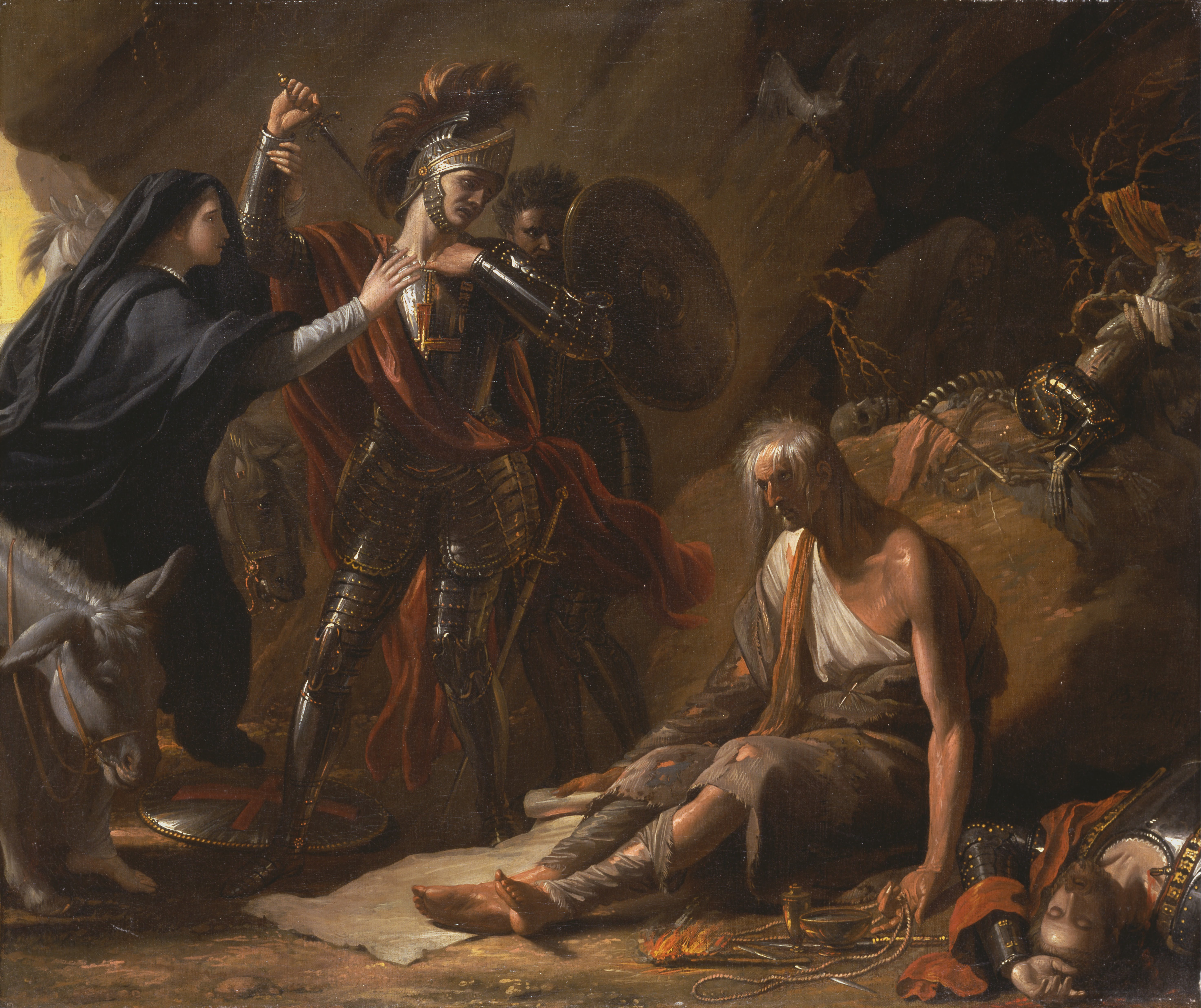
Benjamin West - The Cave of Despair.Its a fun painting, click for bigger version.

Despairs argument I will not go over again, but Spenser has him down, and he still has the same voice now as he did then. Its worth a read or listen.

From a boring genre perspective this character is a lot like still-existing 'ultimate bad guy' characters like Hannibal Lecter or the Joker, someone who's mind or nature is brilliant or exceptional and otherworldly and who's point of view so utterly inverse to life that they can, simply by talking, persuade others to kill themselves.

And, as usual with Spenser, we get a character who is simultaneously a highly abstracted archetype, but whos description  and 'acting' is filled with vigour and human immediacy so that they seem to spring to life from the page.


Literally no-one is actually reading this but I do not care.

Tuesday, 31 October 2017

Ultimate Catfish - The Faerie Queene Book 1 Canto 8

An Action Canto!

Spensers verse form really comes alive when applied to action scenes, usually I take a break every 10 verses or so but in this case I read through the entirety of the fight with the Giant and Hydra in almost one go.

Briefly;


  • Arthur fights the giant, cuts off his arm.
  • The Hydra gets involved.
  • The Squire holds off the Hydra.
  • Arthur is driven to the ground and the Squire poisoned by Duessa. It looks like the good guys are about to lose.
  • The Giants blow tears away the veil before Arthurs magic shield.
  • This is so bright it blinds and terrifies both Orgoglio and the Hydra.
  • Arthur murders everyone and the Squire grabs Duessa.
  • They investigate the Giants castle, meet his foster-father Ignario, who knows nothing.
  • The castle is very sweet but unfortunately covered with the blood of innocent Christians and also has a death alter where the souls of Martyrs wail continually.
  • Arthur finds Redcrosse and tears off the door to his iron prison with pure manliness.
  • Recrosse is in a very bad state.
  • Una advises them not to kill Duessa but to strip her of her royal robe, this done she is revealed as the ultimate Catfish and flees.
  • Our heroes decide to stay in Orgoglios castle, despite it being carpeted in innocent blood and having a death altar in it.


Popular verse elements - more brightness metaphors, this time Arthurs shield directly saving the day. If we get a Canto without a brightness metaphor I will eat my eye.

Also more 'subtil engines' this time undermining castles as part of another metaphor. Spenser must have seen some kind of 'subtil engine' at some point, as well as gunpowder, technology made a big impression on him I think,

Trying to make Catholicism look awful but accidentally making it look amazing.
Not certain of the Artist yet.

So there are a few polarities that keep coming up;

One is Spensers dual skill/presentation. One one hand he is a classical telenovella/action movie director, the motherfucker can hit story beats, move people around, manage scenes, a lot of classic but often unregarded talents.

He's also doing all this while absolutely everything in the story is a highly elaborate and specific analogy for various kinds of spiritual and religious whatever.

For the modern reader this presents a kind of split perspective, in which we are simultaneously reading a thrilling genre story while also going to the back to decode his references and work out his religious and political commentary.

But his telenovella aspect is so.. not cheesy, but so common as my mum would put it. Its a crowdpleaser, its Spielbergian, Dickensian. So my cultural programming keeps telling me to look for the trick or the irony, that Spenser isn't really doing both those things at once, that one is actually a kind of cheat so he can do the other one.

But no, I think he is actually doing both for real.

By Walter Crane I think
The second one is the loops of his metaphor and references. Our boy loves him some Greek references, and also talking about the weather and weather effects, all very standard poet stuff. But we see, especially in this Canto, the way he speaks keeps looping back into near-common speech and common references, the high tone modulates into the low, then back again, the complex into the simple and direct.

(There's another with alliteration. Spenser is doing that a lot, I feel like he is alliterating for play, allowing the rhyme and metre to take the heavy load as the 'solid' sound structure and 'painting' with alliteration, but I suppose I will have more time to think of that as we go on.)


As a Podcast

Searching for this; http://pca.st/c44P should find it on most podcasting apps.