Thursday, 27 July 2023

Ride the Giants Development Blog, Part 2

The Speed of the Giants 

This matters not only in general gameplay but because the initial concept of the game was ‘a game in real time’; an adventure lasting two to three hours, with a gaming session lasting the same two to three hours. 

There would be some, but little, compression of time. The time-limit was meant to add impetus to the PCs choices and get them making decisions faster. It was also meant to add a bit of interest and challenge to the choices made. 


Estimating the Gait 

I began by asking people on Discord for advice on estimating the gait of the giants. That is, when one takes a step, how long is the step. 

If they stood up straight, the Giants are nearly 3,000 feet high. Hunched over as they are their heads are about 2,000 feet high. So I started with the step-length of an imaginary 3,000 foot high man. Using various mysterious means, including reverse-engineering an equation used by the police to derive height from step-length, the Discord homies came back with a step length of just under 1,300 feet per-step. 

That’s just under 400 metres per step or a little under a Kilometre per double-step. 


The Chronology of a Step 

Estimating the timing of each step is more difficult. Giants of this size are physically impossible anyway. Large long-legged animals have to take care of their steps as they can easily break their own legs with their weight. 

I essentially just ended up eyeballing it. Each step takes roughly a minute and a half. 90 seconds. 

10 to 15 seconds at the start for the weight to rise and the foot to accelerate, then 30 seconds in the air, then another 10 to 15 seconds landing time for the weight to fall, the foot to settle, and weight to be transferred through the hip to raise the other foot. 

I estimate the Giants are is moving roughly 14.4 feet per second. Which makes I think its total movement being just under 10 miles per hour. 

This sounds.. really not totally insane. Like a reasonable synthesis of the impossible and pseudo-realism. 

A good one-to-three rounds of slow-foot time for you to leap up and grab on. A big "whoosh" as you travel 400 meters in 30 seconds. Then the settle time at the end. 

So a human could run away from it, someone on horseback could run faster than it. It could be 'boarded', but with real difficulty as the foot is only slow and close to the ground for not that long. To match their speed a human would need to be jogging or running. To overtake you would need to run pretty fast or have a horse. 

And a continuous 10 mph walking speed sustained essentially forever, would be very hard to keep up with for a long period of time I think? 


Boarding the Giant 

If you were trying to ‘board’ a giants foot, you could probably catch up with it, via sprinting, or if you had a horse. The really dangerous part would be when the foot comes down. If the giant trod down onto something like the soil of a field, it might send up fountains of soil like an impact crater all around the foot. If the soil was wet or the water table was high, it might send up actual fountains or more likely, dangerous torrents of wet mud. 

In the area around the foot-fall it would be like an earthquake hit. The earth might crack open, or roll like waves. Horses might break their legs and men would fall to the ground. 

If you survive all that, you have about 15 seconds at the weight of the foot settles and transfers where it will be relatively still. 

All you need to do is get to the huge curved wall of the foot, I estimate it to be about a 100 foot climb, but you don’t need to make it immediately, just hang one, hang on hard

Because that foot is going to rise up into the air. Its lateral speed at its going to be about 15 miles an hour during the swing of the foot but its speed measured across the whole of its curve till it hits soil on the next step might be more like 20 miles per hour. 

Not insanely fast. But jarring as hell. Plus the angle of its motion is constantly curving and shifting. 


What Strait do they Cross? 

Depending on if or how much time we leave for organisation the actual giant-riding part of the game might range from one and a half hours to three hours. Lets assume two hours of actual giant-riding. 

Assuming ‘real time’ that means the Giants would travel about 20 miles. 

The idea of the game is that you only have the length of the game itself to solve the problem of the giants – by the end of the game they will have reached the Nightmare Continent and if you get off the giant after that you are DOOMED  

Looking for real-life places of roughly the right dimensions the first that comes to mind is the Dover strait. 


Between Dover and Calais is almost exactly 20 miles 

But nowhere near deep enough – its only 50 meters deep!


That’s only 164 feet! About up to the giants Knees! 

Well I suppose it’s acceptable – in their hunched over posture their knuckles will be grazing the ocean surface as they walk. It also gives the PCs a fair amount of time to get up over the knee. Though if they are still dicking about with that half-way through the mission is probably failed anyway. 


Climbing the Giants 

There are several problems; the linear nature of the directional choices on a larger scale, the curved, flowing and non-intuitive surface of the giant and the shifting position and orientation of the limbs. 


The Linear Nature of the Choices 

The main problem here is that the arrangement of the giants limbs is very much not like a dungeon. There are only a few routes and risks. Large parts are semi-visible from various points. 

Most of a limb-climb is just getting up that limb,  and to make the adventure interesting at all I would need to make actually falling off relatively rare. Instead I would have to produce something like the climbing in VotE; everyone can do it a bit and failure leads to ever more nightmarish fail-states without ever quite booting you off. 

Once a climb is begun, the route-choice is largely made and any tension or interest comes  more from how challenges are met than what they will be. 


The Curved and Flowing Surface 

Lets Envisage the Giants Skin -What is this like? A curved, slightly-flexing, rocky surface. Even ‘smooth’ parts are like a rocky, and in fact most of the giants skin is deeply corrugated. 

If you look down at the skin around your knuckles. If you make a claw with your hand so the skin bunches up there, all those little triangles and oblongs of skin where the lines of compression meet and cross. Image that as a karstic landscape, but much more wrinkly – like a very old persons skin, and much deeper in its corrugations. 

Smooth parts – like  a cobblestone road, but with the cobbles jagged and not smoothed. 

Intermediate parts – like clambering over or up large boulders. 

Very Crinkly parts – like clambering over and through sharp man-sized or larger boulders

Which tilt and grind together or apart – big enough that the gaps make an ‘interior of sorts. 

So the smooth parts are actually very easy to fall off & quite dangerous while the rough parts where the limbs meet – the crinkly places of our own bodies, are relatively safe – even though they are moving and flexing, there are many holds and handholds and spaces where you can place yourself to avoid falling off (these might be dynamic holds though). 

But, maybe if I think about the actual shape and details of each part of the leg, arm and side, and think deeply about how each might move I could come up with some general ideas or abstract some rules which would help to form encounter spaces, or interesting encounter ideas? 


The Shifting Gravity 

The limb orientations are shifting regularly from near-vertical to sloped, from climb to overhang, or from climb to scramble. 

Will you wait for the position of the limb to change - it could shift from overhang to climb, or from climb to scramble and the potential danger of an opposing encounter might grow larger or smaller if you are willing, or able, or forced to, wait. 

So that idea of having to make up, lose or gain time feels appropriate. 

OR - you hear movement, or sense something above you, and if you wait you might be able to get a better look - but that will cost you time. 

TIMING – if this is ‘real-life’ timing then there could be a metronome or something. Or you could time the giants steps minute by minute. 

I don’t know if someone’s done this before but if each 90 seconds is a real-life round and an in-game round, a single step of the giant. Could it be made to work? You would have to roll fast! 


Climbing a map of the muscle groups 

Another possibility is - making some kind of map of the MUSCLE GROUPS of the limbs and making THAT a sub-map of each ascent. 

like you can LEAP from one muscle group to another to avoid an encounter.


POSSIBLE DANGEROUS CLIMBING ENCOUNTERS 

These could be quite minor - the main danger is that they could drop you. They should also be 'rock beasts', cliff beasts really. (I didn’t put pigeons in as they suck.) 

Seagull-Griffons; micro-Griffons based on seagull heads and wings but with the bodies of racing dogs. That sounds sufficiently awful. 

Goats 

Condor-Riding Snow Monkeys – they bathe in the hot springs atop the giants backs and form a symbiotic relationship with the semi-intelligent condors, travelling on their backs and performing tasks involving fine motor control – they can crack open bones with flints and actually they have learned to work in close co-operation with the condors, the monkeys can pull open flaps of skin, bare muscle, expose the joints of dead animals, brace cutting surfaces and put flesh under tensile strain so it cuts more easily. 

SUPER-TICKS – these feed upon the giants magmic blood. [The giants are tectonic inside so their ‘spots’ or pimples might be popping lava and their sweat might be steam or thick bubbling oils. A walking mountain has to be generating a pretty serious amount of heat. The giants back – hot, even steaming, would carry a moving column or a trailing flag of hot air above and behind it, a layer or a stream of cloud following each of them like a pennant in the atmosphere as that pillar of air rises, cools and probably condenses. The heat of the giants would make them of much more fecund than many other forms of similar mountain.] The blood does cool quite a bit in them but it’s still pretty hot and dangerous. Plus this is still a tick as big as a man or maybe horse. 

Animated magical kites that won't die - These were the creation of some ancient empire of magicians far away who wanted to study the giants – the kites were so well made they have a basic self-repair function and can weave the substance of cloud into solidity to act as canvas or waxed paper to sustain them – the kites are more like solid memes, or paper golems, semi-intelligent but not really alive, men can ride them but their actions may be very unpredictable – possibly they will obey commands in the language of the long-dead wizards. They might do slightly bonkers A.I. stuff based on garbled comprehension of their original instructions.  

Friday, 7 July 2023

Dark Corridors

 Choice Theory 

So you come to a split in a dungeon, or you come to a room set with three portals, each seems to lead in a different direction but they seem identical. 

Depending on party and DM, game style and preference, you either just pick one, or have a little conference with the team, maybe looking at the map, or start asking weird questions like “what do the corridors smell like?” 

Whether this is a good or bad thing depends very much on the style of game and whether the needs and intuitions of the players and DM match. 

I intuit that the ‘actual’ Old School old school process had a lot more time for no-context choices, partly due to the prevalence of player-mapping, (easier to do in-person in a 70’s game session and which would be part of their problem-solving procedure), partly due to what I would expect to be longer more digressive gaming sessions and partly due to a somewhat harder more ‘masculine’ quality where its expected that some decisions will be tricky, oblique or apparently pointless, either due to pseudo-naturalism or a Gygaxian riddlemaster element. 

I intuit that a more ‘neo’ OSR scene would have shorter sessions, more likely to be online so player mapping harder, more likely to want events and drama condensed and with less tolerance for ‘dead’ time, unguided choice and apparently contextless decisions. 

Yet, in either situation, a choice must be made, and if the choice is to be informed at all then how shall it be so? There are greater context elements which can be brought into the question; general dungeon intel, the use of mapping, informers, magic and guides.

But what can be learned from the empty corridor itself? 

And as a corollary to that decision, what information can be imbued into  that apparently-empty corridor by the designer or DM? 

I will break our discussion into elements. In lived experience all of these will interrelate but I will try to cover those interrelations within each subject; 

·        AIR

·        SMELL

·        TEMPERATURE

·        LIFE

·        SOUND

·        STONE


Once I started to think about it I decided that a key dominating and synthesising element is AIRFLOW

so I will begin with that and discuss why.


Ernst Fuchs


Air

Based on my research for VotE, Caves and cave systems can differ hugely in temperature and airflow. 

This depends on whether the system massively intra-connected or isolated, if there is running water in the cave and the general temperature gradient around the cave. 

An isolated cave system with no big interconnections and no water flow within will often be a bit warm. An underground space with static air will often maintain a steady, not-quite-cold temperature. Mines, being closed systems and full of people and movement, are often hot. 

Conversely, a huge cave system with many exits will often have very strong airflows. Caves 'breathe', and any slight differences in temperature and pressure between its varied entries can create winds which can be focused and channelled by narrow passages in the system itself. 

Most caves are shaped by water and many have streams moving through them, this creates airflow

and often cools the cave. 


Dungeons vs Caves 

Dungeons are more likely to be smaller and contained and much more likely to be made of different materials with closed doors and other connectors and divisions within, but airflow can still tell the prospective dungeoneer a lot. 

Dungeons, specifically; the classic tomb buried under temperate soil, might not actually be cold. A tomb complex separate from any other dungeon, well if it’s a rainy area it might be damp, but not necessarily, it might be slightly warm, or at least no colder than the outside. 

[Question; have you actually been in an actual tomb complex? What was the temperature and airflow like?] 

An experienced dungeoneer, or the average Dwarf, should be able to make some decent guesses about the nature of a dungeon just by carefully feeling the airflow. If a system is 'breathing' with air flowing in or out after dawn or dusk; that suggests a system of considerable size. If the air flowing in or out is warmer or colder than the outside air that might indicate the presence of moving water within, or of something else that is cooling or warming the air within, (like, for instance, the presence of life, like Goblins or an Owlbear). 

Airflow is such a dominant factor because it effects the transmission of SMELL, SOUND and TEMPERATURE, all of which are strongly bound within the greater medium of Air. Conversely the absence of airflow is itself a strong negative signal which might not explicitly tell you much but does suggest that either this dungeon, or system, whatever it is, is either small and closed, or has doors and closing elements.


Smell! 

Smell is life! 

The key aspect of scent is that in almost every case it is indicative of the processes of life. A dungeon with intelligent things living in it for any period of time is going to STINK. 


The Food Sequence 

Acquisition, Storage, Preparation, Consumption and Disposal. 

Acquisition; alpha predators like monsters who drag prey back to the dungeon as a lair will leave the stink of blood wherever they are and repeated blood trails will lead to any feeding spot, as well as blood smears and fur snatched from carried prey. 

Anything bringing living or recently dead food back to the Dungeon from outside stands a good chance of leaving marks of some kind, especially since they will be tracing the same route each time to preparation or storage spaces. 

A lot of food smells or has a distinctive scent, and in a still-air environment that scent might remain in place for a long time. 

Storage; if left unattended, the rotting bodies of victims or prey will absolutely stink to high heaven. Even for unaltered human basic smell powers it should be pretty simple to find your way through a still-air environment to a rotting body. 

Poorly-stored non-meat foods can still rot, and will summon their own micro-environment of insects and small mammals, all of which can be sensed or traced. If there are mouse droppings, that’s a sign of something. 

Well-stored or dry foods are more complex, I imagine these as leaving little scent and few biomarkers. It might be that the presence of a particular dry and contained space might leave tangential markers but I am not sure. 

Preparation; if something is intelligent and eats cooked food, and/or just needs warmth or light, then there will be fire. If there is fire there must be smoke. If there is smoke it has to go somewhere. So either there is a chimney leading up out of this dungeon or the smoke is moving through the corridors which will leave traces stains, and scent. 

Consumption; large predatory animals will definitely leave bits and pieces here and there. Smaller more civilised beings might still leave scent, the wall-sweat of their respiration, residual warmth, stains, fragments and the small biomarkers that go along with them. 

Disposal; Poo. All of this stuff has to go somewhere and unless there are convenient rivers or pits then it is going to leave strong scent markers and all the small insects which emerge from feasting on the poo. And spiders, which feast on the flies, the webs of which will remain in place for a long time in a low airflow environment. 

tldr; any closed system which has living respiring and eating residents is going to stink. If there is airflow, then its strength and direction will effect where those smells go and how strong they are. Tracing those smells might be very useful for a dungeoneer. This is one thing that encourages me in the idea of bringing a bloodhound of some kind to the dungeon 


Temperature 

Warmth is co-dependent on airflow and the presence of life within a dungeon so many of the basic concepts have already been considered in those two sections. 

[Question; how much of a temperature differential can an average, or sensitive human being detect if they are paying attention? Could they intuit the presence of a living being occupying a room behind a door? Could they tell micro difference in temperature in the air between two identical corridors?] 

What about cold? Would any particular natural phenomena cause a dungeon to chill unexpectedly? The first thing that comes to mind is the presence of para-normal phenomena like Magic and the Undead. Both are often associated with rapid temperature drops. 

Conversely, super-beasts like dragons or elemental creatures might raise underground temperatures more than you would expect. 


Life 

Respiration 

SWEATY WALLS! Why are the walls of the dungeon dripping, dank, with the nitre, so beloved of Lovecraft? It may be water flow from outside but more likely the combination of water and warmth coves from living things in the dungeon. A system of closed stone with living things within it will naturally sweat, and drip, over time. 

What about the sweaty walls of a sleeping dragons cave? Why wasn’t the gold surrounding Smaug absolutely dripping with condensation? Maybe it was and that is what caused Bilbo to slip and slide around. Wet Hobbit action. 

[Question; have any of you actually been in an actual Dungeon, under an actual castle, working or not? Are they actually the cold, dark, dripping places of fiction?] 

I mean clearly they are made not to be comfortable, but surely actual temperature would depend on how much airflow there is, or the temperature of the living rock, if its carved into that. 

Would a dungeon under a living castle with locked doors and no windows, truly underground

actually be cold? Or might it be temperate? It would be damp I think due to the respiration of everyone above in the castle and their condensed breath dripping down.


Lichen, Moss, Mushrooms, Insects 

I feel like Gary must have at least conceived of a grand table of microflora and microfauna that might grow in a dungeon and have the required and likely temperature ranges, water needs, food sources, and, in the case of insects and small mammals, roaming distances. 

I am taking being a dungeon detective a bit too far here, into Forensic territory, BUT - IF you did actually know a lot about these micro-environments you could in theory tell quite a lot about a dungeon just from observing them as you went through. 

This should go for Rot as well, a microorganism which leaves sensory traces. A rot wizard could tell quite a lot about living systems. There is probably an opening somewhere for someone to produce a matrix of easy-to-use and 'read' pseudo-realistic dungeon microfauna, not for use as enemies or 'colour' but as a kind of spread of information that can be observed to tell what kind of things have gone on in a dungeon. 

This, because of its complexity, I think I know least about. I know a bit about cave fauna, but the secret of that is that, beyond a certain depth, there really isn’t much of it. Without light you get near-nothing and so far as I know, mushrooms will not actually grow on the cold limestone of a cave wall. 

[Question; does anyone out there know if lichen will grow in dark conditions? Or any such moss? Any fungal experts who can say which foods and temperature ranges are needed for fungal growth?]


Unknown Artist


Sound 

How does sound carry underground anyway? Irregularly I would think. It must depend a huge amount on the substance and layout of the place. Some shapes and materials I know just EAT sound, but in others, small sounds can travel a very long way. 

[Question; does anyone know about what kinds of stone, material or corridor shape interact how with various sounds? Do the stone walls and floors of a classic dungeon echo with footsteps of mocking laughter as Gothic novels claim? Can anyone confirm?] 

The most important matter must be FREQUENCEY. Specifically, is there anything in this dungeon that produces a low-bass sound, like stone scraping, or something huge moving or rolling? Those low frequency sounds travel a lot, through materials more than air. How many times on a quiet day have you realised a big truck is moving several street away, or a washing machine or other large device is working several rooms, or an entire property away? 

A sleeping dragon, for instance, will produce not only sweaty gold but probably a very deep, but soft, sound that might transmit strongly through stone. 

Doors opening and closing; if these are on hinges there is a good chance they will be badly maintained and so screech. They may also thud and slam. Stone doors may produce the deep frequency sounds that transmit so easily. 

Living things; the biomarkers we talked about in the ‘Smell’ section. Is there scampering? The buzzing of flies or mosquitoes? The crawling of insects? 

Consistent background sounds - Water should produce some kind of distant continual sound

likewise, wind changing outside the dungeon, rain, storms, these should produce some sort of effect, unless there are many portals between here and there. 

Is this place indeed as 'Silent as the Tomb'? If so that itself might be quite unusual.  In a state of such absolute silence it might be that very super-quiet noises which are usually indiscernible could become more prominent, like the crawling of a bug for instance, or the shifting of dust. 

At what distance and in what circumstances can we expect living inhabitants to produce discernible sound? 


by Art of Raman

Stone 

Or whatever material the dungeon is made of. 

You would probably need to know a lot about bricks, or slate flags, for micro differences in them to be useful in any way, but.... aren't dungeoneers (and Dwarves) exactly the type to pick up just such knowledge? 

What could we reasonably expect a skilled observer to pick up from various arrangements of building stone in separating corridors? Could they guess which corridor was built first? If one is a later addition to the other that should be obvious should it not? as well as the various skill and the resources available to the builders. 

A culture in decay producing less perfect masonry, or cutting into a stone-lined corridor with one lined with brick. 

What the hell are the roofs of these dungeons anyway? Logically they should be braced with wood, but that would decay (or would it?), so they should be either megaliths or arches. 

Does stone degrade over time (without use, probably not..?) but with use and perhaps dripping water, how does stone degrade? 

What stone would you even expect to be used in construction of a dungeon? Granite is too hard surely? I would expect bricks to be the most practical and affordable and bricks do crumble both from use but also from compression and freeze-thaw over time. 

Does sound echo across marble? How about light? In the Mersey tunnel near me, the roof has been covered with black tar or pitch. it was originally made with a white, reflective, opalescent roof to the tunnel. The idea was that it would reflect the lamps of vehicles and make the tunnel seem more full of light. Two problems; exhaust fumes blackened it, and where that didn't happen the improving strength of electric lights made the roof blindingly white so they had to paint if over. 

But if you were in a classic Carrera-marble tomb, with only lamps, it would be pretty relatively bright surely? There can't be many materials like that. Do we have any idea of the reflective nature of various kinds of stone? Would a difference between slate, bricks or granite slabs add or reduce 10 or 20 feet of visibility?


Viggo Johanson


21 Questions for Empty Corridors 

(This is my attempt to condense the discussion above into a simple set of concrete questions, more for Dungeon designers and DMs, in a style similar to Jeffs ’20 Questions for your Campaign World’.)


1.      Is the air still or does it flow?

2.      If there is airflow, where does it flow to or from, and at which times? (i.e. does it ‘breathe’ in and out as it warms and cools with dawn and dusk like a cave system might?).

3.      Is there moving water? If there is, does it cool the dungeon?

4.      Is it warmer or cooler than outside? Are any parts especially warm or cool?

5.      Are there living things eating, breathing and pooping in the dungeon?

6.      Do the walls sweat? Is there nitre?

7.      Is there a food store? Are there mice or insects?

8.      Is there fire in the dungeon? If so, where does the smoke go?

9.      Is there poop in the dungeon? Where? How strong is the smell?

10.   Is there rot in the dungeon? Are there flies?

11.   Do smells emanate evenly through still air or are they carried by airflow?

12.   If you followed the smells of blood, meat, smoke, spices or poop, where would they lead?

13.   Are their spiders in the dungeon? How stable and old are the webs and where?

14.   Do lichen, moss or fungi grow in the dungeon? If so where?

15.   Are there any sources of LOW FREQUENCY sound in the dungeon?

16.   Are there any permanent natural sounds like moving water or wind?

17.   Do voices, steps or door sounds transmit in a reliable way?

18.   Would the sound of fighting transmit and if so how far?

19.   If someone stays absolutely silent in the dungeon and listens, what do they hear?

20.   Are there obvious changes in construction? Like in materials, methods, age, wear etc?

21.   Do any of the above elements come into play at otherwise contextless choices in which door or corridor to take?


Sunday, 25 June 2023

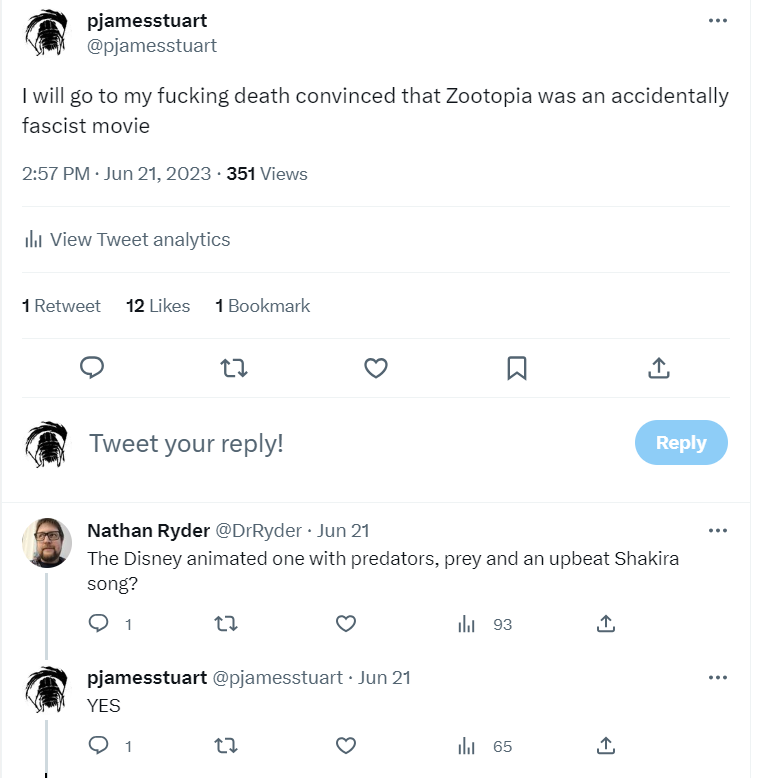
Zootopia was accidentally Fascist


I have never been able to stop thinking about this; the 2016 animated film ‘Zootopia’ is a defence of liberal cosmopolitanism so earnest and poorly thought-out that it accidentally becomes crypto-fascist.


A Quote from Matt Zoller Seitz 

"Zootopia is constantly asking its characters to look past species stereotypes, and not to use species-ist language or repeat hurtful assumptions. This all seems clever and noble until you realise that all the stereotypes about various animals are to come extent true, in particular the most basic one carnivores eat herbivores because it’s in their nature”


Some Warnings; 

This is me going full schitzo-autist on a funny animal movie from 2016, AT LENGTH. 

None of my commentary is aimed directly at modern headlines or intra-group relationships, but the parallels are obvious and are absolutely necessary to the film itself, so its impossible to talk about it in detail without mirroring some of that stuff. 

So BE WARNED, this is what you are in for. If you don't want to read about that then stop reading! 


Not Deliberate 

To be clear, I don't think Zootopia is crypto-fascism. There are no deliberately 'hidden messages'. Instead I think it presents a case for liberalism so flawed, garbled and intense it accidentally says the exact opposite. 

So I am accusing the makers of being fools, rather than monsters. 


But What Is Zootopia Patrick? 

Zootopia is 2016 animated film by Disney set in an imagined utopian city if sentient, language-using partially humanoid animals. 

“Zootopia is a gleaming metropolis populated by anthropomorphic mammals, divided into several districts including Sahara Square, Tundratown, Little Rodentia, and Rainforest District.


This film begins with a jungle which fades into a children's play about the history of Zootopia. One day, Judy Hopps, a bunny rabbit from rural Bunnyburrow, fulfills her dream of joining the Zootopia Police Department as the first rabbit officer, however, she is regularly assigned parking duty by Chief Bogo. During one of her shifts, she is manipulated by Nick Wilde, a con artist fox. Judy unlawfully arrests Duke Weaselton at Little Rodentia and is reprimanded by Bogo until Mrs. Otterton, an otter, arrives pleading help on locating her missing husband, one of the many recently missing predators. To Bogo's dismay, Judy volunteers and the assignment is praised by assistant mayor Dawn Belleweather. However, Bogo gets Judy to agree to resign if she cannot solve the case within 48 hours. With Nick as a key witness of Mr. Otterton's disappearance, Judy locates the fox and coerces him to assist her with the investigation lest he be charged with tax evasion, which he openly admitted and Judy recorded with her carrot pen, saying "It's called a hustle, sweetheart." 

After acquiring Mr. Otterton's license plate number from Mystic Springs Oasis, Judy and Nick track the vehicle from the Department of Mammal Vehicles to Mr. Big, an arctic shrew crime boss in Tundratown. Mr. Big spares their lives after learning that Judy had rescued his daughter earlier, and informs the pair that Mr. Otterton is his florist and had been picked up by his chauffeur Manchas, a black jaguar, to bring him to Mr. Big to talk about something important. However, en-route, Otterton suddenly "went savage" - meaning he reverted to a feral state - and attacked Manchas before running off. Judy and Nick locate Manchas at his home in the Rainforest District for questioning. Manchas describes the attack on him and mentions that Otterton had been yelling about "night howlers". However, before he can reveal anything else, Manchas suddenly turns savage himself and chases the pair, but they manage to escape. Judy calls the ZPD for help, but when Bogo and his reinforcements arrive, Manchas is nowhere to be found. Bogo demands Judy's resignation, but Nick takes a stand, insisting they have 10 more hours to solve the case. As the pair leave the Rainforest District, Nick opens up to Judy, revealing that he was bullied by prey animals as a cub for being the only predator and subsequently became a con artist, resolving to live out the "sly fox" stereotype, as he felt no one will ever see a fox as anything else. 

Nick realizes that the city's traffic camera system may have captured how Manchas disappeared, and the pair consults Assistant Mayor Bellwether. They then discover that Manchas was captured by wolves, which Judy assumes is what Otterton had meant by "night howlers". Judy and Nick locate Cliffside Asylum, where the wolves have detained the missing predators (including Mr. Otterton), all of which have gone savage, and eavesdrop on Mayor Lionheart consulting with a doctor about their condition, revealing that he is keeping the savage predators hidden from both the public and the ZPD, and that the cause their strange behavior is unknown. The pair escape, inform Bogo and the police swarm the area, arresting Lionheart and those involved. Bellwether subsequently becomes the new mayor. 

Having developed a friendship with Nick throughout the case, Judy requests that he joins the ZPD and become her partner, which Nick happily considers. However, a pressured Judy describes the savaged predators' condition during a press conference as them reverting to their natural instincts. This confirms Judy's bigotry against foxes to Nick, who angrily walks out on her offer after he asks her if she sees him as a savage predator (along with her almost reaching for her fox repellent after he asks if she thought he would eat her). When fear and discrimination against predators spread across Zootopia, a guilt-ridden Judy resigns, feeling that she made things worse. During this time, Gazelle holds a peaceful protest and publicly asks for the harmonious Zootopia she loves to be restored. 

Two to three months later,[3] Judy has returned to Bunnyburrow and rejoined the family business as a carrot farmer. However, she later learns from her parents and reformed childhood bully, fox Gideon Grey, that "night howlers" are toxic flowers that have severe psychotropic effects on mammals. Realizing that the flowers are what Otterton was referring to and that they must be the cause of the outbreaks, Judy returns to Zootopia, where she reconciles with Nick. They then locate Weaselton, who explains that he has been collecting night howlers for a ram named Doug Ramses, who owns a lab hidden in the subway tunnels. The pair finds the lab and discovers Doug creating a night howler serum, which he has been exposing to predators via paintball-like pellets fired by an air-powered sniper gun.


Judy and Nick hijack the lab (which is on a still functional train) and race to the ZPD with the evidence but are pursued by Doug's henchrams, whom they barely manage to defeat. The train is destroyed in the process, but Nick manages to save a case containing Doug's sniper gun and the serum pellet.

Just short of the ZPD, the pair encounters Bellwether, who insists she takes the evidence. Realizing she is the mastermind of the conspiracy, Judy and Nick try to flee but are knocked into a pit by her henchrams. Bellwether shoots a serum pellet from the evidence case at Nick and frames a call for help to the ZPD. Nick seemingly becomes savage and corners Judy, but it turns out the pair was acting in order to trick Bellwether into openly admitting her prey-supremacist scheme to take over Zootopia and rid it of all predators, and that they replaced the dart gun ammo with blueberries from the Hopps' farm. With Bellwether's monologue recorded on Judy's carrot pen just as Bellwether made her short-lived threat to frame them as she did with Lionheart, Chief Bogo and the ZPD arrive and arrest her and her henchrams upon hearing everything. Upon being informed and interviewed on the matter, Lionheart denies any knowledge of Bellwether's plot, but admits to having illegally imprisoned the savage predators, claiming it to have been done for "right reasons".


Later, Judy is reinstated into the ZPD. An antidote is discovered for the effects of the night howlers, and all the infected predators, including Mr. Otterton and Mr. Manchas, are cured. Months later (about a year after Judy started her job at the ZPD), Nick joins the ZPD as the first fox officer and Judy's new partner. The final scene (during the credits) has almost all Zootopian citizens attending Gazelle's concert while Bellwether angrily as Doug, Jesse, and the other prisoners patting on their lap views it on a television set in prison.”


THINGS THAT ARE TRUE IN ZOOTOPIA 

Ok, imagine you are the average Zootopia resident. statistically you are likely to be a 'Prey' animal. (90% according to the Wiki). 

You surround and outnumber, but are in regular day-to-day contact with a minority group  who are specifically designed to kill and eat you, and who could do so relatively easily. 

But... they don't eat you. Instead they eat Fish, plant protein and bugs. 

The Mayor of the city, much of the police force, and many of its celebrities, are all of this minority group. 

So if you did, for instance, suspect that the minority group were secretly killing members of the majority and covering it up. Or, if a member of this minority group ‘ran amok’, , you would go to the police, who are made up of that minority, and who report to the Mayor, who is also of that Minority. 

It seems that, even when given a free choice, the majority group will vote for, promote or valorise this minority group, they are just that much more charismatic and powerful .


There are rumours of the minority group losing control, running amok and attacking the majority. There are rumours of the minority group “disappearing”. 

Its revealed that this has in fact been happening. Minorities have been ‘running amok’ and savagely attacking others at random. A situation made much more dangerous by their terrifying natural weapons. The mayor, who is a member of this minority, has been secretly imprisoning the guilty parties and hiding the truth while he investigates this matter. 

The Mayor is fired and the deputy Mayor takes his place, this is one of the majority group. 

The police officer who revealed this scheme (one of the few majority members of the police force), speculates that the minorities biology might be behind these violent attacks. This is in some senses a truism, they a literally designed to kill you and you are their natural food. For most of history the minority group could not live without destroying you. They simply choose not to. 

A chill falls over the city and suspicions rise. 

A beautiful and charismatic Gazelle music star appeals for the return of normalcy. 

After a short interval, the same police officer reveals the origins of the situation; the new majoritarian mayor was secretly developing chemical weapons to drive select minority members violently insane so they would attack members of the majority group, all as part of a plan to put the majority group fully in charge of the city, this whole situation arose because of Her scheme. 

The Majority group mayor is imprisoned, and the old Minority group Mayor is back in charge. He says imprisoning violent members of his own group secretly was ‘the wrong thing, for the right reasons’. 

The problem now solved, you and the city relax, everything is back to normal. 

............


Now, let me know at what point any of this reminds you of; 

  • Blood libel conspiracy.
  • Hitlers fantasies.
  • Modern headlines.
  • Alex Jones.
  • The internal sound of your brain melting as you suffer a schizophrenic break. 


Predators and Prey are Fundamentally Adversarial 

.. and this is the point of the film. From the Wiki; 

“The primary issues centering the film, as mentioned, are prejudice and preconceived notions based on stereotypes. To further emphasize this, the creatures that inhabit Zootopia were limited down to mammals, to portray a sense of segregation between animals of predator and prey mentality; animals such as birds and marine life were left out like most, if not all, are consumers of other living organisms, making it difficult to narrow them down within the status quo of the story's conflict.” 

Of course, if you imagine a world of sentient, tool-suing and civilised compulsory carnivores, living in close integration with equally sentient prey animals, what you have is a moral horror story. All of the good stories using this as a premise include some element of moral horror because it is inherent to the setting.

 And ‘Zootopia’ was very nearly this. Again, from the Wiki; 

“In response, the story was tailored to center the relationship between the "predator and prey" group while reflecting modern day society by having the story serve as an allegory for racism and prejudice. In this version, predators, despite having evolved, were generally viewed as dangerous threats and were forced to wear electric shock collars as a means to keep their "aggressive natures" under control at the hands of prey. The "tame collar" concept stuck through most of the film's production, even being approved by John Lasseter, but when screened for the team at Pixar, the response was negative. The city of Zootopia, in this state of being so blatantly unjust, was deemed too unlikable, and the story too dark, whereas the goal was to create a city that the audience could fall in love with while making a film that—despite its serious subject matter—can still be a fun family film”


I Get "Don't Think Too Hard About It" 

But Zootopia DEMANDS you think about it! It was designed specifically as an allegory for racism from early development. It is a very, EXTREMELY values-laden film. 

It’s all about the greatness of cosmopolitanism, how wonderful diversity is and how evil twisted members of the majority group might try to destroy that wonderful peaceful diversity with evil schemes. 

It is a very, very, very earnest film that is intensely anxious about having 'something to say'. This quite intense seriousness is written through the whole of the film


Zootopia demands you pay deep attention to exactly the ideas it cannot sustain 

One thing that hit me very hard on viewing Zootopia was the gravity of the scene where Judy Hops states that the minorities that ran amok were reverting to their natural instincts. 

This is treated with deep and overwhelming seriousness by those in the imagined world and by the structure and tone of the film itself. it feels like a grave sin against the rules and ideals of this world. 

I must be autistic as fuck as I may have been the only person in the room thinking "Well yea, they are wolves, lions and tigers of course they are biologically dangerous to fucking rabbits or whatever". 

I know what the film intended. The deep tragedy, gravity and sinfulness of this statement only makes sense if we view Zootopia as an allegory or metaphor for relations between human groups

In a statement about humans saying "Well they are just biologically dangerous, of course they were going to flip out and kill someone, its inherent to them" would be monstrous and this matches the feel of the scene 

But as a statement about Lions and Tigers and Wolves it’s just obviously true. 

And Zootopia insists we think about this

Or more precisely, it demands we think about this in precisely this way and no other. It is so confident of its argument, its premise and the way its scenes and message are meant to be felt and considered, that it just leaps ahead. It is a story for an audience that already knows what the answer is and is just waiting for the story itself to fill that in 

Prejudice  = bad 

Brining up biological differences in discussion of violent acts - horrible 

they clearly didn't think, or were so confident, or so half-Intelligent that they didn't even consider that anyone would possibly read it any other way


The Fascist Reading of Zootopia 

You surround a minority group of biologically dangerous potential killers. 

It’s considered social death to point this out. 

This is very important; saying the wrong thing, making assumptions about someone’s nature just because they, for instance, have teeth and claws, is considered very terrible. so you have to not mention these very clear and obviously physical and innate behavioural differences. 

Just don't bring it up. Don't bring it up or our fragile society will implode. 

There are rumours of attacks by the minority. 

There is confirmation of attacks by the minority. 

They have been going crazy and TEARING APART members of the majority at random. 

The city government has been covering this up. 

The city government is headed by a member of the same minority and the police force is dominated by them, so essentially they rule over you

Later another conspiracy is revealed, the conspirators are of the majority faction. 

They have been triggering the dangerous minority with drugs made from certain commonly available garden flowers. The old Mayor is returned and the conspiracy ended, everything is fine now. 

You still surround a minority of potential killers,  and they could be triggered to kill randomly at any time by the use of a commonly available chemical. 

So this is hell, surely? It’s the Liberal Polity as seen through the eyes of a Fascist. Fundamentally opposed groups bound together by a tissue of lies under the leadership and control of elite members of the powerful minority group with anyone who defies the lie by pointing out basic biological and historical fact ostracised and driven into poverty. 


Beastars is Zootopia Done Right

Beastars – is an animated series based on almost exactly the same setting and concept as Zootopia; an urbanised society of anthropomorphic sentient animals which hands, language and tools, but still massively different body types and huge differences in natural capacity, and with obligate predators and obligate prey animals “trying to get along”. 

Beastars is a weird, queasy, sometimes disturbing story and the main reason it works as anything at all is because it directly acknowledges and is largely about the massive innate differences between Predators and Prey and the fact that this society is a thin strand of compromise over a roiling churning mass of potential conflict.


In Beastars Predators do occasionally Run Amok, and eat Prey citizens. Its not quite covered up but is down-valued by the media. Predators have secret meat markets where they go to eat flesh and criminal groups who supply them. Many Prey-citizens live in a state of quiet helpless terror about being killed, many Predator-citizens live in a state of consuming dysphoria and self-loathing about their own nature. 

Despite being a pervy, weird, strange and intense story Beastars feels more moral and sane than Zootopia because the characters in it are grappling directly and honestly with the unresolved darkness at the centre of their society while in Zootopia; it was all an evil conspiracy by bad majority group members and things are back to normal now.


Wednesday, 21 June 2023

A Review of ‘Northern Journey’

 This is a review of a videogame ‘Northern Journey’ by Sild Studios. I found out about it via this video;


I thought this would be interesting to False Machine readers and OSR types as a game art which has a bunch of OSR-type theming and but also as a distinct work of art by chad neurodivergent creator who made it while sitting in a cellar for several years.
 
(Maybe also with fans of 'Thief' and the Thief modding community maybe? It has that kind of feel.)


Chad Neurodivergent Creator


Interviewer - "Working on your own, you must have had a pretty deep schedule."
 
Chad - "No I didn't really have a schedule or a plan. As you are working on something, things, story beats, come to mind. So for instance you might realise you want some mountains, or you want to fight a witch. Then you might be in a forest and realise you need something to go between the forest and the mountains or it doesn't feel right "
 
Chad - "There were a lot of things I didn't spend time doing. Like sketching and drawing and planning enemies and whatnot. I usually just made them then and there."
 
Chad - "The game was made in a cellar and there were a lot of spiders there so there are spiders in the game."
 
Chad - "Anyone can make music really, you look at pictures of the place you are making music for and start making sounds."
 
So, he made the game by making the game.
 
I will return to this in the end.


The Level Design

 
Northern Journey combines vast-feeling levels and wide-open spaces with complex, nested and carefully planned challenge routes. In the interview above the creator says they often solved design problems by just removing space, bringing things more closely together.
 
Often the routes and locations are nested vertically, with looping fishbone paths, leaps and scrambles taking you from one to another, or caves, long diversions or surprising detours leading you back to somewhere you have already seen from afar, maybe only a few feet away from where you were standing, buy previously unable to reach.


The internet tells me that this is “like Dark Souls”.
 
You are almost always in sight of the promise of a future journey,  being shown expanses you might traverse, places you might visit and methods you might use. There are keys to open doors but there is also a winch thing you can use to access ziplines which take you whooshing across these densely-plotted levels - you can see the ziplines coming in but can't access them till you get this widget. In terms of level design this is in practice, just another kind of key or teleportation system, but it doesn't feel like that, instead it feels like an extremely cool reward for achieving stuff.
 
How could this feeling be expanded to OSR-style games? With difficulty I think. The functioning of team play using largely the minds eye and maps doesn’t work the same way as in a videogame. In Northern Journey, the ‘correct’ or accessible routes are obvious and the language of the game and movement in its space is easy to accept. You know you can’t climb things above a certain set incline, so you don’t bother. In an OSR game you can try climbing things above a set incline, and can try doing a whole bunch of things that wouldn’t work in Northern Journey.
 
As well, the presentation of a vertically nested environment is more difficult in map form, and the sheer power of a open view of a big landscape promising various adventures and possibilities wouldn’t act the same way.
 
Perhaps to some extent, partial maps, rumours and ‘promising objects’ serve a similar aim in D&D adventures. I tried to do something a bit like this in Demon-Bone Sarcophagus but apparently fucked it up .


The Music

 
The music is custom, nothing in its pockets but knives and lint. It’s dungeon synth/ambient created for each environment. This is distinctive because there really isn’t a big gap between the sounds of the environment, the twitchy calls of insect danger (or witches), the wind, the treetops moving in the wind, the echoing of cave noises and whatever the ambient music is for that area.


The Fucking Spiders

 
Or monsters generally, but most of them are fucking spiders.


None of the spiders are the same, look the same, act the same or interact with the environment and the player in the same way. Some crawl in the undergrowth quietly, some swarm in gangs, some hover and leap, or hang in treetops and drop on you.
 
The enemy design, movement plans and AI loops are carefully integrated into the environments, the spiders in the trees, the tree-tops slowly waving, the spiders in the waving grass which bob and move in the same rhythm as the grass.
 
The juddering, weaving repetitive but incoherent attack patterns of the insect enemies exist apparently because they were easy to program - presumably real insects are running something not that much more complex than the systems in a modern computer.
 
The deep integration with the environments means you spend a lot of time hiding, listening, watching, stalking and paying a huge amount of attention to trees, grass, sounds and movement.


The Combat

 
I feel like there are two main ways to run the combat in Northern Journey; Doom Style or Cheese It.
 
If you have really good twitch sensitivity and aim then you could maybe burst into target-rich environments and race around shooting things while brilliantly swapping weapons for optimal effect. I absolutely could not do this and so most of the time I just cheesed it by save-scumming, creeping forward till I trigger one or two enemies then running like fuck away till they are lined up behind me on an attack run, then turning round and shooting them, save-scumming and doing the same thing again.
 
The sling was an interesting embodied weapon. You get it for free, it never runs out of ammo.
 
On pulling out the sling the p.o.v character WHUMPS it round your head, one, two, three, four, five, six times then puts it away. You can trigger a cast at the peak of any of those WHUMPS. If you wait till the 3rd or 4th WHUMP, the damage goes up to 100, which is actually not bad, on par with other weapons, or you can release early for a faster shot with less damage.
 
This starts as a crap and awkward weapon, but as you get better with it, it becomes quite workable and your skill with its timing helps you upgrade it along with your other stuff so it never quite goes out of fashion.


Characters

 
Oddities drawn from something like a folk tale; a village idiot, a suspicious priest, a fool in the stocks, a policeman in his hut, some mysterious crones with a bubbling pot, a doctor throwing runestones and laughing, a sketchy soothsayer whacked out on fumes, an isolated engineer living in a box held over an abyss; there is literally no-one normal in this village,
 
Crones - Lots of crones in this one, a large variety of tricky witches doing crazy witchy things, trying to push you off bridges, strand you in infinitely black pools, fly screaming and cackling at you on broomsticks
 
The Mysterious Flute Player – is he Odin? A wizard? The Gygaxian Game Master? He feels a little like all of these things. He has his own theme and you can hear him noodling on his flute as you enter some levels. At other times a dog or raven will turn up with a rune-stave message.


The Special Missions!

 
Caving, cave-diving, diving into a haunted, drowned village in a leaky bathysphere, taking a hang-glider through super-mountains, diving into a maelstrom & coming out the other side, slowly scaling and ziplining up a staggered and vast mountain face; 


the darkness, fear and paranoia was lovely. In particular the bathysphere mission and cave-diving was just utterly rich with darkness and a deep sense of strange otherness. Any Veins of the Earth fans  would enjoy these.


The Ending

 
There are parts of the end I love, and which feel a lot like the pure mood of the game and other combat-based parts I don't love anywhere as much.
 
It feels like a lot of supernatural problems in Norway are solved with a midnight communal village rave to dungeon synth electrobeats. Probably this is just how they do it, who knows. The game nearly ends with what I think should have been the final scene, a game of keep-away with a bunch of crazy villagers dancing in a circle around a cursed dimensional violator while the village idiot keeps trying to grab it and run away, while demonic root monsters run interference. Then there is a tower shooting bit which is less interesting.


Hyperreality

 
A game about an environment by a guy who lives in that environment. The production loop is a hiking loop - guy goes for a hike or climb in Norway, takes photos, records sounds, observes nature
then comes back to the spider-cellar, makes textures from the plants and rocks, builds the sound of streams from the recordings.
 
All of the sounds and textures in the game are made by the creator, so those curiously pixelly textured shadows, waving plants, lichen-spotted wood, are all recovered dreams from the real world.


The combination of the tightly-plotted but expansive-feeling level design, the intensity of dealing with the FUCKING SPIDERS and this transposition and concentration of the natural phenomena means with Northern Journey has a kind of Hyperreality, like its NorwayPlus. The same hyperreality you would get from surrealism but driven towards a natural environment, a bit like 19th century romantic paintings of guys staring at the alps where a natural view is intensified, but in this case it’s a game and a process of doing which includes movement, exploration and challenge.
 
(I am not saying Northern Journey is 'like being there' which I think would be a mediocre aim and which I am unable to confirm anyway, bit it is more like an intense, lucid dream of Norway)


Singularity of Vision

 
Though original, no single element is absolutely better than the best in other games, though much is very good. Instead we must speak of the combination and synthesis of elements in a manner original, expressive and rare. It would be hard for a large group the make *this particular* game because things were combined and "cooked" very closely and very intuitively.
 
The textures, plants, sounds, arrangements of form, living entities, (especially the spiders), etc, are all seemingly drawn from life and inscribed directly into the game without much pre-decision or conversation.


For instance; in one level the waving of grass mimics the colour and movement of the resident spider enemy, which skitters and bobs exactly like the movement of the grass in simulated wind. in another, the texture and size of an attacking spider means it blends with and seems to move "under" the textured knee-high foliage. Combined with its silence (which would have no significance if not for the aural tapestry of the levels), this makes it a particular paranoia-inducing threat.
 
There is a level where, after coming out of a deep dark and claustrophobic mine, you do nothing but climb and zipline up a seemingly endless series of mountain faces, facing a rolling grey sea, it’s wonderful and arguably 'nothing happens'.
 
These things, if done as part of a group or company, would have taken meeting after meeting and description and argument after description and argument. Here, done by one individual, they are simply created and arranged immediately, intuitively, in a manner which speaks of a coherent world, creates beauty and interest in the eye of the beholder an is 'gamic' or playable, leading to interesting and cohesive play.
 
The whole game is like this; a collage or weaving together of elements, some drawn from nature, but woven coherently, subtly, to create a kind of hyper-reality. The sensory aspect of a Norwegian wilderness/biome, compressed, transformed and made into something that can be played. Any addition of complexity of the kind a corporation or marketing director would instantiate would disrupts this clear fluidity and directness of approach.
 
The credits are literally three lines;