Tuesday, 29 January 2019

A Review of The Crimson King by Graham McNeill

(Sorry everyone, will do more proper content soon.)

Alright, I've done enough complaining about my bĂȘte-noir, McNeil’s over-use of recent history and modern cultural references. I'll do it one more time then never again.

McNeil is really good a writing about the grand tragedy of knowledge loss. He wrote two of the most major and impactful scenes about exactly this; the disaster on Mars when the Dark Mechanicum release scrapcoade that trashes huge vaults of collected data and ignites power disasters that annihilate huge libraries of humanities past, and again on Prospero, when the Space Wolves do the same thing to the library collected there.

These scenes and their impact play a large part in the sense of doom and tragedy that informs the setting and the Heresy series in particular. But *in* McNeils stories characters are continually pulling Shakespeare off the wall, picking up European/medieval Tarot cards, finding the skull of Nikolai Tesla etc. I feel something that it wouldn't be a surprise for someone to pull out a vinyl album of Cat Stevens and jam that out on the planet of the sorcerers.

And they rarely seem to reference the forty (or thirty) thousand years of pseudo history between now and then.

It makes the setting feel small and cramped and massively undercuts the horror of lost knowledge and memory loss that plays such an important part in the background and psychology of the characters.

And it irritates me because it knocks me out of the story every single time, and with greater alienation the more it occurs.

Like, if he really wants to do it he should at least invent new (old) crazy shit for people to talk about and discover.

..........................

The book;

While many Heresy books are about terrible parenting, this is also about terrible childrening.

I remember in the book 'Emperor of All Maladies' reading about the children of cancer patients being simply unable to let them go. Though the disease is terminal and the treatments can be agonising, they will often prolong the suffering of the people they love because to simply allow death would be to 'give up'.

Is this love? It is, of a kind.

We start the book after the end of the fall of Prospero. The 1k Sons have been swooshed through space to the Planet of the Sorcerers (which ADB re-names in later books, possibly because he thinks it sounds silly), along with bits and pieces of Tizca and their dad, Magnus, who had his back broken by Leman Russ.

We know that in a few years the 1k Sons, along with Magnus, show up at Terra ready to stomp on things with Horus, and we know that at the moment they seem to have very little interest in doing that. Is all this because McNeill wrote Magnus as too much of a topping fellow in A Thousand Sons and had to come up with a reason for him to join Horus?

Possibly, but if it is we got quite a lot out of it.

The 1k Sons quickly find out that dad is dying. He's essentially a weird Demon/Angel/Supersoldier magical dude anyway and when Russ smashed him up (McNeill describes Magnus's insides like Enochian angel organs, to good effect) he literally broke his hyperdimensional soul into pieces which got scattered throughout the galaxy and which are all now dying separately.

So now we have a classic object quest which is also an internal psychodrama as all the shards of Magnus have their own desires and point of view on what is going on. Curious that this is a book about a contest between powers, sons, nightmares and enemies to either engineer a soul or prevent it being remade.

I didn't count them exactly but I think we have;

- Asshole Bro Magnis.
- Alzheimers Magnus (they all are a bit).
- Weird Ash Magnus (what was up with that guy?).
- Librarian Magnus.
- Cosplay Librarian Magnus (multiple shards are largely bibliophiles).
- Good Guy Magnus (is on earth and bookends the novel).

The less insane and deluded shards of Magnus repeatedly tell the 1k Sons that nothing good will come of putting them back together, that it would be better to let him die, that there is nothing they can do.

Being outside the fiction we know that this is largely (probably) the case. Magnus becomes a demon and ends up 99.9999% evil and cracking the galaxy in half like a dinner plate.

But his sons won't, or can't, let him go. No matter how much he asks to be left to die, or how crazy and dangerous his Altzheimers self becomes, or what the sacrifice is, or how much of  a bad idea it looks like being, they just keep trucking along in their various ways, causing utter havoc to everyone.

All of this is orchestrated by everyones favourite blue, feathered Magic the Gathering and 4e D&D player.

Tzeentch corrupting the 1k Sons to be honest, does not take very long. But to be fair, he has a pretty trump hand, more so than with any other legion. If they choice is between going a bit evil or dying, then some of us would willingly die. If its between evil and being horribly mutated into a huge mindless flesh beast in eternal agony, then few of us would take the deal, and if its between evil and watching people we care about mutating into crazy flesh beasts, how many of us would resist?

So off a-questing we go, with a three-pronged story;

- Amon goes on a freaky dream/grail/spirit quest in a Voyage to Arcturus style, across the Planet of Sorcerers to find his mad dad and persuade him to join up with his other selves. This was my favourite part of the book and some of the shorter elements were very good indeed.

This part also has some of the most affecting scenes as Amons desperate need for his father meets the mental decay of Magnus, whose personality and memory flip back and forth, sometimes enthusiastic and hopeful, sometimes forgetting what is going on or drifting back in time, and on a few occasions massively endangering or murdering his own sons.


- Azhek Ahriman goes on a more classically 40k-ish  journey across space to grab soul bits, along for the ride are a demon in a robot, a gang of increasingly-bitter 1k Sons and Special Guest Appearance; Lucius the Eternal! Lucius is a surprisingly fun character to drag along, his utterly insane omni-destructive hyper-narcissism makes him an engaging counterpoint to the sad introverted 1ksons.

- Annd in hot pursuit of Azhek are Space wolves (boo) an ex-Smurf, one Raven Guard who stays off screen (classic) and the Sigilites slightly-ridiculous 1980's Samurai, who are charged with stopping whatever the hell is going on.


Throughout the book, Magnus and his sons are persistently attacked by their greatest enemy; foreshadowing.

This is more of a general Horus Heresy problem, start the heresy at humanities peak, its megabeasts have already won their reputations so for a large part we don't get to see that happen. Instead we get to see them fall apart while their reputation for being amazing is more told than shown.

But it's brought into sharp relief by the really-very-significant amount of it in The Crimson King. There's lots of bird totems, dust, people falling out of walls talking about inevitable betrayal, multiple warnings of hubris and doom. It all goes on so much that it perhaps makes the characters ignoring it seem a little stupid.

Nevertheless, the books does manage to sustain itself, a little like the planet of the sorcerers itself, on the strength of its own invention; dream visions, megastructures (Celestial Orrerys, Nightmare Psyker Prisons, Warp-Carved Hyper Cathedrals to the concept of extinction, Infinite Oceans of Memory etc), some strong characterisation, some exciting scumbags (Lucius, the Demon Robot) and the essential tragedy of the story.

Towards the end the soul-swapping and hyperpowers do blur a little and make the final conflict a little bit of a 3rd act skybeam but McNiell does nail the landing. The titanic hubris of Magnus and his sons would count for little, or simply be insensible, without genuine and deep idealism. As fucked up and monstrous as they become, they are still originally motivated by the desire to do the right thing. Azhek and Amon want their dad back, Magnus wants to save human culture.

By the end of the story our boys are back on track to the best of all possible worlds, they just need to do one more utterly terrible thing first.

Tuesday, 22 January 2019

Something never seen or mentioned before

Someone, I forgot who, sorry, asked for "Something never seen or mentioned before".

So I have to come up with the whole thing right now, with no prep, and it can't be something I've thought of before?


Ok, this is what you get;


THE MUSIC OF MUTE

A world where time and moment are defined by song. Where light and space are like music and music is audible physics. The sun rises to a single note. The stars are distant cold harmony. The song of evening pales the world.

Reality can shift like music, but it cannot be discordant to itself. (Except Monsters, they are discordant, they are bad notes.)

The note of the sun allows the existence of the beats and rhythms of the material world.

Nothing on Mute can make a sound, it would interrupt the Music. As if living things could re-program the cosmos at a basic level. Maybe Wizards sing, or speak.

Material things fade in as the note of dawn grows louder. Not every material thing is described by its own motif, or even note, but the substance of things must be in harmony with the everpresent song. If the music is low, soft and sad, that might be fog, a still sea, a drooping forest, but it couldn't be a raging fire, supergothic mountains or a crashing waterfall.

The music is never in counterpoint to the world - it is Reality.

Perceived realities must cohere. Sophonts leave snail-trails of perceived reality behind them.
So as a whole its more like a 'real world' than you would suppose. Mutual interacting triangulations of sense produce a reasonably solid consensus wherever sophonts gather. When they are off on their own, and they meet each other, realities merge.

Listening well is a meaningful skill. Those who can perceive and predict the deep structures of the music of Mute have a kind of reality meta-sense. They can make very very strong and very accurate guesses about when and how they qualities of the world can change

Sense a rising theme

"To know the song, the ears and the earth, this is wisdom" - philosophers might sign to each other.

Meaning you have to understand the music, understand how others (and yourself) will perceive the music, and understand the realities as they exist.

Differing kinds of expertise in listening depend on the time signature of familiarity. Someone good at note-to-note tonality might be a great duellist, fighter, gambler or dancer.  Someone good at the medium range might be a great explorer, sailor, trader, climber or worker in a complex environment. Someone good at very deep and very long structural changes might be a great general, philosopher, engineer of megastructures, prophet or cultural guide.

Movement is music and language on Mute. Writing is frozen movement. Musical script is silence and magic. The construction of instruments is high science - like Hadron Collider scale stuff and they can only make maybe one note with great difficulty.

Underground is like a static hiss but touching or feeling things reveals music hidden in the static. So does digging your hand into fresh soil.

Concentrating on something others can't sense is like hearing one conversation in a crowd, or one theme hidden in deep music - it was always there but you couldn't 'hear' it until now.

Is there divergent evolution on Mute?

I would have to say no as the revisions would push the world out of anything easily conceived of. So this is more a fairytale world with different rules but mysteriously similar forms and structures.

But it would be fun to do the full Arnold K version with alternative evolution and entirely different forms - super-display creatures, semaphore giraffe’s and hundred-handed men.

Thursday, 17 January 2019

A Review of the Gloomspite Gitz Battletome for Age of Sigmar

(I haven’t forgotten about that list of things I would do for December, I will still do them. But I was reading this and wanted to talk about it.)


Haven't played AoS, have read the 2nd edition book and a handful of other things so that is my only real point of comparison, as well as stuff I have randomly run into online.

Anyway, far from an expert appraisal.

....................................................

The cover is fun, but not exceptional.

Games Workshop - credit your artists.

Printed end papers have a moody B&W version of an interior piece.

The title page before the contents has one of the best art pieces in the book and whoever did this is fucking amazing. I think they also did the marginalia inside, which is also great.

I'm keeping this small so I don't get sued, but its very good.


So this is an army with a bunch of not-that related factions and races in it;

"Well might their enemies wonder what could unite such anarchic beings into an army capable of conquest and slaughter on a grand scale. For the answer, one need only look to the darkest corner of the heavens."

That darkest corner being the Games Workshop Project Development Meeting Room;

A - "We need to re-do Night Goblins for AoS."

B - "Yeah! Fanatics! Mushrooms! Hoods!"

A - "Oh and we need to re-do those spider riding goblins at the same time."

B - "Ehhhh, they don't sell enough to be worth it."

A - "Yeah but I still kinda like them though, even though the models are old. Plus we need to keep selling the Arachnorok."

B - "Shall we just lump them in together?"

It's not really quite that bad. They are following a MOON. And most of you will know I am a terminal lunaphile. Most of the models do end up with aesthetic and perceptual unity but the Spiderfang Grots are a little bit of a red-headed stepchild in this book. They tend to creep in at the end when everything else has been considered.

Ok onto the interior.


THE WRITING

- Necroquake is still a terrible word.

Here are some words and phrases I did actually like;

- "Danksome destruction"

- "Heralds of the Everdank"

- "To the Gloomspite hordes, the realms will only be returned to their proper state when the Bad Moon waxes fat on high, and all the lands lie draped in pale shadow beneath it...."

- "Grots seized by the Gloomspite feel their minds spinning with mean-spirited schemes and ambitions of 'teachin' da surface gitz a lesson'. Shadows crawl and churn around them like teeming insects, and strange fungi sprout spontaneously before spewing hallucinogenic spores." - This is almost literally my D&D players, and player characters. And me.

- "Loonstone, madrock, loonystone and badstone."

- "Of course such charms nearly always backfire; the bearer is forever thinking devious thoughts of their own, leading to their loonstone pendants glowing constantly and driving them into the depths of frantic paranoia." - Also my D&D players. And me.

- "The Evercrawl"

- "Trog Holes"

- "Skrappa Spill"

- "Glowey Morkeyes"

- "Gangle-legged git grabbers"

- "Boingob - Godbeast father of Squigs"

- "Loontales"

- A sub-heading on 'Bottlethieves' about the mass theft of alembics.

- "Unstoppable Idiocy"

- "Loonwar" (about two moons fighting in the sky)

- "Driven to sate their hedonistic desires, the Slannesh worshippers fall upon the mushrooms and are plunged into a state of psychedelic bliss. Yet as the Bad moon rises over the vale, their euphoria turns to nightmares."

- "The Badsnatchers"

- "The Coast of Dullards"

- "The Infamous Overbounder"

- "Sneaky Snufflers"

I like both the prose and conceptualising in this a lot more than in most of the other AoS stuff I have read. There could be a few reasons for that.

Gobbos are allowed to be a little bit silly and throughout the book there is just the slightest edge of it almost making fun of the more serious aspects of the setting. The "Everdank" being one. This works because it fits the mindset of the Grots, it probably wouldn't work the same way for a more 'serious' race.

The Edge of Ridiculousness, or just growing familiarity and ability with the form they have chosen, allows the UNCREDITED writer(s?) to combine standard, rather starchy (and to me, rather meat and potatoes; 'Necroquake', 'FyreSlayers') Age of Trademark language in a way that opens up some of the more interesting phonetic possibilities producing this sense of rather fecund liveliness and mania which feels more like Lewis Carrol rather than the home of the Stormcast Eternals.

It might just be that they got better at it, or put better people on this one. Or maybe all the AoS battletomes are this good, I haven't read them.


THE ARTWORK

There are two great kinds of art in this, the marginalia and the miniature photography.

Hopefully I won't get sued, I will try to keep images small to give you the general idea;

The main marginalia is this lovely dual pair of fungal pillars with smiling and frowning Bad Moon faces.


It shifts to more sparse margins for the highly referenced pages, but all the little details and elements are still lovely and very well done.

There are also many lively little fragments and drop-ins of art and text which work well, more on those below.


The mini photography alone is a multi-stage art;

> Conceptualising and designing and producing minis.
> Painting the minis by the worlds best mini painters.
> Arranging them in dioramas.
> Photographing this in a professional cinematic style.


So thousands upon thousands of hours of different kinds of talent have gone into each of these battle or display photos. You could write a book about each of these just individually and here they are being carried off together to a level as high as its ever been.

(None of these are credited.)

The 'art' art, the stuff you would consider the 'primary' art, like the two page spreads and the portraits of things represented by the minis in the imagined world, are consistently ok. This is definitely something a skilled person worked on and completed on schedule.

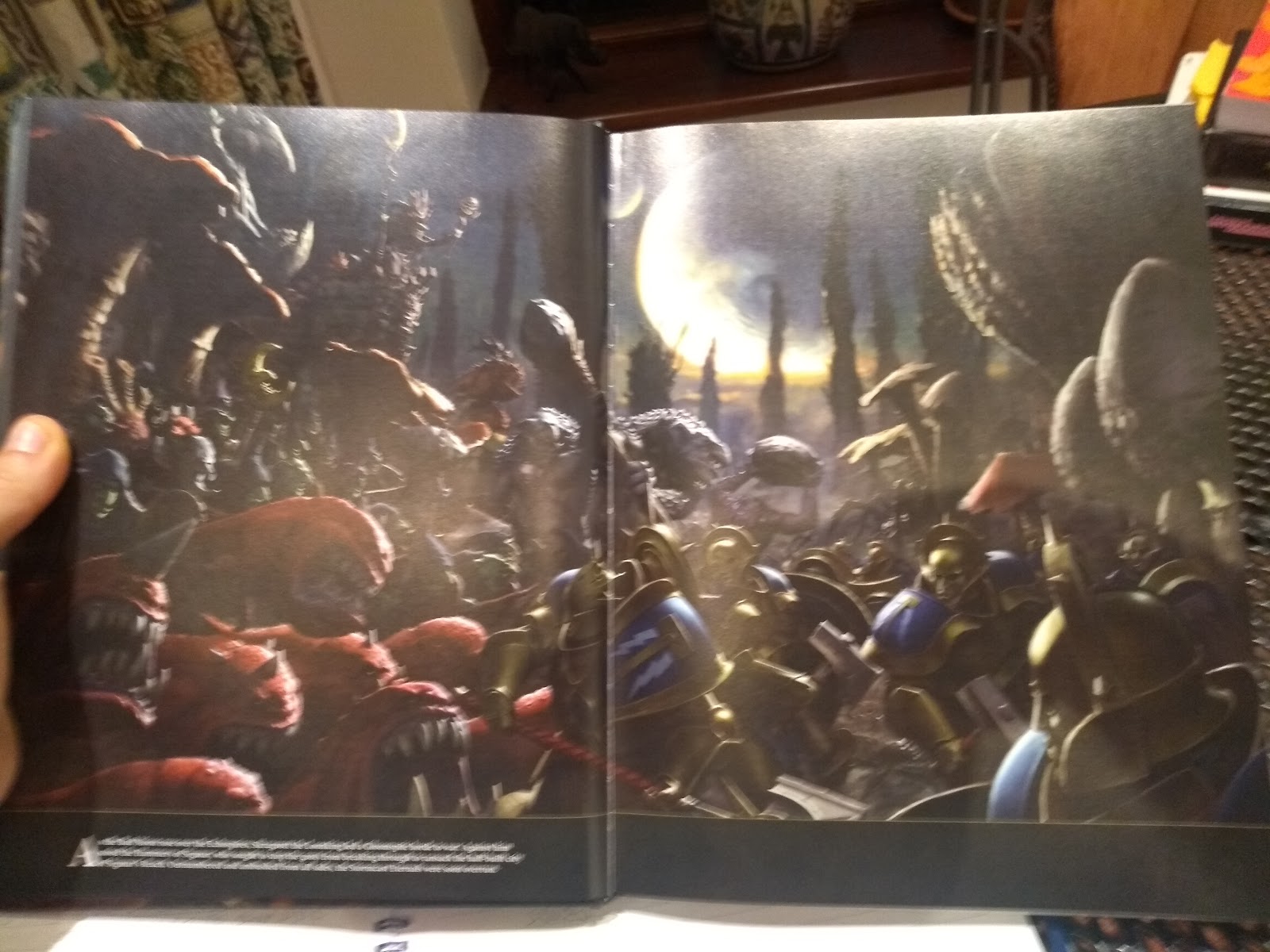
Pages 6 - 7 Squigs fight Stormcast.


Look, any time Squigs fight anything its mildly funny. It can't not be funny. They make any image better. Just the idea of a lightning powered superhero chaos basher being bitten in half by a fucking tooth fungus meatball thing is fucking great.

Again, squigs make everything good;


THE LAYOUT

The fundamental skeleton is the same basic competence as usual (generally better than RPG design or more utility at least, but perhaps also facing less complex challenges)

GW haven't taken any giant leaps conceptually but they do deserve recognition for bringing those elements to the best possible quality and using them in the best possible way given the pre-existing format

Marginalia - magnificent and employed with correct intensity relative to page contents.

Drop-in fragments - colourful, fun and appropriate in a meta-context - the Gitz culture is meant to have a bricolage of life and lively fungification and wiggly things crawling up everywhere, its meant to feel a little dirty.

These are also charming pieces of world-building.


Digital cruft - this is kept under control, and, as with the fungal drop-ins, appropriate to the context of the piece. It's meant to feel a little dirty.

A little example of the page-dirt. Unlike 90 % of books where this is used, here it feels alrgiht.

It's also dialled back on the reference pages so they keep that Tufte-ian clarity.

B&W fade-ins - not sure what to think about these, they are... not terrible? They do not make me want to kill or murder anyone and they seem a reasonable solution to the problem of referability in the rules and stat based  pages.


The balance of 'noise' relating to the referability of pages is good and well thought through, the less often you will need to read something in play, the more page noise there is, the more often you need to read it, the noise is brought down to a minimum and just provides visual texture, but is still well employed when it exists.


THE MINIATURES

Really beautiful and look exactly like something from a dark childhood story. (Said that above, still true.)

The modern aesthetic is very slightly overpowered for my 90's tastes, with always a little too much detail.  It's animated, ridiculous, fun. If you measure only by *skill*, new mangler squigs and squig herds (I was imagining a squig-only army, now possible for the fist time)  are probably better. They have gained something but also lost something.

Too much in-form animation? They are more like frozen images now. The island of time each figure occupies is narrower. Compare the feel of main troops to new models. Old models seem 'boring' in some ways but *still*, *repeatable*, not busy or visually morphologically frantic. There to receive meaning, not impose it. They feel more general, less specific.

If re-done today, they would be full of individual energy and specific locked stances and lots of fun bits, but also busy, striking, frantic, anxious. A Hollywood producer feel, or social medial feel or marvel-movie whedoning feel. We cannot leave the audience to have their own emotions/responses - that is not what they are paying for. They have to be prodded - "see, it's a *GOBLIN*".

I'm being a little harsh on the models and that's probably because I am an old man with old tastes. They are works of art and very beautiful. I actually bought minis based on this book, which rarely happens.


A Note on Diorama photography

Diorama photography is the primary artistic vector of the book and communication of the model as action portrait is the main way they are perceived.

NOT as playing pieces, tessellated forms or 'toys' meant to be grasped. Even the smallest models form and generate their own highly particular world around them.


A Note on Morphic Tessellation

Models used to be played with in ranks. Some were designed with repeating and interlocking patterns that show up in a particular way in a block of troops. In particular what come to mind is the Witch Elves with their flow of hair and dynamic dancing bodies, and the Chaos warriors and the repeated 'negative' spaces on their shields in ranks (these especially look like they still want to be in ranks).

This is not as prevalent in grots but the main line troops still use the old sculpts. It would show up harder with the spear-carrying grots as they looked cool in  block but as more jumbled individuals would look odd. But they are on the cellar-relative list, still on the army list but made to stay out of the group photos, or kept at the back with spider-riders, loonboss in a squig and fellwater troggoths. Maybe because GW thinks the models don't quite work, or maybe to emphasise the New Hotness?

There is a kind of war of silence or hunger for stillness between millennial models and gen x models. When you see them together, they are living in very-slightly different aesthetics of time and sensation.

In modern GW, characters have stillness allowed to them, they are allowed to be perceived as if moving slowly or not at all, but the commoner models aren't allowed that as much I think. The masses must be seen to move.


THE RULES

Not an expert. Never played it. Seems exactly as complex as before, just in a different way.

I have the nagging feeling, common with modern GW rulsets that I am missing something in an unbought book, or generals handbook somewhere, that everyone else knows about.

It looks like a proper bitch to put together what I would consider a 'normal' game. In the old days, if it was in the book you could run it. Now there are grand alliances, keyword cultures, allies, battalions which you pay points for. I only read through the rules a long time ago - but it seems that the complexity has been displaced onto a series of command or bonus bubbles.

From this it feels like the game would be mostly about finding ways to intelligently stack relatively minor but compiling bonuses of just different enough quality that you can use them together but similar enough that they can work together to a particular goal.

The stats themselves are relatively simple but the escalating conditional special rules seem like they would be mind-wrecking and seems like the divide between medium and good players would be mastery of this capacious, point-based and ever-evolving meta-currency and para-economy of mild rules alterations.

I don't like the idea of this.

I haven't played it though so I don't really know.


THOUGHTS

CREDIT YOUR FUCKING CREATORS

- Writers
- Rules Writers
- Model Designers
- Model Painters
- Photographers
- Diorama People
- Scenery Builders
- Whoever else

I realise this is a group effort, but so are films and computer games and they fucking manage it.


Cut lose your artists for the big scenes and mini-character shots. I mean, cut them loose as in allow them more freedom, not fire them.

You really don't need a 'house style' for this as the minis, rules, layouts, margins and everything else provides it. Maybe change the management structure around the from "Ok, who's getting the Gargant picture" to "Ok, who has any freaky image ideas for stuff from the Gloomspite battletome."

Also a laxening of the 'house style' means you could include images from your substantial library, may of which are very good.

Since these pictures are not the primary way people relate to the minis, you can relax the informational stranglehold and do stranger stuff and hopefully get better art.

Otherwise, well done.

This isn't High Art like Realms of Chaos, but its a respectable and worthwhile piece of industrial art. No-one involved with this should feel ashamed of themselves and if that sounds like mild praise then remember how much I fucking hate corporations and look at my shit personality matrix, I hate everything.


And Credit Your Creators.


MINOR PARACOSM WORRIES

There have top be some awkward discussions between Chaos dudes who are smashing stuff for Deep Spiritual Reasons and Green dudes who are smashing stuff to smash stuff.

Chaos is Evilll, and also Random.

The Bad Moon is Random, but also evil.

I'm imagining complex exchanges between Sigmars buff sorcerers in the magic gymnasium;

"The Bad Moon! It's actions are completely chaotic!"

"Wait, do you mean spiritually entropic and dedecated to the reality-eating demon gods?"

"Well, no... More just roulette table chaotic, plus fungus."

"Like Nurgles fungus of plaaaague?"

"Not quite like that no."

"Like Arielles overflowing fungus of liiiife?"

"More like a Jim Henson vibe.. but still Evil, or at least Very Bad."

Behold the Grand Alliances of Good, Evil, Dead and Very Bad.

Tuesday, 15 January 2019

A Review of The Mists of Avalon by Marion Zimmer Bradley

The moral crux of the issue is that the author, Bradley has been accused of child abuse by her children and was, with absolute certainty, at least a long-term facilitator for her husband Walter Breen who was an effective, charismatic and systemic pederast for decades. The details, especially around Breen, are awful. He should have been shot in the head a long time ago.

So we are enmeshed in evil from word one.

Read on if you want to.

Mists is a female-centred re-telling of the Arthurian myth. So instead of Mallorys 14th century tournaments and knights or Whites 20th Century totalitarian parallels, we get a vision of Wicca from the 70s and 80s.

The version it most closely mirrors is Cornwells Pendragon trilogy, which often struck me as a kind of masculine alterverse to this.

The story is based around a network of women and sees the world from their perspective. Men move in and out of the narrative like clouds moving across the sky - doing things in another world as distant from the experience of the main characters as the misty fey dimension they sometimes also inhabit. Battles, tactics, logistics and a lot of 'high level' discussions fade into the distance or go behind a curtain.

The world as the women see it is largely a network of relationships and desires. A network of homes as well. Women stay behind castle walls, or on magic islands. Sometimes they move between them or are forced out of them but it is like a web of nodes spread over the land. In the courts and family spaces, the dramas expand in the psychological space until the space between a fireplace and the door, or the width of a bed is as great as the length of an enemy coast.

This sense of being constrained, of being trapped and of the difficulty of travel is most extreme in the most traditionally feminine character, Gwenhyfar, a delicate agoraphobe who, for the first part of her life, only feels safe in the smallest of contained spaces, for whom the outside world is a terrifying void. But even the more dominant and confident women often think twice about the utility of travel.

This is the nastiest Guinevere I have read. Most male writers have complex and mixed feelings about her but she usually comes out as somewhat heroic. To Mallory she was a 'true lover', White tried his best, somewhat against his instincts, Cornwall gave us a spike-heeled, somewhat monstrous, but still heroic, bold intelligent and charismatic woman.

Bradleys Gwenhyfar is a dislikeable, neurotic, agoraphobic, manipulative bigot. That is not all she is ands the book takes its time (1000 pages of it), giving us a good 360 view of all of the main characters over time, and many of her darker qualities are shared by other characters to some degree. Most are manipulative to some degree, its a major theme in the book, and even the main character is revealed as being in some way, a more intelligent, cultured fanatic. But Gwenhyfar is not only nasty but weak in a largely viscerally unpleasant way. I do wonder if I was meant to dislike her as much as I did, and if Bradley hated her as much as it seemed she did. (She is also blonde, Bradley does not like blondes.)

The generational quality of the book, showing us a good 80 years of history, with the tail-end of one generation, the entirety of another and the start of a final generation, gives us ample time to jostle together people, letting them fall into a range of different relationships with each other over time and letting different aspects of their characters come to the fore. Its neatly done. Towards the end, characters who previously barely tolerated each other are drawn towards each other by the mere solidarity of age. They are the only survivors.

On bigotry; the book makes much of the rise of Christianity and its replacement of pre-existing goddess worship, and Christianity is definitely the bad guy religion here. Or more aptly, the more darkly grey guy religion. This dislike of Christianity is the only major theme Bradley has in common with Cornwall. Both write as if a pre-existing paganism is being overtaken by a new faith and both seem to prefer whatever they see as the original pagan way.

(This is a pair of brief nerd complaints since its insane to complain about realism in a sub-genre where pretty much everything is some variety of 'made up' BUT - Firstly I'm pretty sure the Romano-Britains were already largely Christian by the time the Saxons turned up, and the Romano-Britons lost, meaning that Christianity actually got replaced with horse-head saxon paganism. Second - the moon & goddess pagan business does seem to have actual psychic powers, scrying and actual dimensional twisting it can do, which is pretty common in this kind of story, with Christianity playing the part of the reality-enforcing or magic-dispelling paradigm, but if the pagans have actual magic powers and the Christians either don't or aren't in tune with theirs, then how do the Christians win? Also, medieval Christianity had magic and miracles up the whazoo, but that is not the version we get in these stories, instead we have something like the tonality of a kind of pre-protestant Protestantism. Anyway, rant over.)

So people are divided by religion, with the goddess-worshipping beltane fire-orgy faith engaged in by the main characters slowly but inevitably losing ground to the rising Christianity. The version of Wicca shown is one (I think) pretty-much invented in the 70s by feminists and so we get the super-female moon goddess being replaced by the (here) super patriarchal Christ. This drives many of the worst actions in the book, as people are trying to defend, or expand, their belief system, and that justifies anything.

Despite the Christians being broadly closed-minded and ignorant, their bigotry remains more general. Most of the specific bad actions are engaged in by the heroes, the Goddess worshippers, in pursuit of what they regard as absolutely necessary goals.

The price of this is a main theme of the book.

Sex is rough in Mists of Avalon. Everyone is stricken with deep sexual desire and nobody gets to sleep with who they want. Our heroine Morgaine is first into Lancelet, who isn't into her, then ends up accidentally marrying the father of the guy she really wants (towards the end of the book, reality seems to warp to an almost comedic extent in order to keep the main cast sexually miserable). Lancelent is into Gwenhyfar, but probably largely because he is either bisexual or a massively supressed homosexual who is in fact into Arthur. Arthur is into Morgaine, after being tricked into sleeping with her with moon-magic. Gwenhyfar is into Lancelet, who is not her husband. Morgause is into pretty much anyone she can get over, and is cheerfully utterly amoral for most of the book and really the only person actually enjoying her life, until the end, when her beauty leaves her.

All of this psychosexual stuff is not exactly foreign to the Arthurian mythos, but it carries a rathe long dark shadow behind it. Combined with Whites issues and Mallorys rape arrest, I kind of feel like I need to stop reading this stuff.

Are the Gods real in Mists of Avalon?

Many characters believe in Christ or The Goddess. The Wicca priestesses do seem to have some kind of ability to perform limited magic. But its left open that the capacity for this might be part of everyone, that it is a kind of psychic technology and that you could probably do it without any worship at all, and Morgause proves this in the latter part of the book.

*Something* seems to be real. There are actual miracles and appearances from ancient godheads, past lives and karmic entanglements. Fucking ATLANTIS shows up. People certainly do a lot for their gods, engaging in all kinds of questionable activities.

But the gods themselves are silent. Their faces are dark. Neither their causes nor their concerns are our own, their morality is not ours. Or there is nothing there at all.

The Mother Goddess comes the closest to being 'real', but if she is she is at least complicit in her own annihilation (or temporary quiescence) and she uses her worshippers like chess pieces held in frozen hands, something they extend to their inferiors.

A lot of this is about the pain of intelligence and the costs of manipulation. Most characters are prisoners of others manipulation and intent, some 'nice' like the first Merlin and Arthur, some not so nice, and almost all of them manipulate and use each other, usually for what they consider very good, utterly necessary, causes.

The long generational view of the story means these people live long enough and think deep enough to realise that is the case, and see how these actions have warped them. It’s played out most viscerally towards the end of the book when the maiden Nimue is sent to essentially assassinate Merlin with beauty. He has transgressed against the Goddess in a major way and Morgaine, our heroine, and the Merlins ex-lover, knows he has to be punished.

Nimue is given his psychological profile, which Morgaine has as they used to be lovers, and sent to manipulate, seduce and bring him back to be skinned alive.

To do this she uses magic which she knows will bind her to him as it binds him to her. Therefore, to do her duty, she must kill someone she loves, to betray herself.

Nimue was brought into the Goddess cult by Morgaine, who was likewise brought in by her own half-monster manipulative mother figure Vivaine. Nimue is the closest thing Morgaine has to the daughter she always wanted.

Nimue does her job. Morgaine is unable to order her former lover to be skinned alive, instead he is simply killed. Nimue drowns herself. Morgaine loses her former lover and her proxy-daughter in one swoop, and the Goddess is avenged.

This is the moral universe of Mists of Avalon in a microcosm. People know they are using others the way they were used, but they still go ahead. A kind of double tragedy plays out in their lives. Its a particularly dark view of power, responsibility and parenting, a hunger for and resentment of the hyper-dominant parent figure.

Bradleys daughter talks about Bradley the same way Morgaine talks about her mentor/monster Vivaine, but without the warmth. She also plays the harp, as do Morgaine and Vivaine.

Morgaine herself ends her story (visiting) a Christian convent, having betrayed and in some cases helped to murder almost everyone she loves. Bradley seems to have ended up the same way, going back to church. Her daughter seems to have gone full social conservative, not unlike the book.

I really need to stop reading this stuff.

Friday, 11 January 2019

The Duck is Up

The zine I made with Scrap, A Night at the Golden Duck, is back on sale. (Just spent hours folding about 60 of them).

Its a weird experiment that Scrap and I made, an NPC-driven tavern-encounter fairytale murder mystery giant pocketmod thing.

People asked to be let know if we were back on sale, so here you are.

Here's Ben talking about it;


Zedeck talking about it.

Joe Banner.

Even an RPG.NET review?

As a lot of people have pointed out, we (I) screwed up and the answer to the mystery is printed on the map side which you would probably want to use as a player-aid. We advise either doing some editing with a sharpie once you have read it or folding it over.

Link is over on the right.

Thursday, 10 January 2019

ALL THESE CONCEPTS ARE FORBIDDEN

Adam Stone asked for something to do with the City of Infinite Ruin. (I think. Hope I wrote that one down right.)


"That which must be banned must first be known, otherwise the guilty, (or their lawyers, or various irritating social reformers who keep trying to push edge-cases) will weasel out of it somehow.

As an approved Agent of the Perceptual Inquisition you have been granted access to the following ideas.

These concepts were drawn from the speech and communication of various and sundry scholars, radicals, alleged seers, prophets, explorers, magic-users, scryers, rumour-mongers, playwrights, authors and poets.

Absolutely none of these concepts are true. There is no way for them to be true. Even if they were true (which they are not) there would be no way for the originators of the concepts to become aware of them.

They are therefore entirely fictional. Nevertheless, they are extremely dangerous.

You must never discuss, repeat or acknowledge the existence of these concepts outside of a court of law, unless it is to enforce the law that others not do so either, in which case, your authority is limitless.

Neither may you ever translate the form of these ideas from its approved encoding as a series of silken knots. Neither may you ever teach or reveal the nature of this code to any being without the direct and repeated (thrice times) request of your immediate superior, and their immediate superior in turn.


ALL THESE CONCEPTS ARE FORBIDDEN;

- Exponential Empires.

- Peaceful stone republics like beads of water on a nettles edge. Trembling.

- Sands of beaten-down mortuary stone spotted with the sea-smoothed bones of alternate human strains washed from drowned necropolis.

 - Species that never lived, existing only to be entombed, their words inscribed only on the walls of vast paradoxical tombs - the flotsam of proliferating realities.

- The Cold Birds.

- Golem Armies. Auto-Generated statues with the capacity to make more of themselves, products of a kind of natural selection and an infinity of stone.

- Tomb Wars.

- Thanocausts.

- Empires of the Undying who have never lived.

- Immortal Shadow Empires, whether of size or shrunken to bands of nomadic humans.

- The likelihood, in infinite space, of randomly-generated immortality.

- The likelihood of immortality being passed on to descendants.

- The likely results of this happening even once, in infinite space.

- Empires of living shadows passing like a sundials hands.

- City-worlds of sulphurous rain. Cathedral-volcanoes hurling out small churches like boulders, architectural magma bleeding megastructures from some chthonic heart.

- Animated alter-reality museum cultures. Awoken species and races from ever-wilder theoretical museums of imaginary worlds.

- The necessity, in infinite space, of there being a Museum-of-Museums, and its contents.

- Temporary oceans where micro fluxions of the world-structure cause the outfall of rain storms the size of planets to rush together in one space, producing world-sized sunken cities.

- Living storms. Tornadoes of electrical power and living hyperdimensional masonry-rubble. Symbiotic entities in which the stone possesses the storm and the storm the stone.

-  Cultures of half-intelligent birds raised as prey or farmers of prey, for Empires of intelligent super-eagles which act as vampiric Pharos or demi-gods, promising protection from still-greater powers. Protection they cannot truly offer as they know their 'Empire' is just a shifting network between the boundaries of truly alien Exponential Empires.

- Helical trees grown from the seeds of neverborn worlds bursting from the dry stomachs of tera-human corpses washed from cracked-open tombs by the wars of cyclonic self-aware tornadoes against expanding wave-fronts of lunatic cherubim. Their branches clustered with fat near-flightless peasant-birds awaiting the Judgement of god-emperor pharaonic raptors from the dead sky.

- The apocalypses of omnipotent Abrahamic gods piercing the infinite and expanding infinitely, in infinite space, at the speed of an angels flight, growing without end.

- Creatures for whom the most familiar form of human is an animated corpse or a body carved from stone - the original creatures of flesh a legend, dying of old age before it can ever reach the deeps.

- The speed of the expansion of the city.

- Any acceleration in this speed.

- Any exponential acceleration in this speed.

- The rate at which the strands of the radial expansion must be moving apart from each other as they grow further from the city walls.

- Specifically; the speed at which two people standing side-by-side are pulled across the axis of growth as new material is created.

- The Horizon of Actual return. The furthest anyone has gone into the City and actually come back.

- The Horizon of Theoretical Return. The furthest a human being could possibly go into the city and come back.

- Oneiric Demon Gods of never-born Empires vastly greater in extent and power than anything in the "real"  world - wielding a frustrated near-omnipotence over their Eons of desolate stone.

- The Horizon of Cries - the point at which a shout, when uttered, will never reach even one foot in either direction for the city is growing faster than sound can travel.

- The Horizon of Light - a wall of infinite black. The city growing too quickly for light to reach it and return to the observer.

- Red-shifting of the city.

- Silence in the red-shift zone.

- The red horizon being the great penumbra of the Exponential Empires.

- Sandstorms of proliferating microgolems reducing everything into themselves.

- That these imaginary beings, constructs and polities are effectively *trapped* in this near-infinite silent red penumbra, unable to advance towards the centre due to the cities speed of expansion. [INQUISITORIAL SANCTION - THIS CONCEPT MAY BE DISCUSSED WITH HIGH-STATUS PERSONNEL IN SITUATIONS OF NECESSITY AND UNDER DUE SUPERVISION.]

- But they must know, the more intelligent of them, that their cosmos has a centre. All they need to do is measure the flow of stone. What must they think of it, these endo-cosmic para-deities? Of the great cosmic womb of stone which vomits forth the substance of all they comprehend, a cornucopia of fuming substance and a generative loci, the mouth of a god-beyond-gods which they can dimly intuit but never approach?

- Parasitic cognovores, memetic art-plagues, simple repeated symbols which cause ant conscious mind to repeat them too. But in the infinity of the theoretical deeps there is enough time, for even these para-beings to evolve, grow in complexity, develop self-awareness.

- Fungal cities in the silent red horizon, feeding off the stone and the cherencov radiation spat back from the event horizon, bathing in the dim red light and utter cold.

- Flatness of the city, existing on one plain without a curve. The ability to see a long way inside. The optical cause of its apparent curve upwards.

- Heretical or rebellious deep-city Observatory/Philosophy stations built on theoretical ziggurats, using vast lenses to look as deep into the city as possible.

- Spires of mile-high alien megastructures rising and falling on the horizon like insect limbs."

Record ends. Textural fragment recovered from deep-range Alienist expedition.

Location of recovery claimed as primary seed-stone for surrounding ruinscape. [UNVERIFIED]

Fragment scheduled for auction at Rim-House Mendolo in three days time.

Expedition claims possession of more.

Desired action?

Monday, 7 January 2019

Something about railroading for Jorge Jaramillo Villarruel

Jorge Jaramillo Villarruel wanted something about Railroading.


Jorge, what on earth can I say about this that has not already been said - in the long complex discussions of the Quantum Ogre, and in other places? (I’m really sorry but I couldn’t work out anything actually good to say so this is kind of a crappy mashwork post.)


DCO and MotBM have an expected 'end scene' of climax and if you don't reach it or experience it then you are not getting the hoped for experience.

Silent Titans has things you need to do, byt you can do them in any order and it has advice for putting together an end scene if it looks like the players need one.

But the possibility of not getting to 'the end' exists in all of those adventures and is part of the drive of running and playing them.

"Thing find their meanings in their end." - I wrote that ages ago. I'm not sure if its true. Meaning often seems like a spiderweb reaching across different elements and qualities of experience, with many paradoxes within it.

No human can simulate a world in enough depth to provide the theoretically-infinite possibilities of D&D.

In reality the size, depth and texture of the imagined world is decided by the Dm's imagination, memory, creativity and attention, and by the meta-cognitive tools of preparation like books, maps, notes etc. And by the questions, impulses and knowledge of the players.

A big problem with OSR 'theory' is that there is too much to say. Any statement or rule could be 'wrong' in certain situations.

I'm going nowhere with this. I'm going to turn the question into a post I possibly can write;


How Do You Know When You Are Robbing The Players?


1. Facefall after you reveal too much behind the curtain. In one game a long time ago the players seemed to enjoy a particular part and I told them outright that I made it up there and then.

They did not seem happy and we lost a lot of energy. I have tried to never make the same mistake again. From that point on, long-planned elements and crap I just came up with have blended together with the players (hopefully) none the wiser.


2. They haven't surprised you in a while. If they are exercising agency then players will usually do something odd every half hour or so.


3. You are bending geography known to you, if not to them. Places that haven't been determined yet are ok to shift around a little, but anywhere with a settled location, especially if it’s written down, really shouldn't move after that.

4. Things aren't awkward. There are no long wait followed by desperate hurryups, no weird obsessive tangents, no endless pressing at things that won't move, no irritating or forgotten things and no surprising ultrarapid successes. Free people tend to progress in staccato bursts. Smoothness is suspicious.


5. A Lack of Loose Ends. *Everything gets re-integrated. *Everything means something continually.*


6. A 1 or a 20 won't seriously challenge a PC/NPC relationship, if even only briefly. NPCs who can't be offended or others who can't be persuaded, are a bad sign.


7. No game-breaking. If that crap they brought through from that LotFP game, or that cheesy spell exploit they've been over-using gets nullified *without in-game reason*, then that’s not good. of course if the _PC's_ over-use the same tools and the _NPC's_ adapt, then that's quite another thing.


8. If the end comes early and it isn't the end.

Bad situations - Villain had yet another escape route/was a Doombot*. There is a conspiracy beyond the conspiracy. There is an end monster beyond the end monster.

Good Versions - Turn the end of the game into dealing with complex in-world consequences of unexpected victory. Skipping time forwards until shifts in the power balance after the PCs victory produce new problems. Just straight up ending the session "I got nothing left. You have won."


Ways to Get People Unstuck, or at least Going Somewhere, without Railroading;

1. Leading description to useful info, mixed with general description of the physical world.

2. 'Your *character* would know...' or "My character sits and thinks, does this remind them of anything?

You can't give direct answers or specific information but you can guide thought a better direction.


3. The Sly Wink for *negative* info only. i.e. players become obsessed with searching a castle, convinced secret is there. There is actually nothing there.

"You search for a week until your characters, *and you*, are *sure* [WINK] the place is empty."


4. Return active elements - someone looking for them or following them turns up with useful or at least interesting info. This is better if there is someone they have met, interacted with  or at least herd of, who has a sound reason for turning up.


I think the main thing you are trying to do is to find subtle or less-evident aspects of play or the imagined world which will help people, not find the answer, but re-orient the way they think, the direction of their intuitions and analysis, so they can get out of a rut and go *somewhere*.


*(As an example of my state of mind right now, immediately after this I went into mild fugue and sketched out a brief pitch for a Marvel series about a broken Doombot that gains sentience, works out it is a robot and starts editing its own programming.)